When the grid goes down, the conversation shifts fast from inconvenience to survival math. How long can you run power? What does it cost per hour? What happens when your fuel runs out? And which system actually makes sense for a family that needs to keep critical things running without a engineering degree or a commercial budget?
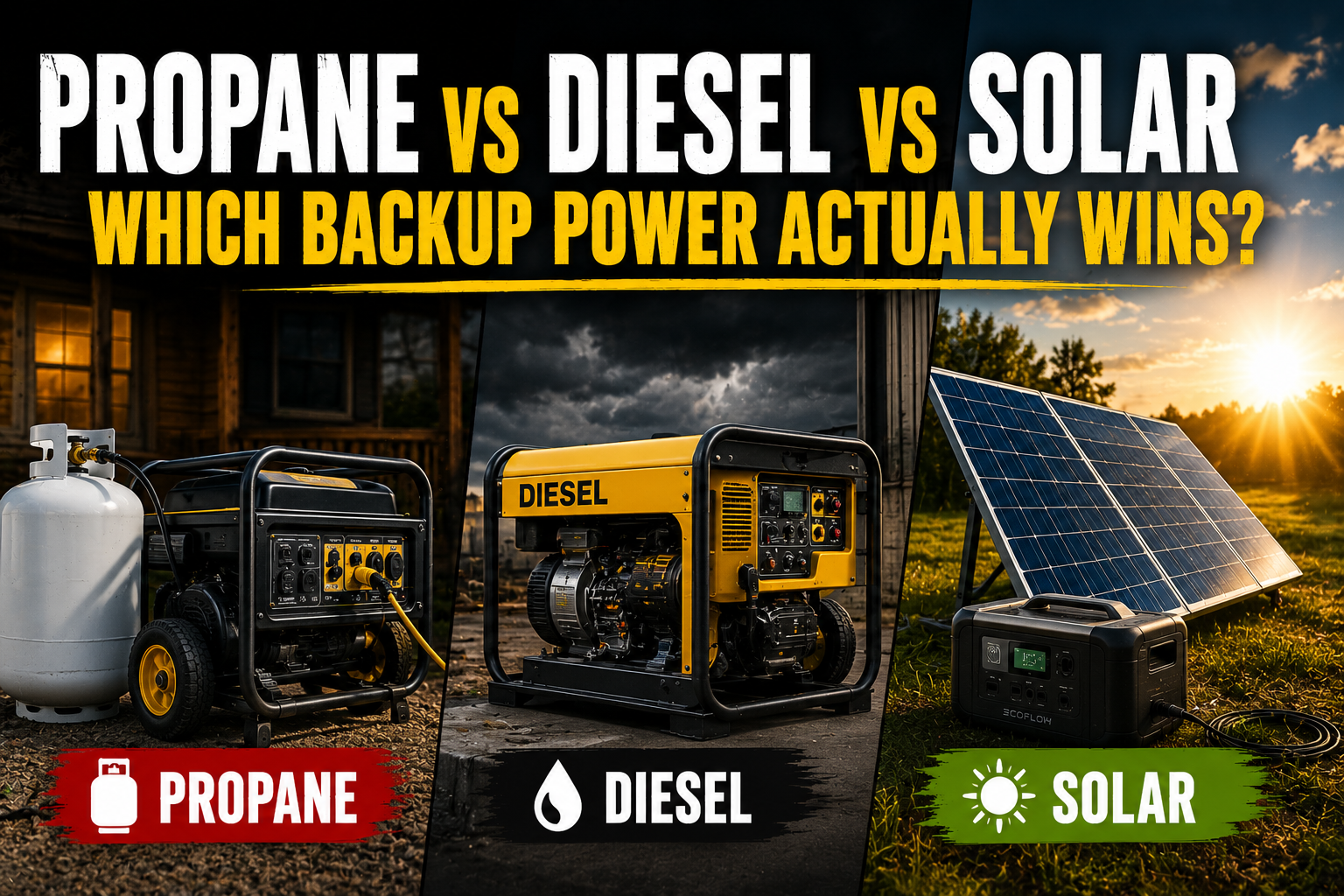
Propane, diesel, and solar each have genuine strengths and genuine limitations. The right answer depends on your specific situation — your climate, your budget, your storage capacity, and how long you’re planning to sustain independent power. What follows is the honest comparison that lets you make that decision based on real information instead of marketing claims.
What You’re Actually Trying to Power
Before comparing fuel sources, get clear on what you need to run. The loads you’re powering determine which system makes sense — and how much of it you need.
Critical loads most preppers need to cover:
- Refrigerator and freezer — 100–400 watts running, 1,000–2,000 watt surge on startup
- LED lighting — 10–15 watts per fixture, negligible total load
- Phone and device charging — 10–65 watts per device
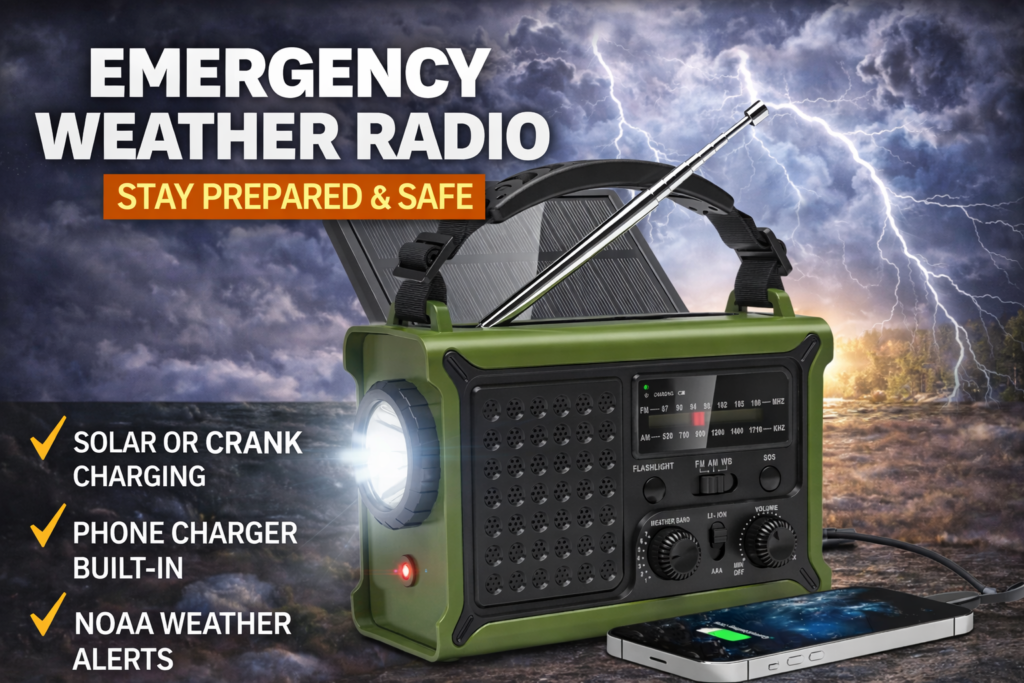
- NOAA emergency radio — minimal draw
- Medical equipment — varies widely, must be calculated specifically
- Well pump if on private water — 750–2,000 watts, high surge demand
- Space heater — 1,500 watts, significant continuous draw
Add up your critical loads realistically. Most households can cover the essentials with 2,000–3,500 running watts. That number drives every sizing decision below.


Propane
How It Works for Emergency Power
Propane generators burn liquefied petroleum gas stored in tanks ranging from standard 20-pound cylinders to large fixed 500-gallon tanks. Propane is also the fuel source for portable heaters, camp stoves, and some water heaters — giving it multi-purpose utility that no other backup fuel matches.
The Case For Propane
Propane’s biggest advantage is storage stability. Unlike gasoline, which degrades in 30–60 days without stabilizer, propane in a sealed tank stores indefinitely. You can fill a tank today and it’ll be just as useful five years from now with no treatment, no rotation, and no degradation. For long-term preparedness, that stability is enormously valuable.
Propane is also cleaner-burning than gasoline or diesel, which means less engine fouling and lower maintenance requirements on propane-compatible generators. It produces less carbon monoxide per BTU than gasoline — still never run it indoors, but the margin matters.

The 9,000 BTU Portable Buddy propane heater runs on the same standard cylinders as most propane camp stoves and small generators — meaning your propane stockpile covers heating, cooking, and power generation from a single fuel source. That consolidation simplifies your supply chain significantly.
The Case Against Propane
Energy density is propane’s weak point relative to diesel. A gallon of propane contains roughly 91,000 BTU versus diesel’s 137,000 BTU — meaning you need more propane by volume to produce the same power output. Propane generators are also generally less fuel-efficient than diesel equivalents, compounding the gap.
Large fixed propane tanks require professional installation, permits in most jurisdictions, and significant upfront investment. The 20-pound cylinders most people use are convenient but expensive per BTU and run out quickly under real load — a propane generator running at half load burns through a 20-pound cylinder in roughly five hours.
Propane Is Best For
Households prioritizing long-term fuel storage stability, multi-use fuel flexibility across heating and cooking, and moderate runtime needs where the convenience of standard cylinders outweighs the higher per-BTU cost.
Diesel
How It Works for Emergency Power
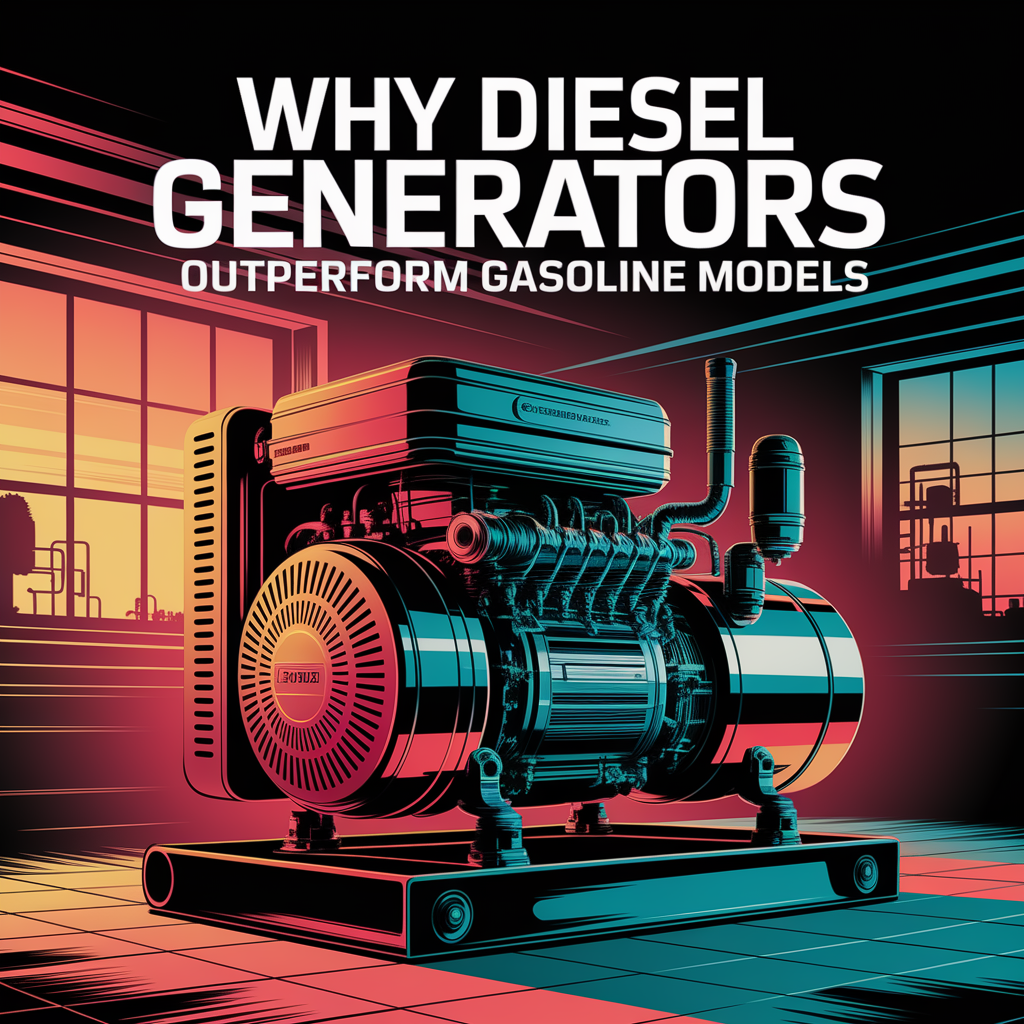
Diesel generators are the workhorses of serious backup power — used in hospitals, data centers, and industrial facilities precisely because they’re reliable, fuel-efficient, and built for sustained heavy-duty operation. The case for diesel over gasoline is well established in the preparedness community.
The Case For Diesel
Fuel efficiency is diesel’s defining advantage. Diesel generators produce more power per gallon than gasoline or propane equivalents — often 20–30% more runtime per gallon than a comparable gasoline generator. At sustained runtime over days and weeks, that efficiency gap translates directly into how long your fuel stockpile lasts.
Diesel fuel also stores significantly better than gasoline — up to 12 months without treatment, and 24–36 months with diesel fuel stabilizer and biocide added. For preppers building a serious fuel reserve, diesel’s storage timeline is a meaningful advantage over gasoline.
Diesel engines are mechanically simpler than gasoline engines in the ways that matter most for field maintenance. They have no spark plugs and no ignition system to fail. Under sustained heavy load — the reality of a true grid-down scenario — diesel engines hold up better and require less maintenance than gasoline equivalents.
The Case Against Diesel
Upfront cost is diesel’s primary barrier. Diesel generators cost more than gasoline equivalents at every power level. Quality portable diesel units in the 3,000–5,000 watt range run $800–$2,000 compared to $400–$1,000 for gasoline equivalents.
Diesel also gels in extreme cold — below approximately 15°F, standard diesel begins to cloud and can clog fuel filters. Cold-weather diesel operation requires treated fuel or diesel additives in climates where winter temperatures drop into that range. This is a manageable problem with the right fuel treatment but adds complexity that gasoline and propane don’t share.
Diesel Is Best For
Households planning for extended runtime scenarios, high power demands, or serious long-term preparedness where fuel efficiency and engine durability justify the higher upfront cost.
Solar
How It Works for Emergency Power
Solar backup power systems convert sunlight to electricity through photovoltaic panels, store it in battery banks, and deliver it through an inverter to your loads. Systems range from small portable units that charge phones and run LED lights to whole-home backup systems that can sustain significant loads indefinitely.
The Case For Solar
Solar’s defining advantage is zero fuel dependency. Once the panels and batteries are in place, the power is free and the supply is unlimited as long as the sun rises. In a true long-term grid-down scenario — the kind that stretches from weeks to months — solar is the only system whose operational cost doesn’t increase with time and whose fuel supply can’t be exhausted.
Maintenance requirements are also minimal compared to fuel-burning generators. No oil changes, no fuel treatment, no filters, no exhaust system. A quality solar and battery system can operate for a decade with minimal intervention.

The BLAVOR solar power bank represents the entry point of this system — a portable panel and battery combination that keeps critical devices charged indefinitely from sunlight. It’s the piece of your power system that never runs out of fuel regardless of how long the outage lasts.
The Case Against Solar
Upfront cost for a system capable of covering real household loads is significant — a quality whole-home backup solar system with adequate battery storage runs from $5,000 to $20,000 or more depending on capacity. Portable systems capable of running a refrigerator continuously land in the $1,000–$3,000 range.
Output variability is solar’s operational limitation. Cloud cover, winter sun angles, snow accumulation on panels, and shading all reduce output — sometimes to near zero. A solar system sized for summer sun production will underperform significantly in cloudy winter conditions. Battery capacity has to cover the gap between production and consumption during low-production periods.
Solar also cannot start high-surge loads like well pumps or air conditioners without a significantly oversized system. These surge demands often exceed what portable solar systems can deliver.
Solar Is Best For
Long-term preparedness planning where fuel independence justifies the higher upfront cost, device and light charging needs at any budget level, and as a sustainable complement to a fuel-burning generator rather than a standalone replacement.


The Honest Comparison
No single system wins across every category. The realistic answer for most serious preppers is a layered approach that uses each system’s strengths to cover the others’ weaknesses.
A practical three-layer backup power system looks like this:
Layer 1 — Solar charging: The solar power bank handles device charging and small electronics indefinitely at zero ongoing cost. Always running, always producing, never dependent on fuel supply.

Layer 2 — Propane or gasoline generator: The PowerSmart 2500W portable inverter generator handles the refrigerator, power tools, and higher-draw loads for as long as your fuel supply holds. Run it strategically — a few hours per day to keep the refrigerator cold and charge battery banks — rather than continuously. That strategy stretches a modest fuel supply dramatically further than running the generator around the clock.
Layer 3 — Propane heat: The portable propane heater handles space heating independently of your generator fuel supply, keeping your generator runtime focused on electrical loads rather than competing with heating demands.
This system covers critical loads across an extended outage, uses fuel efficiently, and has a renewable component that never runs dry. It’s also buildable at a price point accessible to most households — the generator and propane heater together cost less than $500, and the solar power bank adds another $50–$100.
Fuel Storage Realities
Whatever fuel system you choose, storage quantity and quality determine your actual operational runway.
Calculate your specific generator’s fuel consumption at your planned load level — most manufacturers publish this as gallons per hour at 25%, 50%, and full load. Multiply by your planned daily runtime. That’s your daily fuel burn. Multiply by your target duration. That’s your minimum storage target.
A realistic example: a 2,500W generator running four hours per day at 50% load burns roughly one gallon of gasoline per day. For two weeks of operation, that’s 14 gallons — a manageable storage quantity. For a month, 30 gallons. For three months, 90 gallons — which requires serious storage infrastructure and a fuel rotation plan.
Propane and diesel store longer than gasoline, making them more practical for the higher storage quantities that extended preparedness requires. If you’re building toward a 90-day fuel reserve, propane or diesel is the practical choice over gasoline regardless of which produces slightly more power per dollar.

For the full picture of how backup power fits into your broader grid-down preparedness, the grid-down survival guide covers every system your household depends on when the grid fails — not just power, but water, food, heat, and communication working together as a complete survival plan.
About the Author: Jake Mercer spent 11 years in emergency management before turning his focus to practical preparedness education. He lives with his wife and three kids in rural Tennessee, where backup power planning is a year-round priority rather than an afterthought. He writes for Survive Essentials covering gear, infrastructure, and the practical decisions that make preparedness real.