Yes, a portable power station can run many sump pumps during a power outage.
But I wouldn’t buy one based on battery size alone.
A sump pump is actually a pretty demanding piece of equipment for a battery power station. It has an electric motor that can pull considerably more power for a moment when it starts, then it may sit completely idle for several minutes before starting all over again.
So before trusting a portable power station with a basement, I want three questions answered:
- Can it start my actual sump pump?
- How many pumping cycles can its battery realistically provide?
- Will the setup take over when the power fails if nobody is standing there?
If any one of those answers is wrong, the giant battery sitting beside the sump pit may not protect much of anything.
I Check the Pump Before Shopping for a Power Station
I start at the sump pump.
Not Amazon.
Not a generic wattage chart.
Not the horsepower number by itself.
I find the nameplate or manual and look for the pump’s voltage, amperage, running watts if published, and starting or locked-rotor current if the manufacturer provides it.
That’s important because pumps with the same horsepower rating can have surprisingly different electrical demands.
The power station needs to match my pump, not somebody else’s idea of a typical pump.



Starting Surge Is the First Pass-or-Fail Test
Suppose a sump pump uses around 800 watts once it’s running.
A 1,000-watt power station sounds large enough.
But that pump may briefly require much more power every time its motor starts.
If the power station’s inverter can’t provide that starting surge, its overload protection can shut the AC output down before the pump gets moving.
Battery capacity doesn’t help.
The station could still show 100% charge and be completely useless for that particular pump.
Published real-pump examples show why I don’t use one universal multiplier. A common 1/3 HP Zoeller M53, for example, has published electrical specifications that have been used to estimate a starting demand approaching 3,000 VA, while other pumps of similar nominal horsepower can be considerably lower.
That’s a big enough spread to change which power station I need.


I Want Surge Headroom, Not a Barely Passing Number
If my pump has a measured or manufacturer-published startup requirement of 2,500 watts, I wouldn’t be excited about a station rated for exactly 2,500 watts of peak output.
That’s too close for comfort.
Real equipment ages.
Voltage varies.
Starting conditions vary.
The pump may be working against a different head pressure.
And advertised surge ratings don’t necessarily mean every inverter can sustain that peak for the same amount of time.
I’d rather have some margin.
Then I Look at Continuous Output
Once I know the station can start the motor, the next question is easier.
Can it keep the pump running?
If my pump draws 800 watts during operation, I want the power station’s normal AC output comfortably above that.
I also pay attention to anything else connected to the station.
A refrigerator starting at the same moment as the sump pump can add another motor surge.
For a sump backup, I actually like the idea of keeping the pump on its own power station when the electrical margin isn’t huge.
The basement is too expensive for me to lose because somebody plugged something else into the battery.

Battery Capacity Comes After Output
Now I finally care about the big watt-hour number printed on the power station.
A 2,000Wh station stores roughly twice the energy of a 1,000Wh station.
But I don’t assume every rated watt-hour reaches the pump.
The inverter uses some energy converting battery DC into household AC, and the power station itself consumes some power.
For rough planning, I might use something like 85% of rated capacity as usable AC energy, then leave additional reserve instead of planning to drain the battery to zero.
That’s an estimate, not a guarantee.
Here’s the Runtime Calculation I Use
Suppose the station has:
2,000Wh rated capacity
For a rough planning estimate:
2,000 × 0.85 = about 1,700Wh usable
Now suppose the sump pump draws:
800 watts while running
If it ran continuously:
1,700Wh ÷ 800W = about 2.1 hours of actual pumping
That doesn’t sound impressive.
But a sump pump normally cycles.
That’s where things get interesting.

Six Minutes of Pumping Per Hour Changes Everything
Suppose I’ve actually watched my sump during heavy rain and it runs six minutes every hour.
That’s a 10% duty cycle.
An 800-watt pump operating for one-tenth of each hour uses roughly:
800 × 0.10 = 80Wh per hour
Using our estimated 1,700Wh of usable battery energy:
1,700 ÷ 80 = about 21 hours
Now that same battery looks completely different.
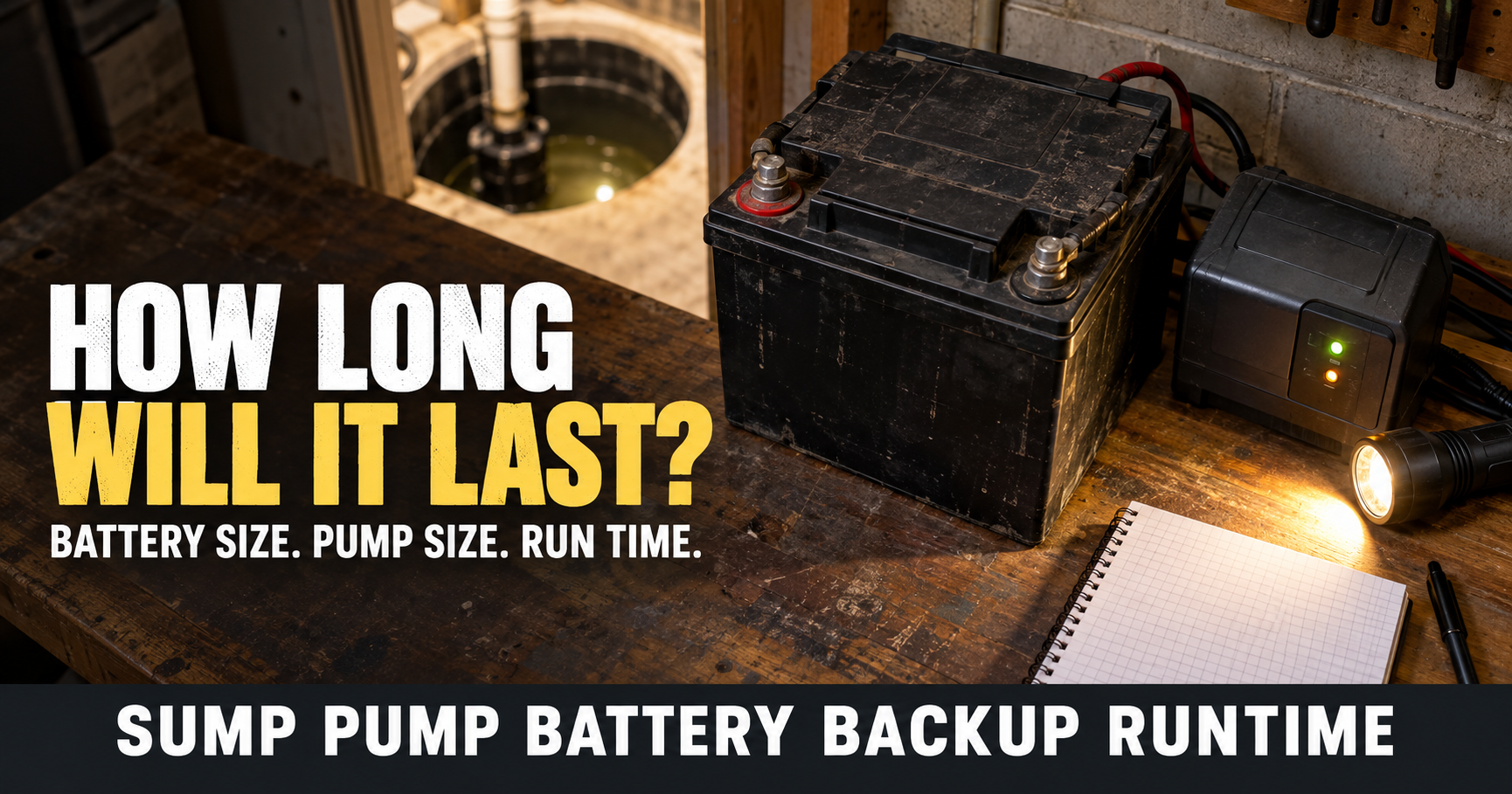
This is why the battery-backup runtime article focused so heavily on pump cycles.
Runtime isn’t determined by the battery alone.
The rain gets a vote.
Heavy Rain Can Cut That Runtime Fast
Now suppose the storm gets worse and the pump runs 15 minutes every hour.
That’s a 25% duty cycle.
The same 800-watt pump would average about:
200Wh per hour
Our same estimated 1,700Wh of usable battery becomes roughly:
8.5 hours
If the pump runs half the time:
400Wh per hour
Now we’re around:
4.25 hours
And if water is entering fast enough that the pump runs continuously, we’re back near that roughly two-hour continuous-runtime estimate.
Same power station.
Same pump.
Completely different storm.
That’s why current sump-power modeling shows enormous runtime differences as duty cycle changes.


I Time My Own Sump During Real Rain
I don’t base an expensive backup-power purchase on a sunny-day test.
I want to know what the pit does when the ground is saturated.
During a meaningful storm, I’ll record:
How many times the pump starts.
How long each cycle lasts.
Whether the interval between cycles gets shorter as rain continues.
Whether the pump ever approaches continuous operation.
Then I size the battery around the tougher conditions I’ve actually observed.
That’s much more useful than saying, “This 2kWh station should probably last overnight.”
Automatic Switchover Is the Next Big Question
Here’s where portable power stations can either become really useful or disappoint me.
If the electricity fails at 2 a.m., I don’t necessarily want the sump pump waiting for me to wake up and manually move its plug.
For unattended protection, I want the setup to transfer to battery automatically.
Some portable power stations provide UPS or EPS-style pass-through operation.
The station stays connected to utility electricity.
The sump pump stays connected to the station.
When grid electricity fails, the station switches its AC output to battery.
That’s much closer to what I want from sump-pump backup.


But I Verify the Transfer Feature for the Exact Station
I don’t see “UPS” in a product description and stop researching.
I check:
- Transfer time
- Maximum pass-through output
- Surge behavior while in backup mode
- Whether the feature is intended for this type of motor load
- Whether AC output remains active between pump cycles
- What happens when the battery reaches its low-charge cutoff
Current power stations vary significantly in their UPS implementation. Some newer units switch in roughly 10 to 20 milliseconds, but that specification alone doesn’t prove suitability for a particular sump pump.
Then I test the exact combination.
Eco Mode Can Be a Problem
This is one of the details I’d check carefully.
Some portable power stations have an energy-saving mode that turns AC output off when the connected load stays very low for a period of time.
That’s useful when I’m camping and don’t want the inverter wasting battery.
It’s potentially terrible for a sump pump.
Remember, the pump may sit there drawing almost nothing for ten minutes.
Then the float rises and suddenly expects electricity.
I don’t want the station asleep.
If the power station uses an automatic AC shutdown or eco feature, I make sure I understand it and can configure the station appropriately for unattended sump-pump duty. This issue is specifically called out in current sump-pump power-station guidance.
I Test Automatic Failure for Real
This is one test I absolutely want to perform.
On a dry day, with everything safely set up, I connect the pump to the power station the way I intend to leave it.
Then I simulate the outage by disconnecting grid input to the station according to its instructions.
Next, I safely add water to the sump pit.
The pump needs to:
Start on battery.
Handle the motor surge.
Complete the pumping cycle.
Then I let it sit idle.
I repeat the test later to make sure the power station didn’t shut its AC output down between cycles.
That’s a much more meaningful test than plugging a lamp into the station.
I Keep the Power Station Elevated
A battery power station has one huge advantage over a gasoline generator.
I can keep it indoors because there’s no engine exhaust or carbon monoxide from normal battery operation.
But I still don’t put it directly on the basement floor beside the sump pit.
If the sump system fails, that’s where water is going.
I want the station elevated somewhere dry and stable, while still following the manufacturer’s clearance, temperature, and operating requirements.
Backup equipment should survive the problem it’s supposed to protect me from.
Would I Choose a Power Station Instead of a Battery Backup Sump Pump?
Not automatically.
A portable power station and a dedicated battery-backup sump system solve the problem differently.
A dedicated backup system normally gives me a second pump.
That’s valuable because the original sump pump itself can fail.
A portable power station generally keeps supplying electricity to my existing pump.
If the only problem is a power outage, that’s great.
If the primary pump motor burns out, jams, or its float switch fails, having a fully charged 2,000Wh battery doesn’t fix the broken pump.
That’s the biggest weakness I see in relying entirely on a power station.
A Power Station Makes More Sense When My Primary Pump Is Reliable
If I already have a good sump pump and mainly want protection from electrical outages, a power station becomes much more interesting.
It can potentially give me:
- Automatic battery power during an outage
- No gasoline
- No engine noise
- No carbon monoxide
- Indoor operation in an appropriate dry location
- Rechargeable energy
- A battery I can use for other emergency needs
That’s a lot of usefulness from one piece of equipment.
But I’m still depending on one sump pump.
I keep that limitation in mind.
A Dedicated Backup Pump Gives Me Redundancy
This is why I still like a second sump pump in a basement where flooding could cause major damage.
Now I have two pumps.
Primary pump fails?
The backup may still work.
Primary float fails?
A separately controlled backup may still activate.
Utility power fails?
The battery system can take over.
That’s more redundancy than simply attaching a battery to the original pump.
For a finished basement with thousands of dollars at risk, that distinction matters to me.
But a Power Station Can Run the Full-Size Primary Pump
This is where the power station gets an advantage.
Dedicated battery-backup sump pumps are often secondary pumps with their own performance specifications.
A sufficiently capable power station can potentially keep the normal full-size AC sump pump operating.
If that primary pump moves substantially more water than the backup pump, maintaining it during an outage can be valuable during extremely heavy inflow.
Again, the station has to handle the motor’s startup surge.
That’s the first test.
The Best Answer May Be Having Both
This is where I keep coming back to the layered approach.
If basement flooding would be expensive, my ideal setup isn’t necessarily:
battery backup OR power station.

It could be:
Primary AC sump pump
plus
independent automatic battery-backup sump pump
plus
portable power station or generator for extended outages
Now I’ve covered both major failures.
If electricity fails, I have backup power.
If the primary pump itself fails, I have another pump.
That’s much stronger.
How Do I Recharge a Power Station During a Long Outage?
This becomes the next problem once the outage lasts longer than the battery.
If the station has 2,000Wh and my sump conditions consume that in ten hours, I need another energy source before hour ten.
Depending on the power station, charging options may include:
- Utility power when it returns
- Generator
- Solar panels
- Vehicle charging
- Other manufacturer-supported charging methods
I want to know those options before the storm.
A rechargeable battery is only renewable emergency power if I actually have a practical way to recharge it.
A Generator and Power Station Can Work Really Well Together
This is one combination I like.
The power station handles the sump pump quietly and automatically between generator runs.
Then I start the generator periodically and recharge the battery while also handling other essential loads.
That might include:
Refrigerator.
Freezer.
Phones.
Power banks.
Emergency radio.
Other appropriate equipment.
Instead of running a gasoline engine continuously just because the sump pump might start once every ten minutes, I let the battery handle those intermittent cycles.
Then the generator replenishes the battery.
That can be a much more flexible system.
I Still Watch the Charging Rate
This is easy to overlook.
Suppose my sump pump and other loads consume 2,000Wh from the battery every 12 hours.
If my charging method can only put 1,000Wh back during that same period, I’m slowly losing ground.
The station may technically be charging, but the overall energy balance is still negative.
So during a long outage I think about:
Energy going out
versus
energy coming back in.
That’s the same principle as a water tank.
If I’m draining it faster than I’m filling it, eventually it’s empty.
Solar Sounds Perfect Until the Storm Lasts Three Days
Solar charging is appealing for obvious reasons.
No gasoline.
No exhaust.
Sunlight is free.
But I don’t build my entire sump-pump backup around perfect sunshine.
The weather causing my sump pump to work hardest is often exactly the weather giving me poor solar production.
Heavy clouds.
Rain.
Thunderstorms.
A solar array may still produce some energy under cloudy conditions, but I don’t assume I’ll get its full rated output.
That’s especially important when the basement depends on it.
Solar Makes More Sense as an Extension Layer
I like solar much more when I think of it as helping stretch the battery.
If the sun comes out after the storm passes, great.
Now I can replenish some or all of the energy I used overnight.
If clouds break periodically, I can harvest whatever power is available.
But for the actual worst hours of a major rainstorm, I want enough stored energy or generator support that I don’t depend on sunshine appearing at the right moment.
Vehicle Charging Is Another Option, but Usually Not My Favorite
Some power stations can recharge from a vehicle.
That’s useful.
But standard vehicle charging can be relatively slow depending on the station and charging method.
I also don’t want to burn through vehicle fuel unnecessarily during a widespread outage.
The vehicle may become important for transportation or evacuation.
So I consider vehicle charging another backup option rather than automatically making it my primary recharge plan.
I Don’t Run the Vehicle in the Garage to Recharge the Battery
This deserves saying clearly.
If the vehicle needs to run, it stays outdoors.
I don’t idle a car in an attached garage while charging a power station sitting inside.
Carbon monoxide can enter the house.
A battery backup exists to reduce emergency risk.
I don’t create a carbon monoxide emergency while trying to recharge it.
A Power Station Has One Huge Advantage Over a Generator at Night
Silence.
If the sump pump only runs occasionally overnight, I don’t necessarily want a gasoline engine running outside for eight hours just waiting for the next pump cycle.
A power station can sit quietly until the float activates the pump.
That’s a much better match for intermittent loads.
It’s also one reason I think power stations are particularly interesting for sump-pump backup.
But Battery Temperature Matters
Portable power stations use batteries that have operating and charging temperature limits.
I don’t assume the station can be stored or charged under any conditions.
That’s especially important if the basement becomes extremely cold or if I’m thinking about storing the unit in an unconditioned area.
I follow the manufacturer’s temperature requirements.
Lithium batteries are useful.
They still have limits.
I Don’t Hide the Power Station Somewhere I Can’t Check It
If I’m relying on the battery to protect the basement, I want to know what it’s doing.
Most modern stations show information such as:
Battery percentage.
Current output.
Estimated remaining runtime.
Input power.
Warnings.
Those numbers can be incredibly useful during an outage.
If I notice the pump is consuming energy much faster than expected, that tells me conditions changed.
Maybe the pump is cycling more often.
Maybe another device is connected.
Maybe the storm is getting worse.
The Display Can Help Me Learn My Real Pump Wattage
This is one feature I really like.
Many power stations display real-time AC output.
When the sump pump starts, I can watch what the station reports.
That gives me a real-world look at how much power the pump uses while running.
It may not capture the full split-second startup surge accurately, depending on the station’s display, but the running number is still useful.
Now I can make better runtime estimates based on my actual pump rather than a generic chart.
I Still Want a High-Water Alarm
A $2,000 power station doesn’t eliminate the need for a simple alarm.
If the station trips.
If the pump fails.
If the float sticks.
If the discharge freezes.
If water enters faster than the pump can remove it.
I want to know.
A high-water alarm gives me another independent layer.
Expensive equipment doesn’t make cheap warning devices obsolete.
What Happens If the Primary Pump Dies?
This is the question that keeps me from using a power station as my only layer in a high-risk basement.
The battery can be at 100%.
The inverter can be huge.
The automatic transfer can work perfectly.
But if the sump pump motor itself fails, none of that matters.
That’s why an independent second pump still has real value.
Backup power and backup pumping are not the same thing.
What Happens If the Float Switch Fails?
Same issue.
If the existing pump never receives the signal to start, the power station can’t force it to pump.
A separate backup sump system normally has its own activation method.
That gives me another path for removing water.
Again, redundancy matters most when failure would be expensive.
When I Think a Power Station Makes the Most Sense
I’d seriously consider one when:
- I already have a reliable primary sump pump.
- The pump’s startup surge fits comfortably within the station’s inverter capability.
- The battery capacity matches my real pump duty cycle.
- The station can remain safely elevated and dry.
- I can configure automatic transfer appropriately.
- I have a way to recharge it during longer outages.
- I want the battery for other emergency uses too.
That’s a pretty compelling setup.
When I Wouldn’t Depend on One Alone
I’d be much more cautious if:
- The basement floods extremely quickly.
- The primary pump is old or questionable.
- Nobody is usually home.
- The station requires manual intervention after every outage.
- The inverter barely handles startup.
- The battery only provides a couple hours under my real storm conditions.
- I have no practical way to recharge it.
- Flooding would cause major damage.
In those cases, I want more layers.
The Portable Power Station Doesn’t Need to Be Enormous if My Pump Rarely Runs
This is another reason measuring duty cycle matters.
A homeowner whose pump runs two minutes per hour may not need the same battery as someone whose pump runs 20 minutes per hour.
Buying the biggest battery available isn’t automatically the smartest answer.
I want enough capacity for my risk, plus reasonable reserve.
That’s a much better way to spend money.
I Don’t Size the Battery Around the Average Sunny Day
I size around the conditions that are likely to knock the electricity out.
That’s the whole point.
If severe thunderstorms are the main threat, I want runtime based on what the sump does during severe thunderstorms.
If spring snowmelt is the big problem, I observe it during snowmelt.
The worst realistic conditions are what matter.
My Simple Power Station Checklist
Before I trust a portable power station with my sump pump, I want to answer all of these:
- What does my pump draw while running?
- What is its starting surge?
- Can the station’s inverter comfortably handle both?
- How many watt-hours does the battery hold?
- How much usable AC energy should I realistically expect?
- How many minutes per hour does my pump run during heavy rain?
- How many hours does that give me?
- Does the station switch to battery automatically?
- Does eco mode need to be disabled?
- Can I keep the station elevated and dry?
- How will I recharge it?
- What happens if the primary pump itself fails?
If I can’t answer those questions, I’m not ready to trust the setup unattended.
The Best Feature Isn’t the Giant Battery
For sump-pump backup, I think people naturally focus on battery capacity.
1,000Wh.
2,000Wh.
4,000Wh.
Those numbers matter.
But the feature I care about first is whether the system actually works when nobody is touching it.
If the power fails at 2:00 a.m., does the pump still start?
If the pump sits idle for 20 minutes, does AC output remain available?
If the motor surges, does the inverter stay online?
If those answers are yes, then I start worrying about how many hours the battery provides.
Automatic reliable operation beats a giant battery that needs babysitting.
A Power Station Can Be Excellent, but I Still Like Layers
I absolutely think a properly sized portable power station can be a good way to keep many sump pumps running during a blackout.
For some homes, it may be one of the most convenient options available.
But I don’t confuse versatility with redundancy.
The power station solves the electricity problem.
A second sump pump solves a pump failure.
A generator solves longer-duration energy needs.
A high-water alarm tells me when all of those plans aren’t working well enough.
That’s why my ideal basement protection system doesn’t depend on one magic box.
It gives me several chances to stop the water before it reaches the floor.
About the Author
Caleb Mercer writes about blackout preparedness, portable battery power, sump-pump backup, generators, household flooding, and practical ways to keep critical home equipment running when utilities fail. His work for the Survive Essentials Power Outages and Backup Power section focuses on matching backup equipment to real electrical loads and real storm conditions rather than relying on advertised runtime claims.