
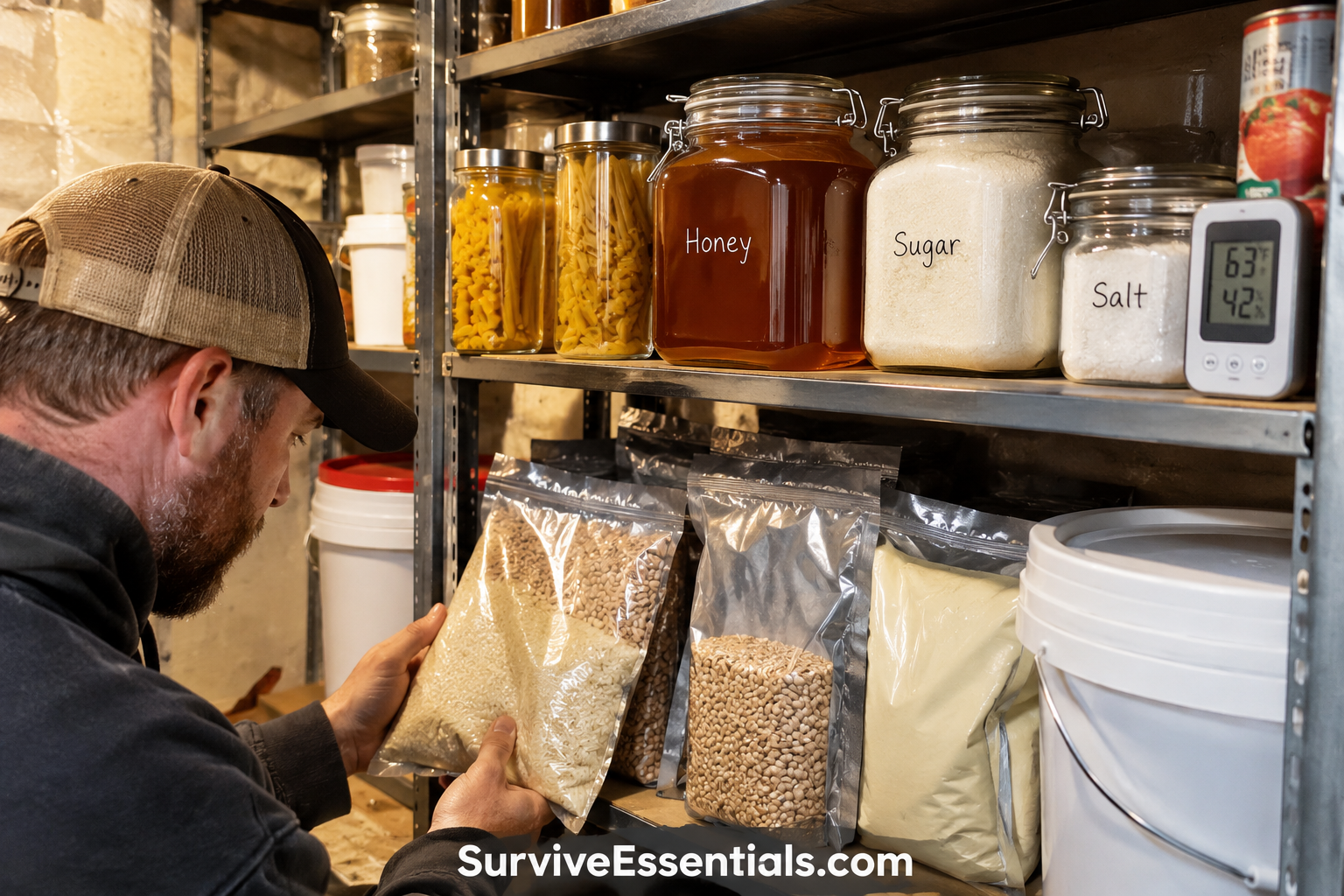
I keep seeing charts online claiming certain foods last 30 years, 50 years, 100 years, or even forever.
Honey supposedly never expires.
White rice lasts 30 years.
Sugar lasts 50.
Dry beans last several decades.
Powdered milk can supposedly sit around for 25 years.
Some of those claims have a surprising amount of truth behind them.
Others leave out the most important part.
How the food is packaged, how hot it gets, how much moisture reaches it, and whether oxygen is removed can completely change the answer.
A bag of white rice sitting in a warm kitchen cabinet is not the same thing as properly dried rice sealed with an oxygen absorber and stored in a cool basement.
That’s why I don’t like simply calling something a “food that never expires.”
There are a few foods that can remain safe or usable for an extremely long time when stored correctly. There are many more that can last years or even decades under the right conditions.
Those are the foods I’m interested in for emergency storage.
Very Few Foods Literally Last Forever
I think this distinction matters right away.
When someone says a food “never expires,” they may be talking about several different things.
It might still be microbiologically safe.
It might still contain usable calories.
It might still cook.
But the flavor, texture, vitamins, color, and overall quality could be very different from when it was fresh.
Utah State University Extension makes an important distinction between food remaining usable and food retaining its original quality. Temperature and moisture are two of the biggest factors affecting how well stored food holds up over time.
So when I build emergency food storage, I don’t just ask:
Can this technically survive 25 years?
I ask:
Would I actually want to eat it after 25 years?
That’s a much better question.


Storage Temperature Can Change Everything
This is probably the biggest thing those viral food charts leave out.
Heat is terrible for long-term food storage.
Utah State cites research where wheat stored under cooler basement conditions maintained acceptable quality for about 25 years, while wheat exposed to hot garage or attic conditions deteriorated much faster.
That immediately changes how I look at claims such as:
“This food lasts 30 years.”
Thirty years where?
A 60-degree basement?
Or a garage hitting 110 degrees every summer?
Those are not the same storage conditions.


Moisture Is Another Major Enemy
Dry foods last because they’re dry.
Once moisture gets into the package, the whole situation changes.
Moisture can contribute to mold, bacterial growth, clumping, package deterioration, corrosion, and general spoilage.
That’s why airtight and moisture-resistant containers matter so much for long-term storage.
It’s also why I don’t automatically trust the paper bag something came home from the grocery store in.
1. Honey
Honey deserves to be near the top because it really is one of the closest things we have to a food with an indefinite shelf life.
Commercial honey is naturally resistant to microbial growth because of its low water activity and high sugar concentration.
Utah State lists commercial honey and other sugars as having an indefinite shelf life from a safety standpoint, although quality can change over time.
That doesn’t mean an old jar will look exactly like a new one.
Honey can:
Crystallize.
Darken.
Change flavor.
Become thicker.
None of those changes automatically mean it spoiled.
How I Would Store Honey
I would keep it tightly sealed in a cool, dry, dark location.
I also wouldn’t store my long-term honey in a container likely to react with it.
Glass is simple and practical.
One thing I would not do is add oxygen absorbers to honey.
Utah State specifically notes that removing oxygen isn’t necessary for honey or granulated sugar.
Would I Keep Honey in Emergency Storage?
Definitely.
It provides calories, tastes good, requires no cooking, and can make otherwise boring emergency food much easier to eat.



2. Granulated White Sugar
White sugar is another remarkably durable food.
Properly stored granulated sugar can have an indefinite shelf life from a microbial-safety standpoint. Its bigger problems are usually quality and moisture.
Sugar can become:
Hard.
Lumpy.
Contaminated with odors.
Wet.
That doesn’t necessarily mean the sugar itself has “expired.”
Utah State recommends storing long-term sugar in airtight, moisture-resistant packaging rather than leaving it in the original paper bag.
I Would Not Use Oxygen Absorbers With Sugar
This surprises some people.
Long-term food storage gets associated so strongly with Mylar and oxygen absorbers that people want to use them for everything.
Sugar doesn’t need oxygen removed.
The priority is keeping moisture and contamination away.
Why Sugar Belongs in Emergency Storage
Sugar isn’t nutritionally complete.
It doesn’t need to be.
It’s a calorie source, cooking ingredient, and useful comfort-food ingredient.
A food-storage pantry doesn’t have to be made entirely of perfect foods.
It needs foods that work together.
3. Salt
Salt may be the strongest example on the viral list.
Properly stored salt can remain usable essentially indefinitely when protected from moisture and contamination.
Utah State lists iodized salt as having an indefinite shelf life when it stays dry and uncontaminated.
Salt may cake when exposed to moisture, but clumping doesn’t automatically make it unusable.
Why Salt Is More Important Than It Looks
Salt doesn’t provide meaningful calories.
So why store it?
Because after eating plain rice, beans, oats, and canned food for an extended period, seasoning matters.
Salt is also used in many food-preparation and preservation processes.
It takes up very little storage space.
I’d absolutely keep it.


4. Properly Stored White Rice
White rice is where the viral charts become more complicated.
Can white rice last 25 to 30 years?
Yes, under appropriate long-term storage conditions.
Can I throw a grocery-store bag of rice in the pantry and expect it to be good in 30 years?
I wouldn’t.
Utah State reports that polished white rice stored in oxygen-free containers under cool conditions can remain usable for roughly 25 to 30 years. At around 70°F with oxygen absorbers, about 10 years is a more conservative expectation.
That is a massive difference.
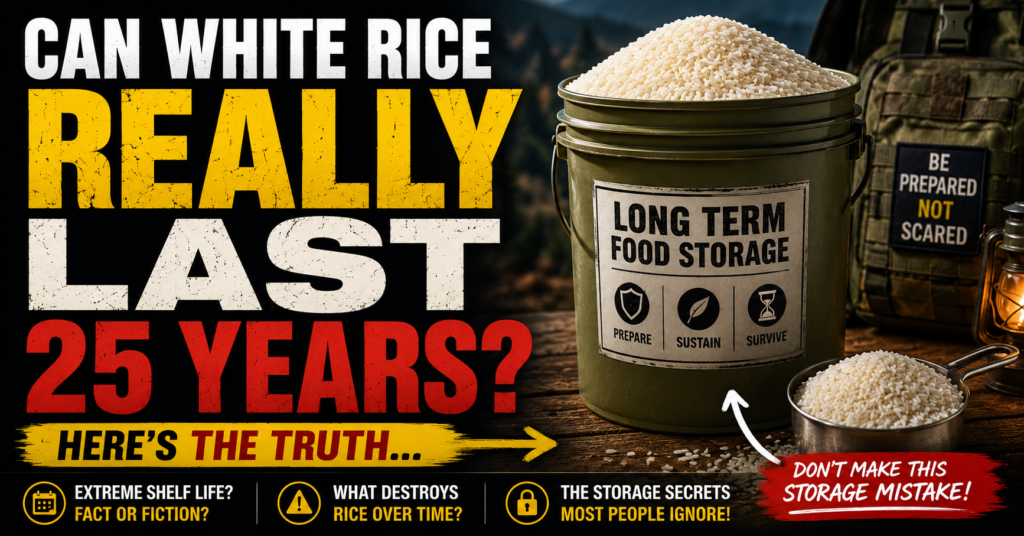
We’ve already gone deeper into this in our guide on whether white rice can really last 25 years.
What I Would Use for Long-Term Rice
For serious storage, I’d want:
Dry white rice.
Food-grade packaging.
Airtight sealing.
Appropriate oxygen absorbers.
Cool storage.
Dark conditions.
Protection from insects and rodents.
That’s very different from leaving it in a thin supermarket bag.
5. Whole Wheat Berries
This is one of the foods I think viral “never expire” graphics often miss.
Whole wheat berries can be an excellent long-term storage food.
Utah State cites long-term storage research showing properly stored raw whole wheat maintaining acceptable quality for around 25 years under good conditions.
Why Wheat Stores Better Than Flour
Once wheat is ground into flour, its storage characteristics change dramatically.
Whole grain protects itself much better.
That’s why someone serious about very long-term food storage might store wheat berries and grind flour as needed rather than trying to store ordinary flour for decades.
The Catch
I’d only store wheat in large quantities if my family actually knows how to use it.
A basement full of wheat doesn’t help much if nobody owns a grinder or knows how to turn wheat into meals.
This fits one of my biggest preparedness rules:
Store what you know how to use.


6. Dry Beans
Dry beans absolutely belong on a long-term emergency-food list.
But again, the packaging changes everything.
In normal grocery-store packaging, Utah State puts dry beans around a year or more for best storage.
Packaged in #10 cans or Mylar-style bags with oxygen removed, dry beans can last 10 years or longer. Research has even found stored pinto beans acceptable for emergency use after much longer periods.
That does not mean a 30-year-old bean behaves like a fresh bean.
Old Beans Can Become Harder to Cook
This is a huge practical issue.
Beans tend to harden as they age.
They may need:
Longer soaking.
Longer cooking.
More fuel.
More water.
Eventually some may become difficult to soften normally.
That’s important in an emergency because fuel and water may already be limited.
Would I Store Beans?
Absolutely.
They’re cheap, calorie-dense, contain protein and fiber, and store very well when packaged correctly.
But I’d rotate them rather than intentionally keeping all my beans for three decades.
7. Dry Pasta
Pasta isn’t truly a “forever food.”
But it is still an excellent emergency-storage food.
Under normal sealed home-storage conditions, Utah State lists dried pasta around two years for optimum quality.
Better packaging and cooler conditions can help.
Why I Still Like Pasta
It’s inexpensive.
It’s familiar.
Children usually eat it.
It pairs with canned meat, sauce, vegetables, cheese powder, and many other stored foods.
The biggest downside is cooking fuel and water.
If fuel is scarce, boiling pasta every day may not be ideal.
That’s why I want different types of emergency food instead of one giant pile of pasta.


8. Nonfat Powdered Milk
This is one claim from the viral chart that I’d correct pretty aggressively.
I’ve seen graphics claiming powdered milk lasts 15 to 25 years.
That is not a number I would casually apply to ordinary powdered milk.
Utah State’s storage research puts properly packaged nonfat dry milk at roughly 3 to 5 years under cool conditions, with heat shortening quality dramatically.
Special commercially packaged products may carry longer manufacturer shelf lives, but that’s different from saying all powdered milk lasts decades.
Why Nonfat Matters
Fat reduces storage stability.
That’s why nonfat dry milk is much better suited to long-term storage than dried whole milk.
Would I Store It?
Yes.
It adds:
Protein.
Calcium.
Cooking versatility.
A familiar drink option.
It’s especially useful in baking and recipes even if nobody wants to drink it plain.
9. Popcorn Kernels
The viral chart claimed popcorn kernels could last 10 to 15 years.
I wouldn’t put that number on ordinary grocery-store popcorn.
Utah State’s normal home-storage guidance lists unpopped popcorn around three years when stored in a can under cool conditions, while popcorn left in ordinary bag packaging can have a much shorter optimum storage period.
Why Popcorn Is Still Worth Storing
Popcorn is cheap.
Kids like it.
It gives some variety.
It doesn’t require refrigeration.
But I would rotate popcorn rather than treat it like a 25-year survival grain.
This is exactly why viral shelf-life graphics can be misleading.
A food can be great for preparedness without lasting forever.
10. Cornstarch
Cornstarch is another very dry pantry ingredient that can remain usable for a long time when kept sealed and dry.
The biggest threat is moisture.
Once moisture gets into a dry starch product, quality can deteriorate quickly and clumping or contamination becomes possible.
I wouldn’t build my emergency calories around cornstarch, but it can be useful for cooking and thickening sauces, soups, and gravies.
That’s important because food storage should include ingredients that turn staples into actual meals.
11. Instant Coffee
Coffee isn’t a survival necessity.
For some households, however, you might have a hard time convincing people of that during a week-long blackout.
Instant coffee is much more storage-friendly than brewed coffee.
It’s dry, lightweight, compact, and doesn’t require electricity to prepare if I can heat water another way.
Would I Call It a 30-Year Food?
No.
Not without a manufacturer specifically supporting that shelf life for that package.
Flavor and aroma are a huge part of coffee, and those qualities deteriorate.
But for a rotating emergency pantry, instant coffee is extremely practical.
A preparedness pantry should include a few things that make a miserable week feel a little more normal.
12. Vinegar
Vinegar makes many “never expire” lists because of its acidity.
It is extremely shelf-stable compared with many foods.
Over time, vinegar can change in appearance, develop sediment, or show quality changes without necessarily becoming unsafe.
I wouldn’t make a dramatic “50 years” promise for every type of vinegar.
Different vinegars contain different compounds and flavor components.
Why I’d Keep Vinegar Anyway
It’s useful for:
Cooking.
Flavor.
Pickling applications where an appropriate standardized vinegar is required.
General pantry use.
And it requires no refrigeration while unopened.
White distilled vinegar is particularly simple and shelf-stable.
What About Maple Syrup?
This is one I would leave off my “almost never expires” list.
I’ve seen graphics claiming unopened pure maple syrup lasts 50 years or more.
That’s not a claim I would build emergency preparedness advice around.
Maple syrup contains enough water that once conditions change or contamination occurs, mold can become an issue.
If I wanted a long-term sweetener, I’d choose honey or granulated sugar before betting on decades-old maple syrup.
What About Hard Liquor?
Another common viral-list entry.
An unopened bottle of distilled spirits can remain stable for a very long time.
But this is an emergency food storage article.
If my storage space is limited, I’m prioritizing actual food, water, medicine, cooking supplies, and household essentials before dedicating shelves to liquor.
So I left it off intentionally.
What About Canned Food?
This is another category where “expiration date” gets confusing.
Commercial canned foods often remain usable past the quality date when the can has been stored properly and remains intact.
But I would never tell someone that canned food “never expires.”
I inspect cans for:
Bulging.
Leaking.
Heavy rust.
Deep dents around seams.
Damage.
Anything else that makes the container questionable.
Emergency preparedness is not a good reason to gamble with food poisoning.
Foods With Fat Usually Don’t Win the Shelf-Life Contest
This is a good rule of thumb.
Fat tends to oxidize and become rancid.
That’s why foods such as:
Brown rice.
Whole-wheat flour.
Nuts.
Cooking oils.
Whole powdered milk.
Generally don’t compete with white rice, wheat berries, sugar, salt, and dry beans for ultra-long storage.
That doesn’t mean I avoid them.
It means I rotate them more often.
Brown Rice Does Not Store Like White Rice
This catches people all the time.
Brown rice contains more natural oils because the bran and germ remain.
Those oils can become rancid.
White rice has had those layers removed, which is one major reason it stores so much longer.
So if I’m building true long-term emergency storage, white rice is the better candidate.
Whole Wheat and Whole-Wheat Flour Are Not the Same Thing Either
Same concept.
Whole wheat berries can store exceptionally well.
Whole-wheat flour contains exposed oils and deteriorates much faster.
Grinding changes storage life.
I would rather store the grain and grind what I need if I were planning for extremely long storage.
A “Best By” Date Isn’t Always a Safety Deadline
This causes an enormous amount of food waste.
A quality date doesn’t necessarily mean the food suddenly becomes unsafe the following morning.
For shelf-stable dry foods, the date is often primarily about expected quality.
But that doesn’t give me permission to ignore obvious signs of damage or spoilage.
I still inspect food.
How I Decide Whether Old Stored Food Is Worth Keeping
I look at several things.
The Package
Is it:
Sealed?
Dry?
Free from insects?
Undamaged?
Not bulging?
Not leaking?
The Food
Does it have:
Normal color?
Normal smell?
No mold?
No obvious contamination?
The Storage History
Was it kept:
Cool?
Dry?
Dark?
Away from major temperature swings?
That’s more useful than blindly reading one date.
Heat Is Why I Don’t Love Garages for Long-Term Food
Garages are convenient.
They’re also often terrible long-term food-storage environments.
Summer temperatures can become extreme.
Utah State’s long-term storage guidance specifically shows how dramatically heat can shorten storage quality compared with cool storage.
I’d much rather use:
Basement shelves.
Interior closets.
Cool pantry areas.
Under-bed storage.
Other climate-controlled spaces.
Mylar Doesn’t Magically Make Everything Last 30 Years
This is worth saying.
Mylar bags are excellent tools.
Oxygen absorbers are excellent tools.
Food-grade buckets are excellent tools.
But packaging can’t turn the wrong food into a 30-year food.
High-fat foods still have limitations.
Moist foods absolutely should not be casually sealed with oxygen absorbers.
Poor-quality food doesn’t improve because I put it in a silver bag.
Storage begins with choosing the right food.
Oxygen Absorbers Are Not for Everything
I would use oxygen absorbers with suitable dry foods such as:
White rice.
Dry beans.
Wheat.
Certain other very low-moisture foods.
I would not automatically use them with:
Sugar.
Salt.
Honey.
Moist foods.
That’s why we’re eventually going to give oxygen absorbers their own article in this food-storage cluster.
Using them correctly matters.
What Foods Would I Actually Build My Emergency Pantry Around?
If I were choosing foods based on a combination of shelf life, cost, nutrition, and usefulness, my core would look something like:
White rice.
Dry beans.
Wheat or flour depending on how I actually cook.
Oats.
Pasta.
Canned meat.
Canned vegetables.
Canned fruit.
Peanut butter.
Sugar.
Honey.
Salt.
Powdered milk.
Ready-to-eat foods.
Some long-term packaged emergency meals.
Not everything needs a 30-year shelf life.
That’s the key.
A 30-Year Food Isn’t Automatically Better Than a 3-Year Food
This is another place I think prepper advice gets distorted.
Suppose I buy something that lasts 30 years but nobody in my house likes it.
Then I buy something we eat every week that lasts three years.
Which one is more useful?
Probably the second one.
I can rotate it.
We enjoy it.
It doesn’t get wasted.
Emergency food storage should fit normal life whenever possible.
I Build Food Storage in Layers
We recently broke down how much emergency food I think a family should store.
I don’t think beginners need to jump immediately into 25-year storage.
I’d start with:
Three days.
Then a week.
Then two weeks.
Then a month.
After that, deeper long-term food storage starts making more sense.
My Normal Pantry Is the First Layer
Food we already eat.
That’s the easiest emergency storage.
Cans.
Rice.
Pasta.
Oats.
Peanut butter.
Soup.
Crackers.
Shelf-stable foods.
I buy extra.
Rotate it.
Eat the oldest first.
Nothing complicated.
Long-Term Staples Are the Second Layer
This is where white rice, wheat, beans, sugar, salt, honey, and similar foods become more interesting.
These are foods I can package specifically for longer storage.
I don’t have to constantly rotate every package.
Long-Term Emergency Meals Are Another Layer
Commercial emergency food has advantages.
Long shelf life.
Compact packaging.
Easy preparation.
Known serving counts.
I don’t think it needs to replace a normal pantry.
It’s another layer behind it.
Why I Like This Approach Better Than a “Never Expire” List
Because emergencies aren’t about winning a shelf-life contest.
They’re about feeding people.
If my storage room contains 500 pounds of food that technically lasts decades but requires huge amounts of water, fuel, equipment, and cooking knowledge, I haven’t necessarily built a great system.
I want:
Calories.
Protein.
Variety.
Foods my family recognizes.
Food that works without refrigeration.
Some food that requires no cooking.
Some long-term staples.
Some comfort foods.
A realistic water supply.
That’s much more useful.
Which Foods From the Viral Lists Would I Trust Most?
If I had to pick the strongest long-term choices from the typical “foods that never expire” graphics, I’d put these near the top:
Honey
Granulated sugar
Salt
White rice stored correctly
Whole wheat berries
Dry beans packaged correctly
Those have the strongest case.
Then I’d put foods such as pasta, powdered milk, popcorn, instant coffee, and other dry goods into a rotating category instead of pretending they are immortal.
The Storage Method Matters as Much as the Food
That may be the most important takeaway from this entire article.
A food doesn’t have one universal shelf life.
The same white rice can have wildly different outcomes depending on whether it is:
Sitting in a thin bag in a hot garage.
Or sealed properly, protected from oxygen and moisture, and kept cool.
The same beans can last a relatively short period in ordinary packaging or remain useful for many years under dedicated long-term storage conditions.
So when somebody tells me:
“This food lasts 30 years.”
My next question is:
“Stored how?”
That’s where the real answer begins.
The Foods I Trust Are the Ones I Know How to Store
I don’t need a pantry full of mythical forever foods.
I need foods that are dependable.
Food I’ve stored correctly.
Food my family eats.
Food I know how to prepare.
Food I’ve protected from moisture, heat, insects, and rodents.
That’s what actually makes an emergency pantry useful.
Some of those foods might last two years.
Some ten.
Some twenty-five.
A few may remain usable practically indefinitely when kept in the right conditions.
But I would rather have a well-managed pantry that gets rotated than a shelf full of 30-year-old food I haven’t looked at since the day I bought it.
That’s the part the viral charts usually leave out.
About the Author
Evan Brooks writes about emergency food storage, gardening, foraging, seed storage, and practical household self-reliance for Survive Essentials. His work focuses on realistic food-storage systems, long-term pantry staples, reducing waste through rotation, and building emergency food reserves families can actually use.