Your refrigerator keeps food safe for about four hours after the power goes out. Your freezer buys you 24 to 48 hours if you keep the door shut. After that, without a plan, you’re looking at hundreds of dollars of spoiled food and a family eating through emergency rations far earlier than your timeline called for.
In a short outage, that’s an inconvenience. In a two-week grid-down scenario, spoiling your food supply in the first 48 hours is a genuine survival problem. Planning food storage around the right timeline starts with understanding how long outages can last.
Keeping food cold without grid power is a solvable problem — but it requires knowing the options, understanding their limitations, and having the right supplies ready before the outage starts. Here’s the full breakdown.
The Clock Starts Immediately
The moment power goes out, your refrigerator begins warming at roughly 4–5 degrees Fahrenheit per hour with the door closed. At that rate, a refrigerator starting at 37°F crosses the 40°F food safety threshold — the point where bacterial growth accelerates rapidly — in less than an hour of door-opening or about four hours completely undisturbed.
Your freezer is more forgiving. A full freezer maintains safe temperatures for 48 hours. A half-full freezer holds for 24 hours. A nearly empty freezer may not make it past 12. The single most impactful thing you can do in the first hour of an outage is pack empty freezer space with bags of ice or frozen water bottles you keep on hand specifically for this purpose.
Know these numbers before the power goes out. Decisions made in the first hour of an outage determine whether you’re managing your food supply strategically or scrambling to salvage it two days later.

The Consumption Order That Saves Your Stockpile
The most important food management decision in any outage is eating the right things in the right sequence. Most people intuitively get this right in a short outage. In a prolonged scenario, doing it systematically matters enormously.
Eat in this order:
- Refrigerated items first — dairy, fresh meat, leftovers, opened condiments. These have the shortest post-outage window.
- Freezer items second — as the freezer warms, eat or cook freezer contents before they reach 40°F. A frozen item that has partially thawed but is still cold can be cooked and then eaten or stored as cooked food in a cooler.
- Shelf-stable and freeze-dried last — your ReadyWise emergency food supply and pantry staples are your long-haul supply. Don’t touch them until refrigerated and frozen food is gone.
Never open your refrigerator or freezer unnecessarily. Every door opening exchanges cold air for warm air and accelerates the temperature rise. Decide what you’re getting before you open the door. Get it in one trip. Close it immediately.
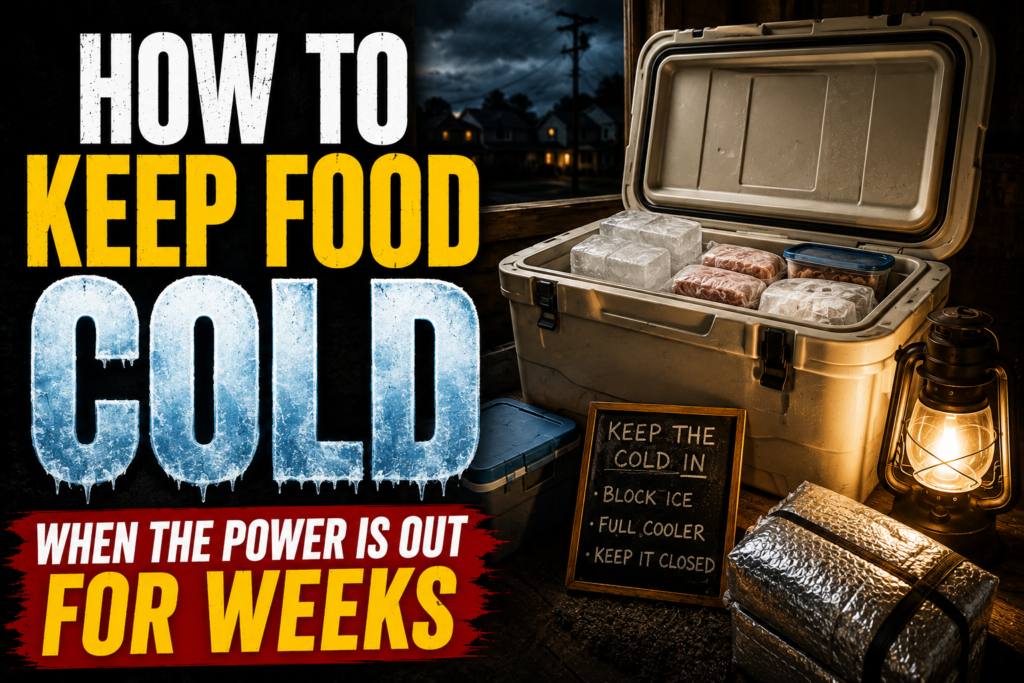
Option 1 — Ice Coolers
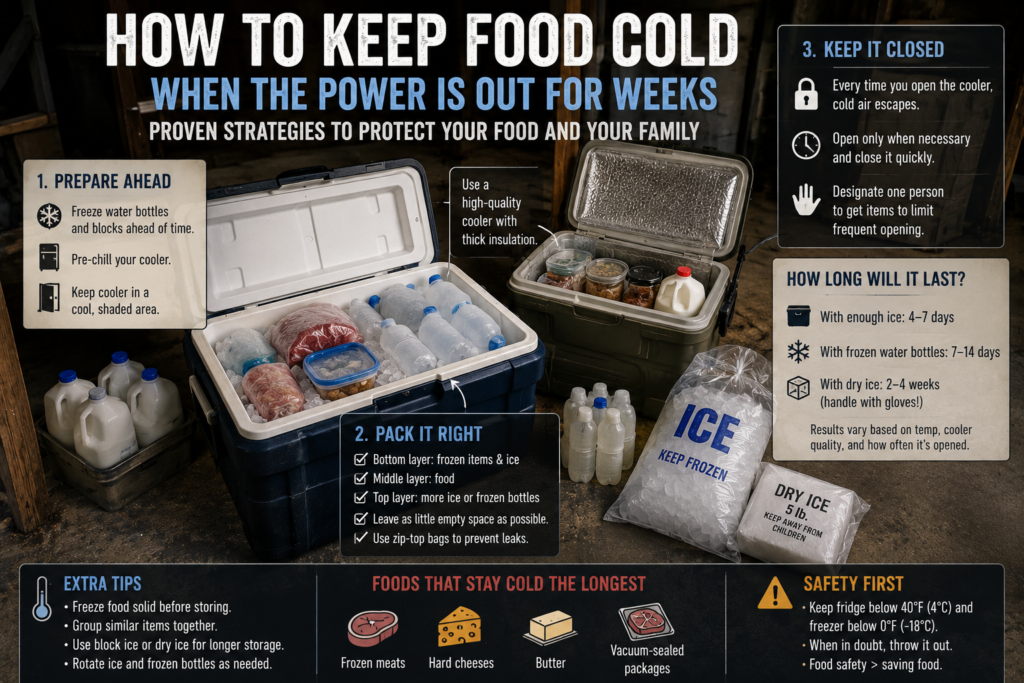
The most accessible cold storage solution for most households is also the most limited. Standard coolers with block ice keep contents below 40°F for two to three days. Quality insulated coolers — the premium rotomolded models from brands like Yeti, RTIC, or Pelican — can hold ice for five to seven days with proper technique.
Cooler technique that actually matters:
- Pre-chill the cooler before loading it by filling it with ice for an hour, draining, then reloading with food and fresh ice
- Use block ice rather than cubed — block ice melts significantly slower
- Pack food tightly to minimize air space
- Keep the cooler in the coolest location available — basement, garage in cool weather, shaded outdoor space
- Drain meltwater regularly — standing water accelerates ice melt
- Open as infrequently as possible and close immediately
Ice is the limiting factor. In a widespread outage, ice becomes scarce at stores within hours. If you don’t have ice on hand when the power goes out, you’re dependent on whatever’s left locally — and in a major event, that’s often nothing.
Ice prep before an outage: Keep two to three gallon bags of ice permanently in your freezer. In the first minutes of an outage, those bags move into your cooler to extend its operational window while you assess the situation. Also keep several water-filled bottles in your freezer — they serve the same purpose and cost nothing.
Option 2 — Dry Ice
Dry ice — solid carbon dioxide at -109°F — is dramatically more effective than water ice for cold storage. It keeps food frozen rather than just cold, lasts two to three times longer than water ice by weight, and leaves no meltwater. Ten pounds of dry ice in a standard cooler can keep contents frozen for 24 hours. In a quality insulated cooler, that window extends significantly.
The limitations: dry ice requires handling precautions — never touch it with bare skin, always use insulated gloves, and never store it in a sealed container where CO2 buildup could cause pressure problems. It also requires ventilation — dry ice in an enclosed space produces carbon dioxide that displaces oxygen. Use it in well-ventilated areas.
Dry ice is available at many grocery stores, gas stations, and specialty suppliers under normal conditions. Like water ice, it disappears from store shelves quickly in a widespread outage. Source it early if you have warning, or identify suppliers in advance and call ahead before you go.

Option 3 — Generator-Powered Refrigeration
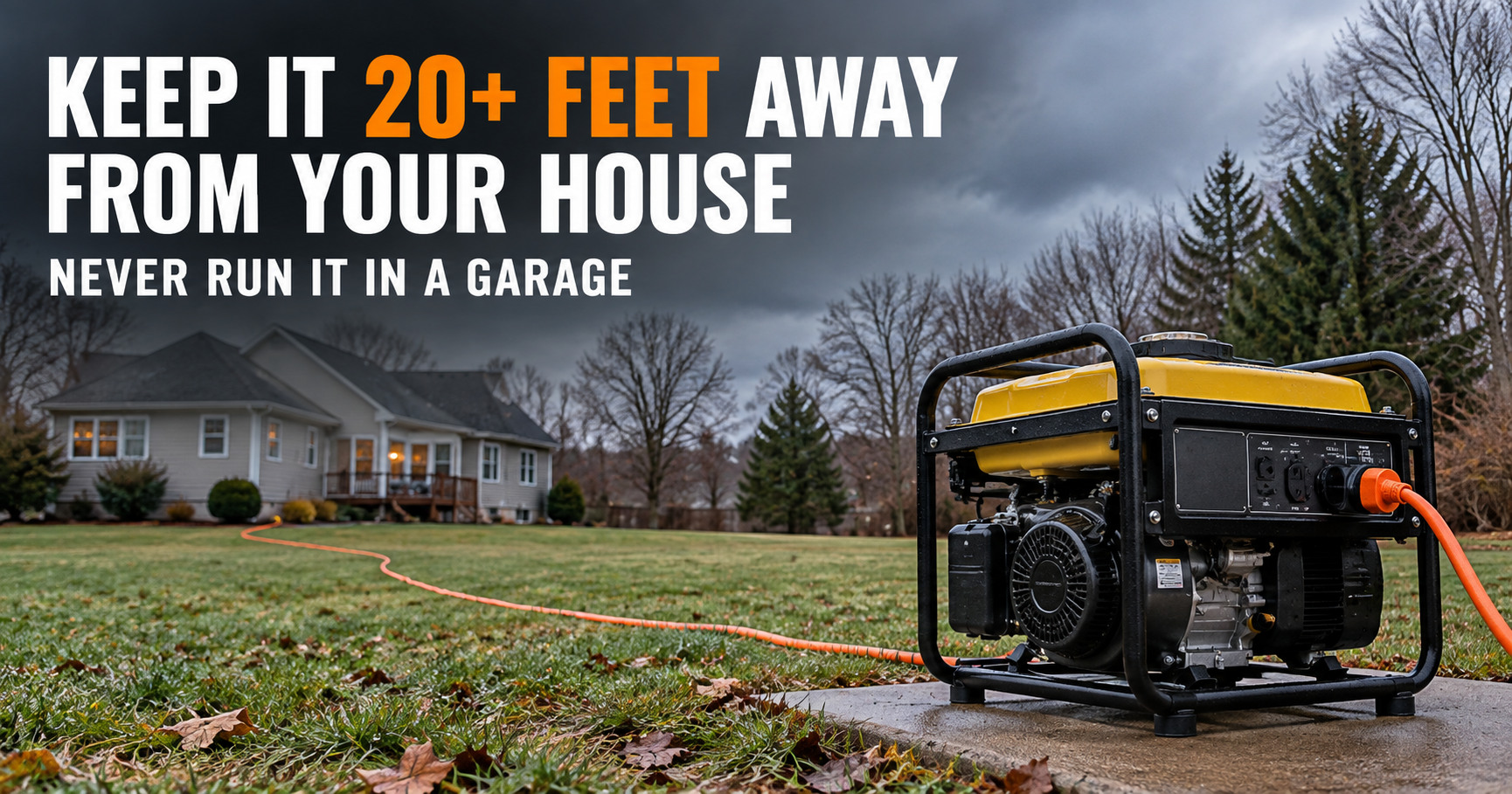
Running your refrigerator from a generator is the most effective way to maintain normal cold storage through an extended outage — but doing it efficiently requires strategy.

A standard refrigerator draws 100–400 watts running and 1,000–2,000 watts on startup surge. The PowerSmart 2500W inverter generator handles a refrigerator comfortably at a fuel-efficient operating point. Running it continuously burns through fuel faster than necessary — refrigerators are well insulated and only need power periodically to maintain temperature.
The efficient approach: Run your generator for two to three hours in the morning and two to three hours in the evening. During those windows, the refrigerator cycles and brings internal temperature back down to safe levels. Between generator runs, keep the door closed and let the insulation do its job. This strategy can cut your daily fuel consumption by 50–70% compared to continuous operation while maintaining food safety temperatures.
Use an inexpensive refrigerator thermometer to monitor internal temperature during and between generator runs. If temperature approaches 40°F before your next scheduled run, adjust your generator schedule accordingly.

For the full picture of fuel management and generator strategy in a grid-down scenario, the backup power comparison covers runtime calculations and fuel storage in detail.
Option 4 — Evaporative Cooling
In low-humidity environments, evaporative cooling can extend the life of produce and some refrigerated items without any power or ice. The concept is simple: wrap items in wet cloth or burlap and place them in a shaded, breezy location. As water evaporates, it draws heat from the contents.
This works best in dry climates with low relative humidity and decent airflow. In humid climates, evaporative cooling produces minimal temperature drop. It’s not a substitute for mechanical refrigeration but can add meaningful hours to produce life when other options are exhausted.


Option 5 — Cold Weather and Natural Refrigeration
In cold climates, a winter outage creates a natural refrigerator outdoors. Temperatures between 32°F and 40°F are ideal food storage range — cold enough to prevent bacterial growth, warm enough to prevent freezing of most items. An unheated garage, shed, or porch in winter conditions can serve as supplemental cold storage indefinitely as long as temperatures stay in range.
The caveats: outdoor temperatures fluctuate. A food cache stored in a space that hits 50°F during the warmest part of a winter day is still warming beyond the safe zone intermittently. Monitor temperatures with a thermometer rather than assuming outdoor conditions are consistently cold enough. Also protect outdoor food stores from wildlife — in a grid-down scenario, the neighborhood wildlife pressure on accessible food increases as human food waste patterns change.
For summer outages, natural refrigeration outdoors isn’t viable. You’re dependent on mechanical cooling options — generator-powered refrigeration, ice, or dry ice — and consumption rate management becomes even more critical.
What to Do When Cold Storage Fails
Despite best efforts, cold storage eventually fails in a prolonged outage. When that happens, the question shifts from how to keep food cold to how to safely extend its life through other means.
Cooking and immediate consumption: Meat and other high-risk items approaching the temperature limit get cooked immediately and consumed. Cooked food at room temperature has a two-hour window before bacterial growth becomes dangerous — less in heat. Cook only what you’ll eat.
Preserving with salt: Salt-curing meat has preserved food without refrigeration for thousands of years. It requires significant salt quantities and time — not a rapid response solution but worth knowing if a prolonged scenario extends into weeks.
The sniff test is not reliable: Food that smells fine can still carry dangerous bacterial loads. When in doubt about whether refrigerated food is still safe after a prolonged outage, throw it out. Food poisoning without access to medical care in a grid-down scenario is a serious medical emergency.
The most important protection against cold storage failure is having adequate shelf-stable food that doesn’t require cold storage at all. Your stockpile of freeze-dried meals, canned goods, and dry staples is the buffer that makes cold storage failure a setback rather than a crisis. When the refrigerator empties, your pantry takes over.


The Supplies to Have Ready Before the Power Goes Out
- Quality insulated cooler — at minimum one large enough for critical refrigerator contents
- Refrigerator and freezer thermometers — know when you’re approaching the danger zone
- Frozen water bottles permanently kept in your freezer
- Ice supply or a dry ice sourcing plan
- Generator with fuel — sized to run your refrigerator on an intermittent schedule
- Adequate shelf-stable food supply that makes refrigerator failure survivable
None of these preparations require significant expense. All of them require doing the work before the outage rather than scrambling after it. That’s the through-line of every grid-down preparation — the families who fare best are the ones who solved the problems on a Tuesday afternoon rather than at 2 a.m. when the lights went out.
For the complete framework that pulls all these systems together, the grid-down survival guide covers water, heat, power, communication, and food as an integrated plan rather than isolated problems.
About the Author: Jake Mercer spent 11 years in emergency management before turning his focus to practical preparedness education. He lives with his wife and three kids in rural Tennessee, where food storage and cold chain management have been tested through real extended outages. He writes for Survive Essentials covering gear, planning, and the practical knowledge that makes the difference when systems fail.