
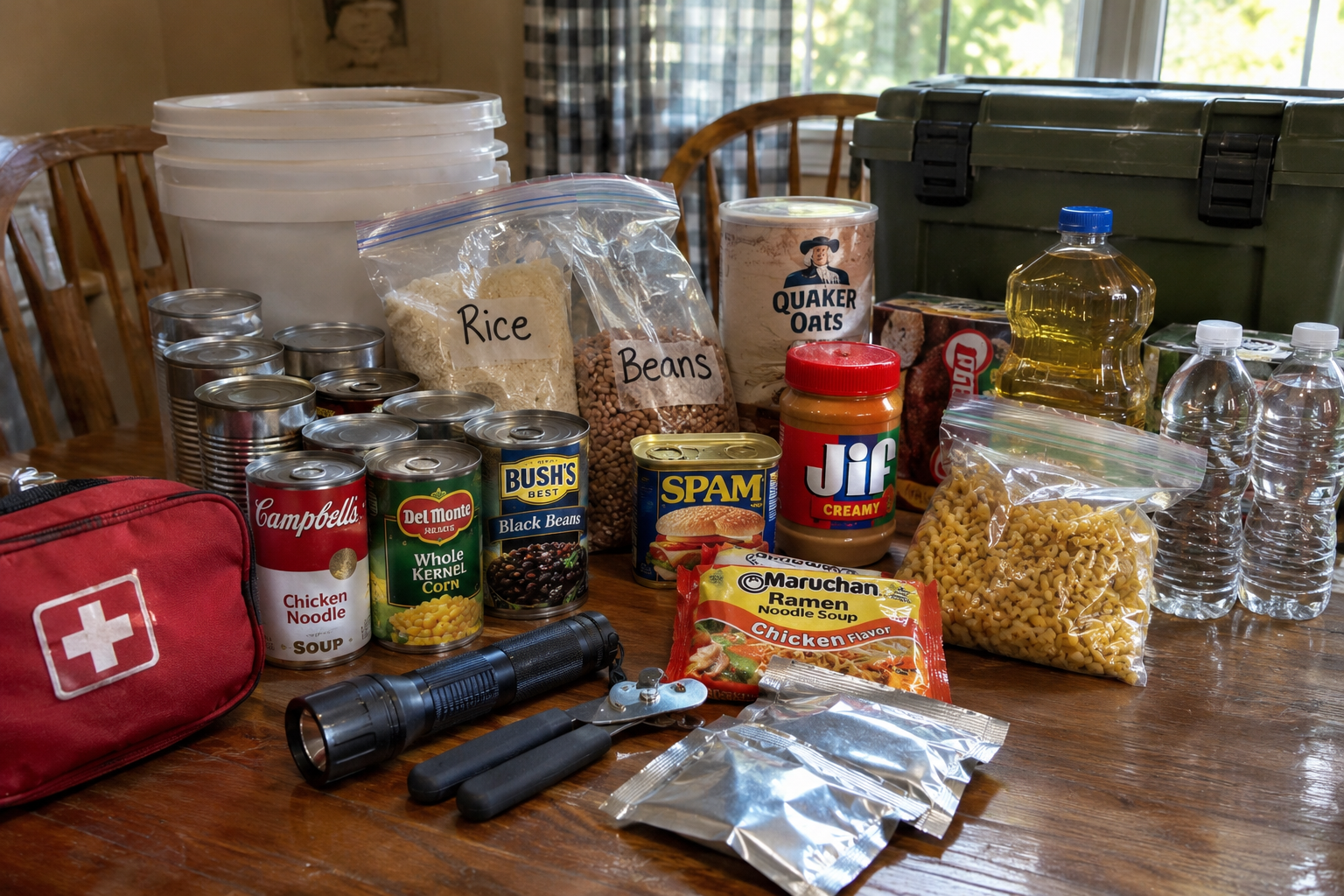
If I were building an emergency food supply from scratch, I would not start by buying a giant bucket with a huge serving number printed on the front.
I would start with a much simpler question:
Could my family eat reasonably well for 14 days if we couldn’t make a normal grocery run?
That changes the way I build the list.
I want food that stores well.
I want some meals that require no cooking at all.
I want foods that don’t depend on a working refrigerator.
I want enough protein and calories that everyone isn’t hungry all day.
And I want food my family already recognizes instead of a closet full of survival meals nobody has ever tasted.
For me, a good two-week emergency food storage list is mostly normal grocery-store food with a smaller layer of true long-term emergency food behind it.
Why I Like a 2-Week Emergency Food Supply
Three days is a good starting point.
Two weeks is where emergency food starts feeling genuinely useful.
Fourteen days gives me breathing room during things such as:
Long power outages.
Winter storms.
Flooding.
Road closures.
Supply disruptions.
Illness.
Unexpected financial problems.
A temporary inability to get to a store.
I don’t have to believe grocery stores are going to disappear permanently.
I just want my household to be able to miss several shopping trips without food becoming the immediate problem.
We already broke down how much emergency food I think a family should store.
This time I want to answer the next question:
What should actually be on the shelf?


First, I Count People and Days
This is the easiest way I’ve found to make emergency food less confusing.
A family of four preparing for two weeks needs:
4 people × 14 days = 56 person-days of food
That doesn’t tell me exactly how many cans of beans to buy, but it gives me something concrete to work with.
I can start thinking in meals.
For a family of four:
14 breakfasts.
14 lunches.
14 dinners.
Plus snacks.
That is much easier to visualize than staring at a pile of cans and wondering whether it’s enough.


I Would Not Use One Calorie Number for Everybody
A toddler doesn’t eat like a grown adult.
A teenager may eat more than both parents.
Someone doing physical work after a storm may eat much more than they normally would sitting around the house.
So I don’t try to pretend every person needs exactly the same number of calories.
For planning, I look at what the household normally eats.
If the pantry I’m building would obviously provide far less food than we normally consume over two weeks, I know it isn’t enough.
For a typical family of four, I would want the emergency pantry to provide roughly 100,000 to 115,000 calories total as a broad planning range.
That isn’t a medical prescription.
It’s simply a practical check to make sure my “two-week supply” isn’t actually three days of food spread across fourteen days.
I Would Build the Food Around Real Meals
I think this is where many emergency food lists fail.
They give me ingredients.
Rice.
Beans.
Oats.
Peanut butter.
But they don’t tell me what dinner looks like.
So I would build the pantry around meals I can actually imagine serving.
Breakfast might be:
Oatmeal with dried fruit.
Cereal with shelf-stable milk.
Peanut butter and crackers.
Granola with fruit.
Lunch might be:
Tuna and crackers.
Canned chicken wraps.
Peanut butter and jelly.
Soup.
Beans and rice.
Dinner might be:
Pasta and sauce.
Rice with canned chicken and vegetables.
Chili.
Beans and instant potatoes.
Soup with crackers.
Emergency meals from long-term storage.
Now I’m buying food with a purpose.



My 2-Week Emergency Food Storage List for a Family of 4
This is not the only correct list.
Families eat differently.
Kids eat differently.
Allergies and medical needs change everything.
But if I were trying to build a practical starting point for four people, this is roughly what I would want.
Rice: About 10 Pounds
White rice is one of the easiest emergency staples for me to justify.
It’s cheap.
Stores well.
Pairs with almost anything.
Ten pounds of dry white rice contains a lot of food without taking up much space.
I would use it with:
Beans.
Canned chicken.
Canned vegetables.
Soup.
Seasonings.
Sauces.
Rice also fits nicely with the long-term part of the pantry because properly stored white rice can last far longer than most ordinary groceries.
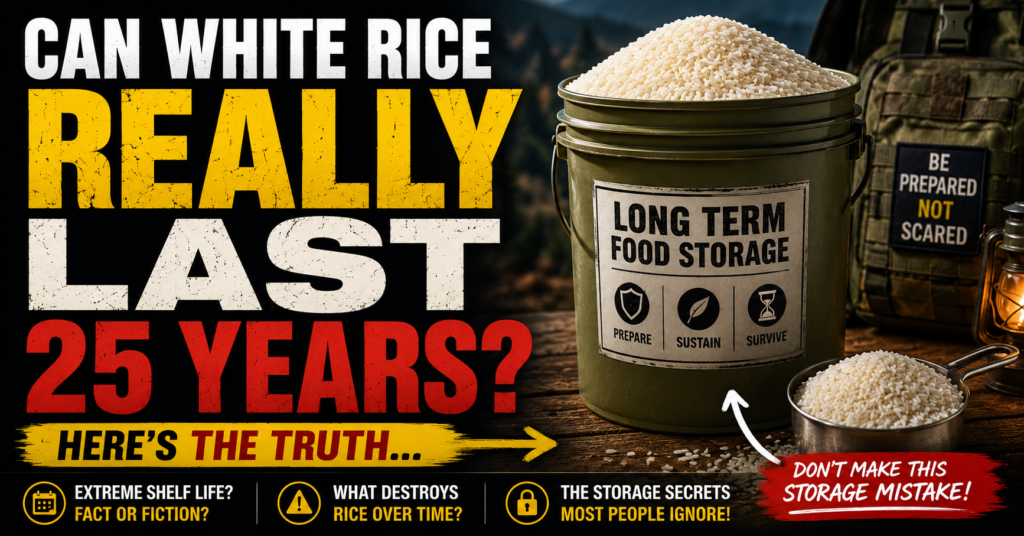
We’ve already gone deeper into whether white rice can really last 25 years.
The Downside
Rice requires water and cooking fuel.
That’s why I would never make the entire pantry dry rice and beans.
I want plenty of food I can eat without cooking too.

Pasta: About 6 Pounds
Pasta adds variety.
Six pounds gives me several family-size meals without taking over the pantry.
I would keep different shapes if that’s what we normally eat.
Spaghetti.
Macaroni.
Penne.
Whatever works.
I would also store sauce separately.
Maybe six to eight jars or cans depending on how much sauce the family normally uses.
Again, Think About Fuel
Pasta needs boiling water.
During a prolonged outage, cooking fuel may be limited.
That’s why quick-cooking pasta or other faster-cooking starches can be useful.
Oatmeal: About 5 Pounds
Oatmeal is one of my favorite emergency breakfast foods.
It’s cheap.
Compact.
Filling.
Easy to flavor.
Five pounds gives a family a lot of breakfasts.
I could add:
Honey.
Sugar.
Cinnamon.
Raisins.
Dried cranberries.
Powdered milk.
Peanut butter.
Oats also cook relatively quickly, which helps save fuel.

Cereal: 2 to 3 Large Boxes
I like having some breakfasts that require no cooking.
Cereal works well for that.
I’d choose varieties the family already eats and pair them with shelf-stable milk.
This is also good for kids who may not be excited about oatmeal every morning for two weeks.
Shelf-Stable Milk: 1 to 2 Gallons Worth
That could be:
Shelf-stable UHT milk.
Powdered milk.
Shelf-stable milk alternatives.
I don’t need fourteen gallons of milk.
I just want enough for:
Cereal.
Cooking.
Drinking if we normally drink it.
Powdered milk is especially useful because it takes up much less space before mixing.
Peanut Butter: 3 to 4 Large Jars
Peanut butter earns a lot of space in my emergency pantry.
It’s ready to eat.
Calorie-dense.
Contains protein and fat.
Requires no refrigeration before opening.
Doesn’t require cooking.
And most families already know whether everyone likes it.
A spoonful of peanut butter and some crackers can become a meal when cooking isn’t practical.
For a family that uses peanut butter heavily, I’d lean toward four jars.
Crackers: 6 to 8 Boxes
Crackers work with:
Peanut butter.
Tuna.
Canned chicken.
Cheese spreads.
Soup.
They’re also an easy snack.
I would rotate these more often because crackers do not have the ultra-long storage life of rice or dry beans.
That’s fine.
Not everything in emergency storage needs to last twenty years.
Canned Chicken: 12 to 16 Cans
This is one of the easiest shelf-stable proteins for me to use.
I can add canned chicken to:
Rice.
Pasta.
Soup.
Wraps.
Crackers.
Casserole-style meals.
And if necessary, I can eat it straight from the can.
That no-cook ability matters.
Canned Tuna or Salmon: 8 to 12 Cans or Pouches
Another shelf-stable protein.
I like mixing canned proteins so the family isn’t eating chicken every day.
Pouches can be especially convenient because they don’t require a can opener and create less waste.
I’d choose what the family already eats.
Canned Beans: About 16 to 20 Cans
Dry beans are better for very long-term storage.
Canned beans are better when I want food quickly.
That’s why I would keep both.
Canned beans are:
Already cooked.
Ready to eat.
Easy to heat.
Easy to add to chili, rice, soup, or other meals.
During an emergency, convenience matters.
Dry Beans: About 5 Pounds
These become another layer.
They’re cheap.
They store well.
They provide protein, fiber, and calories.
But I don’t want dry beans to be my only protein because they require soaking, cooking, water, and fuel.
We’ll eventually build a separate article around how long dry beans actually last in emergency storage, because there is a lot more to that question than the date printed on the bag.
Canned Vegetables: 24 to 30 Cans
That sounds like a lot until I remember I’m feeding four people for two weeks.
I would mix them.
Corn.
Green beans.
Carrots.
Peas.
Mixed vegetables.
Tomatoes.
Whatever the family normally eats.
One thing I like about canned vegetables is that they don’t need cooking.
Heating them is nice.
It isn’t required.
Canned Fruit: 16 to 20 Cans or Cups
Emergency food gets depressing quickly when everything is salty and heavy.
Fruit helps.
Peaches.
Pears.
Pineapple.
Mandarin oranges.
Applesauce.
Fruit cups.
I especially like fruit packed in juice because the liquid is useful too.
Dried Fruit: 3 to 4 Pounds
Raisins.
Cranberries.
Apricots.
Whatever we actually eat.
Dried fruit is:
Portable.
Ready to eat.
Calorie-dense.
Useful with oatmeal or cereal.
Easy to snack on.
Again, I rotate it rather than trying to store it for decades.
Nuts: 3 to 4 Pounds
Nuts add calories, fat, and protein without cooking.
That’s extremely useful.
But nuts contain oils that can become rancid over time.
They’re a rotation food.
I would not seal away thirty pounds and forget about them for ten years.
Granola or Protein Bars: 2 to 3 Boxes
These are excellent for the first few days of an emergency.
No cooking.
No dishes.
Portable.
Easy for kids.
Easy to carry during evacuation.
I don’t think bars should become the whole food plan, but they’re useful.
Canned Soup and Stew: 12 to 16 Cans
This is another easy meal category.
Soup.
Chili.
Stew.
Pasta meals.
Bean soup.
I prefer cans that can become a meal rather than tiny side dishes.
If there’s enough water and fuel, I can heat them.
If necessary, most commercial canned foods can be eaten without heating once opened.
Instant Potatoes: 2 to 3 Boxes
Instant potatoes are underrated emergency food.
They cook quickly.
They’re filling.
They pair well with meat and vegetables.
And they use much less fuel than starting with whole potatoes.
That’s exactly the kind of thing I want when power has been out for several days.
Tortillas: A Rotating Supply
Tortillas are great because they don’t need cooking.
Peanut butter wrap.
Chicken wrap.
Bean wrap.
Tuna wrap.
They don’t store forever, though.
So I would treat them as part of the rotating pantry rather than long-term emergency storage.
When they’re getting old, eat them and buy fresh ones.
Honey: 1 Large Jar
Honey is one of my favorite long-term sweeteners.
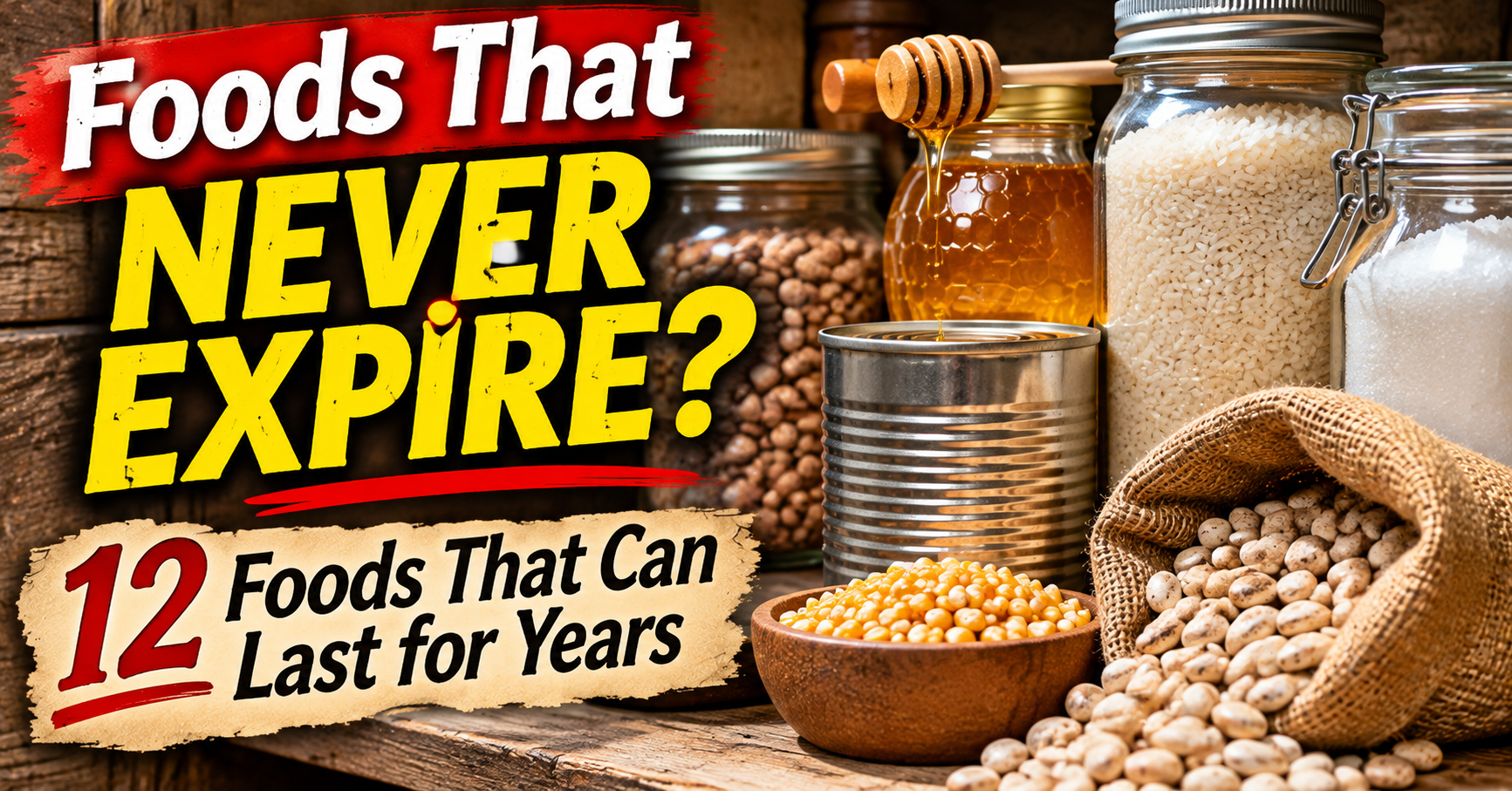
We’ve already looked closely at foods that can last for years when stored correctly.
Honey gives me:
Calories.
Sweetener for oatmeal.
Something for tea.
A way to make plain foods more enjoyable.
And it stores exceptionally well.
Sugar: 5 Pounds
Sugar is inexpensive and useful.
I don’t need a giant mountain of it for two weeks.
Five pounds is plenty for:
Coffee.
Tea.
Oatmeal.
Cooking.
Baking if possible.
Comfort food.
Salt and Seasonings
This is one category people forget.
Plain rice and beans get old fast.
I’d want:
Salt.
Pepper.
Garlic powder.
Onion powder.
Chili powder.
Cinnamon.
Bouillon.
Hot sauce.
Other seasonings the family actually likes.
Seasonings take up almost no space and can completely change the same basic ingredients.
Cooking Oil: 1 to 2 Quarts
Fat is calorie-dense and useful for cooking.
A quart of oil contains a surprising amount of energy.
I don’t store enormous quantities because oils don’t last indefinitely.
I rotate them through normal cooking.
Coffee and Tea
Not essential for survival.
Very important for morale in many homes.
If everyone normally drinks coffee every morning, I wouldn’t plan an emergency pantry that suddenly eliminates it.
Instant coffee is especially easy because it doesn’t need a coffee maker.
Hot water is enough.
Comfort Food Matters More Than It Sounds
I’d include some food whose main purpose is making people happy.
Chocolate.
Cookies.
Candy.
Hot cocoa.
Favorite snacks.
An emergency is already stressful.
I don’t see any benefit in making every meal miserable too.
The Most Important Category: Food That Needs No Cooking
If the power goes out tonight, I don’t want to immediately start burning propane just to eat breakfast.
I’d make sure a meaningful part of my 14-day supply can be eaten directly.
That includes:
Peanut butter.
Crackers.
Canned tuna.
Canned chicken.
Canned fruit.
Canned beans.
Granola bars.
Protein bars.
Cereal.
Shelf-stable milk.
Dried fruit.
Nuts.
Ready-to-eat canned meals.
This becomes especially valuable during the first day or two of a power outage.
I Would Plan at Least 3 Days of Completely No-Cook Meals
That’s one of my own practical rules.
Even if I have a camp stove or generator, I don’t want every meal depending on it.
For the first three days, I want the ability to eat without cooking anything.
That buys me time.
Maybe the electricity comes back.
Maybe I need to conserve fuel.
Maybe we’re busy dealing with storm damage.
Maybe cooking simply isn’t a priority.
No-cook food gives me flexibility.
Then I Add Quick-Cooking Foods
After the no-cook layer, I like foods that use minimal fuel.
Oatmeal.
Instant potatoes.
Couscous.
Ramen.
Quick-cooking rice.
Canned soup.
Canned beans.
These are easier than simmering dry beans for hours.
Long-Cooking Foods Come Last
Dry beans and regular rice are excellent emergency staples.
But they belong in a system.
Not by themselves.
If I have abundant fuel and water, they’re great.
If I don’t, I have other options first.
That’s why the pantry needs layers.
Don’t Forget the Manual Can Opener
This deserves its own section because it would be ridiculous to own fifty cans of food and no way to open them after the power goes out.
I would own at least two manual can openers.
They’re inexpensive.
And I don’t want one broken can opener turning into a problem.
What About Water?
Food storage and water storage cannot be separated.
Dry foods need water.
People need much more water than food.
And cooking consumes water too.
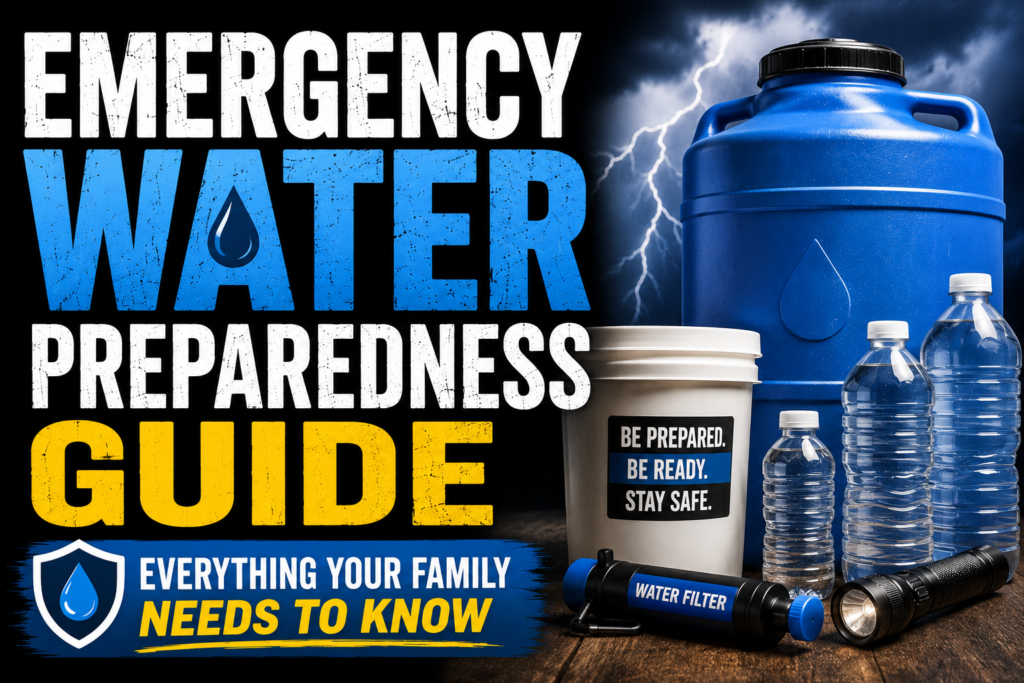
That’s why I would build this list beside our emergency water preparedness guide.
For a two-week emergency, water storage can become a much bigger space problem than food storage.
I would solve water first.
Avoid Extremely Salty Emergency Food if Water Is Limited
Salt is important.
Too much salty food can also make everyone thirstier.
That’s why I don’t want every meal to be:
Jerky.
Salty crackers.
Canned soup.
Ramen.
Processed meat.
A good mix is better.
What About the Refrigerator and Freezer?
I don’t ignore them.
If the power goes out, I’d use safe refrigerated and frozen foods strategically before opening long-term supplies.
But I do not count everything in my freezer as part of the reliable two-week shelf-stable reserve.
That food depends on electricity or another way of keeping it cold.
The emergency pantry should still work if the freezer becomes unavailable.
I Would Avoid Building the List Around Frozen Food
This is one difference between a normal 14-day meal plan and an emergency 14-day food supply.
A normal meal plan can rely heavily on:
Frozen meat.
Milk.
Eggs.
Cheese.
Frozen vegetables.
An emergency food list should still function when refrigeration is gone.
That doesn’t mean I throw frozen food away.
It simply doesn’t form the core of the plan.
Emergency Food for Babies Requires Separate Planning
If there’s an infant in the house, this list is not enough.
Formula.
Baby food.
Clean bottles.
Feeding equipment.
Safe water.
Any specific medical or dietary needs.
Those need their own supply.
I would never assume an adult emergency pantry automatically covers a baby.
Kids Need Food They Will Actually Eat
This matters more than people admit.
An adult may tolerate plain beans and rice because they understand why.
A small child may refuse it.
So I’d keep some familiar foods.
Cereal.
Crackers.
Fruit.
Peanut butter if safe for the child.
Granola bars.
Favorite shelf-stable snacks.
Food is partly about nutrition.
During an emergency it’s also about keeping the household calm and functioning.
Special Diets Need Their Own Section of the Pantry
Food allergies.
Diabetes.
Gluten-free diets.
Religious dietary requirements.
Medical restrictions.
Those don’t disappear because the power went out.
If someone needs a specific diet, I build around it from the beginning.
I don’t plan to improvise during the emergency.
Don’t Forget Pets
Pet food absolutely belongs on the emergency food list.
If I want two weeks for the household, I want two weeks for the pets too.
I would also store extra water for them.
A family food supply isn’t complete if the dog runs out of food on Day 3.
I Would Rotate Most of This Food
One reason I like this list is that almost everything is normal food.
We can eat it.
That solves one of the biggest emergency food problems.
Waste.
When pasta gets older, we eat it.
Replace it.
When canned chicken is nearing the date I want to rotate it, use it for dinner.
Replace it.
Peanut butter gets used.
Cereal gets used.
Nothing sits untouched for ten years unless it’s intentionally packaged for long-term storage.
First In, First Out Works Fine
I don’t need a complicated inventory system.
Oldest food in front.
Newest food behind it.
Eat from the front.
Replace from the back.
That’s enough for most families.
I Write the Purchase Date on Things That Are Easy to Lose Track Of
A marker makes this simple.
Especially on foods where packaging changes or dates are hard to see.
I don’t need perfect records.
I just want to know which food is older.
I Still Like Having Some True Long-Term Emergency Food
A rotating pantry is my first layer.
A commercial emergency-food supply can sit behind it.
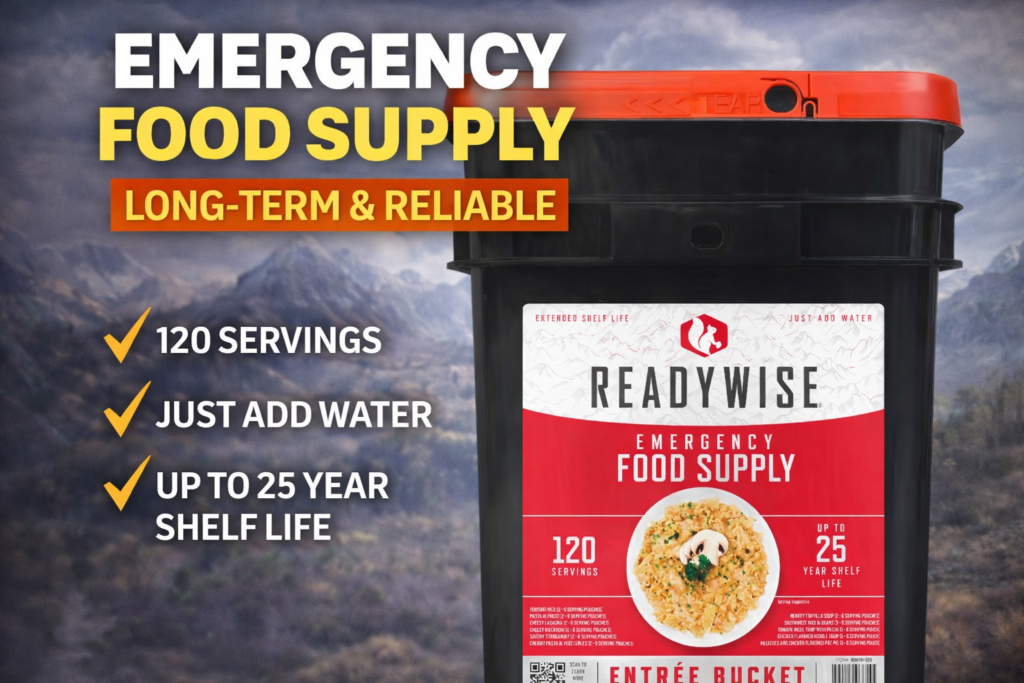
Your Sheet already has the ReadyWise 120-Serving Emergency Food Supply.
I think something like that makes the most sense as backup depth.
Not the entire pantry.
If I’ve used most of the normal food, the long-term supply gives me another layer.
A Larger 30-Day Supply Can Add More Depth
There’s also the ReadyWise 30-Day Emergency Food Supply.
Again, I wouldn’t buy this and declare the household finished.
I’d use it behind:
Normal pantry food.
Canned food.
No-cook food.
Rice.
Beans.
Water.
Cooking capability.
That combination gives me much more flexibility than any one bucket.
“Servings” Can Be Misleading
This is something I always pay attention to with packaged emergency food.
A serving may be:
A full meal.
A side dish.
A relatively small portion.
That’s why I don’t automatically convert:
120 servings = 120 meals.
I look at calories and actual serving sizes.
The number on the bucket is useful.
It just isn’t enough by itself.
Storage Location Matters
I don’t want my emergency pantry sitting in the hottest place in the house.
Heat shortens food quality.
Moisture creates problems.
Rodents create problems.
For long-term food, I prefer:
Cool.
Dry.
Dark.
Stable temperatures.
That might mean a basement shelf, interior closet, pantry, or another conditioned space.
I Would Be Careful With the Garage
A garage sounds perfect because it has space.
But summer heat can be brutal.
That can shorten the useful storage life of food.
We’ll eventually give garage emergency-food storage its own article because this is a surprisingly common problem.
Rodents Can Destroy a Pantry Fast
Paper bags and cardboard boxes don’t offer much protection against mice.
Rice.
Pasta.
Oats.
Dry beans.
Pet food.
Those are all attractive to rodents.
For longer-term dry storage, I like sturdy food-safe containers.
I don’t need to put every canned good inside a bucket.
But vulnerable dry foods need protection.
What I Would Buy First if Money Is Tight
I would not try to buy this entire list in one trip.
I’d prioritize:
Peanut butter.
Canned meat.
Canned beans.
Rice.
Oatmeal.
Pasta.
Canned fruit.
Canned vegetables.
Crackers.
Shelf-stable milk.
Those foods give me a good mix quickly.
Then I build from there.
Add a Few Things Every Grocery Trip
This is probably the easiest way to do it.
Normal grocery trip?
Add:
Two cans of chicken.
Two cans of fruit.
Two cans of beans.
A bag of rice.
Peanut butter.
Next week, do something similar.
Emergency food storage grows surprisingly fast when I stop trying to buy everything at once.
I Would Keep a Simple 14-Day Meal Plan With the Food
This is one of the best ideas for making the pantry actually usable.
I don’t need a detailed recipe book.
Just something like:
Day 1
Breakfast: cereal and fruit
Lunch: tuna and crackers
Dinner: rice, chicken, vegetables
Day 2
Breakfast: oatmeal and raisins
Lunch: peanut butter and crackers
Dinner: pasta and sauce with canned chicken
And so on.
Now I know the food actually forms meals.
A Sample 14-Day Meal Rotation
I would not necessarily follow this exactly, but it helps me see whether the pantry works.
Day 1
Breakfast: cereal, shelf-stable milk, canned fruit
Lunch: tuna, crackers, dried fruit
Dinner: rice, canned chicken, canned vegetables
Day 2
Breakfast: oatmeal, raisins, honey
Lunch: peanut butter and crackers
Dinner: pasta with sauce and canned chicken
Day 3
Breakfast: granola and shelf-stable milk
Lunch: canned soup and crackers
Dinner: beans, rice, canned corn
Day 4
Breakfast: oatmeal with peanut butter
Lunch: chicken wraps
Dinner: chili and crackers
Day 5
Breakfast: cereal and fruit
Lunch: tuna and crackers
Dinner: instant potatoes, chicken, vegetables
Then I rotate similar combinations while changing flavors and proteins.
The point isn’t gourmet cooking.
It’s variety.
What I Would Not Stock Heavily
Some foods look good on emergency lists but don’t make much sense for me in huge quantities.
Foods Nobody Likes
Obvious, but people still do it.
Foods Requiring Huge Amounts of Water
If water is already limited, this creates another problem.
Foods Requiring Hours of Cooking
Great if I have fuel.
Less great if I don’t.
Extremely Salty Food
Can increase thirst.
Giant Packages
Once opened, leftovers may require refrigeration.
Smaller cans can sometimes be more practical.
I Would Rather Have 14 Good Days Than 30 Miserable Ones
That’s how I judge this list.
Some emergency food plans look impressive because the numbers are huge.
But if everyone is hungry, tired of the food, and burning half the cooking fuel just to make dinner, the plan isn’t very good.
I’d rather build a realistic 14-day supply first.
One that includes:
Enough calories.
Protein.
Fat.
Fruit.
Vegetables.
No-cook meals.
Quick meals.
Normal family food.
Then expand it.
Once 2 Weeks Is Covered, I Would Build Toward 30 Days
The next step isn’t changing everything.
It’s adding more of what already works.
More rice.
More canned meat.
More fruit.
More vegetables.
More breakfast food.
More long-term emergency meals.
More water.
That’s how a two-week pantry becomes a month without starting over.
The Exact List Is Less Important Than the System
No two households will buy the same food.
That’s okay.
One family may eat far more rice.
Another may hate canned tuna.
Someone else may need gluten-free food.
The important part is the structure.
Enough meals.
Enough calories.
Some food that needs no cooking.
Some food that uses very little fuel.
Shelf-stable protein.
Carbohydrates.
Fats.
Fruit and vegetables.
Water.
Familiar food.
That’s the emergency food storage list I trust.
If I Were Starting Tonight
I would open the pantry before buying anything.
Count what we already have.
Then ask:
Could we eat tomorrow without shopping?
Three days?
A week?
Two weeks?
That tells me where the holes are.
Maybe I already have plenty of pasta but almost no shelf-stable protein.
Maybe I have 40 cans of vegetables and almost no breakfast food.
Maybe I have rice for months but only two days of water.
The answer isn’t always buying more food.
Sometimes it’s balancing what I already own.
My Goal Is Simple
I want grocery stores to be convenient.
Not critical.
If a snowstorm closes roads, we’re okay.
If the power is out for days, we can still eat.
If everybody gets sick and nobody wants to shop, we’re okay.
If supply problems hit for a couple weeks, we have breathing room.
That’s what a two-week emergency food supply gives me.
Not some fantasy of living indefinitely from a bunker.
Just enough food that one disrupted week doesn’t turn into panic.
That’s a practical goal most families can build toward a little at a time.
About the Author
Evan Brooks writes about emergency food storage, gardening, foraging, seed storage, and practical household self-reliance for Survive Essentials. His work focuses on realistic household food reserves, long-term pantry staples, rotation, and emergency plans built around food families will actually eat.