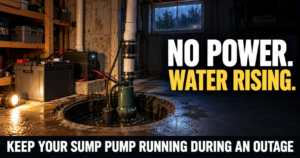
The worst time for my sump pump to lose power is usually the exact time the electricity is most likely to go out.
Heavy thunderstorms. Days of rain. Rapid snowmelt.
Those are the conditions filling the sump pit, and they’re also the conditions knocking trees into power lines.
That’s why I don’t consider a sump pump truly prepared just because it works perfectly when the grid is up.
If my basement depends on that pump staying dry, I want to know what happens at 2:00 a.m. when the power fails, rain is still pouring down, and nobody is standing beside the pit waiting to start a generator.
I think about sump-pump backup in layers.
A dedicated battery backup can take over automatically. A properly sized portable power station may be able to run my existing pump. A generator can carry the load through a much longer outage. In some homes with municipal water, a water-powered backup sump pump may provide another layer.
But before I buy any of them, I need to understand the pump and the basement I’m trying to protect.
First, I Find Out How Fast My Basement Actually Gets Into Trouble
Not every sump pump has the same job.
I’ve seen sump pits that barely collect water except during unusually wet weather. Other pumps seem to cycle every few minutes whenever the ground becomes saturated.
That’s a huge difference when the electricity disappears.
If my pump runs for 30 seconds every 20 minutes during heavy rain, I have a much different backup-power problem than someone whose pump is running for a minute every three minutes.
So one of the most useful things I can do costs nothing.
I watch the pump during a real rainstorm.
I want to know:
- How often does it start?
- How long does each cycle last?
- How quickly does the pit refill?
- Does the pump ever run continuously?
- How high does the water rise before the float activates?
Those observations tell me far more about my real backup needs than a generic article promising that a battery will run “up to 12 hours.”



I Actually Time the Pump
Let’s say I’m watching my sump during a heavy rain.
Over 15 minutes, it starts three times.
Each cycle lasts about 30 seconds.
That’s 90 seconds of pumping during those 15 minutes.
Over an hour, that works out to roughly six minutes of actual pump runtime.
Now I know the pump has roughly a 10% duty cycle under those particular conditions.
That’s useful.
If tomorrow’s storm sends twice as much water toward the foundation, that duty cycle could change dramatically.
That’s why battery runtime can’t be answered accurately with the pump wattage alone.
I need to know how often the thing actually runs.


Then I Find the Electrical Information on My Pump
Before I shop for a generator or portable power station, I look at the sump pump itself.
I want the nameplate or manufacturer’s specifications.
I’m looking for:
- Voltage
- Amperage
- Horsepower
- Running watts if provided
- Starting or locked-rotor current if provided
I don’t rely solely on horsepower.
Two pumps labeled 1/3 HP aren’t guaranteed to have identical electrical demands.
That’s one reason generic charts can get people into trouble.
Starting Power Matters More Than Most People Realize
A sump pump contains an electric motor.
When that motor starts, it may briefly demand considerably more electrical power than it needs once it’s running.
This is where a backup system that looks perfect on paper can fail.
Imagine my pump normally uses around 800 watts while running.
I buy a portable power station capable of supplying 1,500 watts continuously.
Plenty, right?
Not necessarily.
If the pump briefly demands more than 2,000 watts when the motor starts and the power station can’t handle that surge, its overload protection may shut the output off.
The battery can contain plenty of energy and still be unable to start the pump.
That’s why I separate two questions:
Can this backup source START my sump pump?
and
How LONG can this backup source run my sump pump?
Those are completely different questions.


I Test Instead of Assuming
Once I have backup equipment that should work on paper, I test it.
I don’t wait for a thunderstorm.
On a normal dry day, I connect everything the way I intend to use it during an outage.
Then I safely add water to the sump pit until the float activates.
I watch the pump start.
I let it complete a full cycle.
Then I repeat the test.
I want to see the motor start under backup power several times.
That’s much more meaningful than plugging the power station in, seeing its screen light up, and declaring myself prepared.
Option 1: A Dedicated Battery Backup Sump Pump
If a flooded basement could cause serious damage to my house, this is one of the first options I’d consider.
A traditional battery-backup sump system usually adds a second pump.
My normal AC sump pump remains the primary pump.
The backup pump has its own battery, controller, and float or activation system.
If utility electricity disappears and the water rises, the backup pump can begin removing water automatically.
That word matters:
Automatically.



Automatic Backup Solves the 2 A.M. Problem
This is the scenario I’m really preparing for.
A thunderstorm rolls through overnight.
At 2:17 a.m., a tree takes down the power.
I’m asleep.
The primary sump pump stops.
Rainwater and groundwater don’t care that I’m asleep. Water keeps entering the pit.
A portable generator sitting in my garage doesn’t solve that problem by itself.
Somebody still has to wake up, recognize that the electricity failed, safely move the generator outside, start it, and connect the pump.
An automatic battery-backup pump can already be working.
That’s why I see battery backup as the first line of defense for a basement that’s genuinely vulnerable to flooding.
A Second Pump Protects Me From More Than a Blackout
There’s another reason I like this setup.
Electricity isn’t the only thing that can fail.
The primary pump motor can die.
The float switch can stick.
The pump can jam.
Something can block the intake.
A generator powering a broken primary sump pump doesn’t accomplish much.
A second independent pump gives me another layer.
That’s a meaningful difference between owning backup electricity and owning a backup sump-pump system.

Battery Backup Still Has Limits
This is where I become skeptical of simple runtime claims.
If a backup system says it can provide 24 hours of protection, I want to know what that actually means.
How often is the pump cycling?
What battery was used?
What pumping height?
What flow rate?
Was that 24 hours of continuous pumping or 24 hours with occasional cycles?
Those aren’t remotely the same thing.
If my backup pump cycles for 30 seconds twice an hour, a battery can last dramatically longer than it would with water pouring into the pit fast enough to keep the pump running continuously.
I Think About Battery Runtime in Watt-Hours
Let’s use a simplified example to show why.
Suppose a pump consumes 500 watts while it’s actually running.
If it runs five minutes during each hour:
5 ÷ 60 = about 0.083 hours
Then:
500 watts × 0.083 hours = about 42 watt-hours per hour
Real-world losses and system consumption mean the actual number won’t be perfectly clean.
But now imagine that same 500-watt pump has to run for 30 minutes each hour.
That’s:
500 watts × 0.5 hour = 250 watt-hours per hour
Same pump.
Same battery.
Six times the energy consumption simply because more water is entering the pit.
That’s why I want to know what my sump does during a bad storm.

Option 2: Using a Portable Power Station
This is another option I find really interesting.
Instead of adding a separate DC backup pump, I may be able to run my existing AC sump pump from a sufficiently capable portable power station.
There are some obvious advantages.
No gasoline.
No exhaust.
No carbon monoxide.
No engine noise.
I can keep the unit indoors in an appropriate dry location.
And when the weather is good, the same battery can potentially serve other emergency-power needs.
But I still have those same two questions.
Can its inverter start my pump?
Does its battery have enough capacity to keep the pump going?
Watts and Watt-Hours Tell Me Different Things
This is something I think every power-station buyer should understand.
Watts tell me about power.
That’s important for determining whether the inverter can operate the pump and survive its startup surge.
Watt-hours tell me about stored energy.
That’s what helps me estimate runtime.
A power station could have a huge 3,000-watt inverter connected to a relatively small battery.
It might start the pump beautifully and then run out of stored energy surprisingly quickly.
Another unit might contain a massive battery but have an inverter that can’t tolerate the pump’s starting surge.
I need both sides of the equation to work.
Here’s a Realistic Example of Why Duty Cycle Changes Everything
Let’s say I have a power station rated at:
1,000 Wh
I don’t assume every one of those watt-hours will reach my AC sump pump because converting battery DC power into household AC power involves losses.
For a simple planning example, suppose I estimate:
850 Wh of usable AC energy
Now imagine my sump pump draws:
800 watts while running
During moderate rain, it runs for six minutes each hour.
Six minutes is one-tenth of an hour.
So:
800 watts × 0.1 hour = about 80 Wh per hour
Then:
850 Wh ÷ 80 Wh = roughly 10.6 hours
That’s not a guaranteed runtime.
It’s an example showing how I think through the problem.
Now let’s make the storm worse.
The Same Battery Could Last Only About Three Hours
Suppose water starts entering much faster and the pump now runs 20 minutes every hour.
Twenty minutes is roughly one-third of an hour.
So:
800 watts × 0.333 = about 266 Wh per hour
Using our same estimated 850 Wh of usable battery energy:
850 ÷ 266 = about 3.2 hours
Nothing about the pump changed.
Nothing about the battery changed.
The rain changed.
That’s why I don’t trust somebody telling me a certain battery will “run a sump pump all night” without knowing how frequently that sump pump actually needs to run.
I Keep the Power Station Off the Basement Floor
If I’m protecting against flooding, I plan for the possibility that my backup plan fails.
That means I don’t place an expensive lithium battery directly on the basement floor beside the sump pit.
If water gets out of the pit, that’s exactly where it’s going.
I keep battery equipment elevated in a dry location while following its operating requirements.
The same goes for extension connections and other electrical equipment.
Manual Power Stations Have the Same Away-From-Home Problem
If the electricity fails and I have to manually unplug the sump pump from the wall and connect it to a portable battery, that setup depends on me being there.
That’s fine if I’m home.
It’s less useful if I’m 40 miles away.
Some power stations offer pass-through or UPS-style functions.
If I’m considering one for automatic sump-pump protection, I verify that the exact model’s transfer time, AC output, surge capability, battery behavior, and manufacturer instructions make it suitable for that job.
Then I test it with the actual pump.
I don’t assume the letters “UPS” automatically make it a sump-pump backup.
Option 3: A Portable Generator
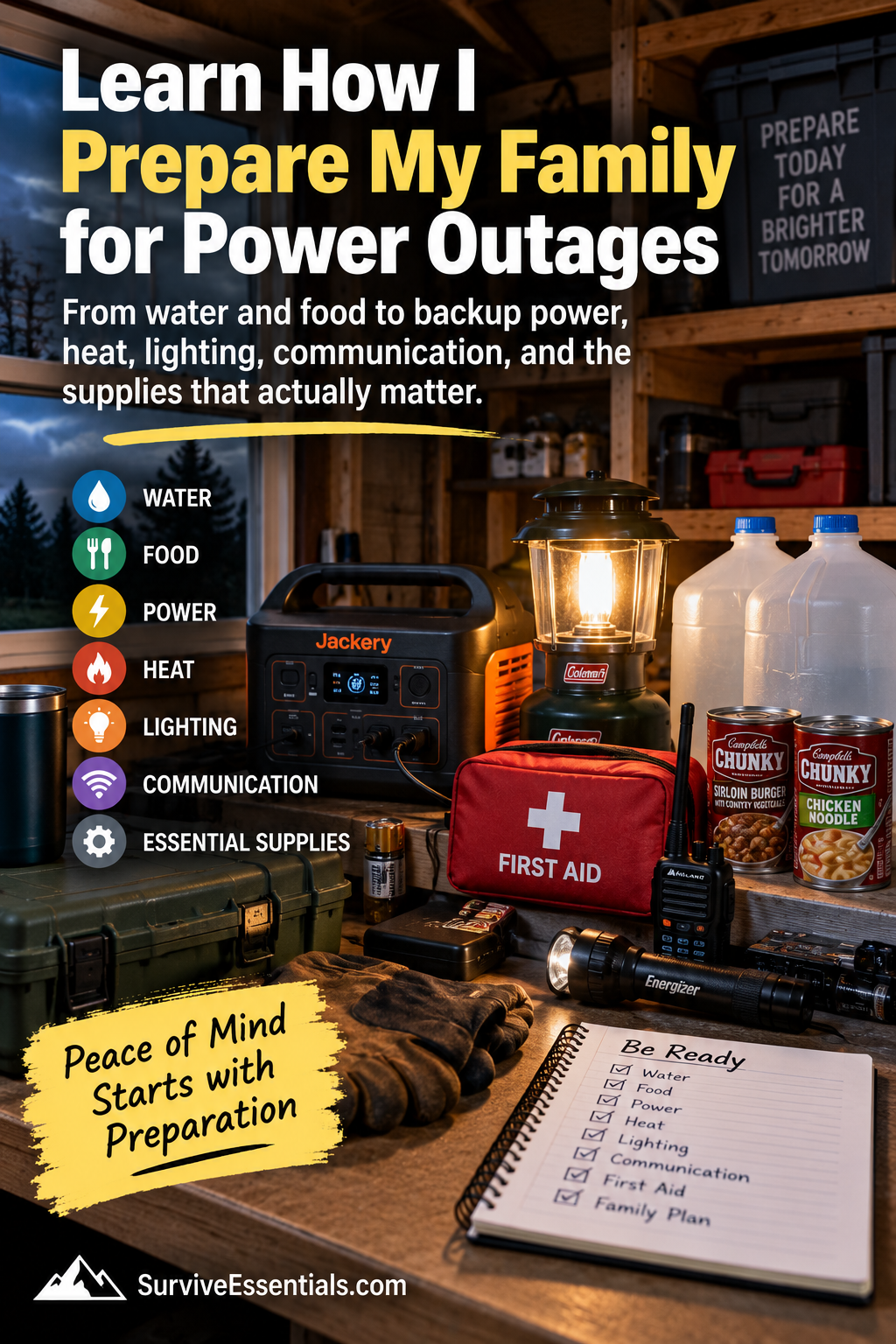
When an outage starts stretching from hours into days, a generator becomes extremely valuable.
A properly sized generator can potentially run the sump pump while also helping me maintain other essential household loads.
That might include:
- Refrigerator
- Freezer
- Phone charging
- Emergency radio
- Lighting
- Furnace controls
- Other essential equipment within the generator’s capacity
That’s why generators remain such a useful part of my broader long-blackout preparedness plan.
But the generator still has to pass the sump pump’s startup test.
I Leave Headroom for the Pump to Start
If my sump pump needs 800 watts while running and perhaps 2,400 watts for a moment when it starts, I don’t choose a generator with barely enough surge capacity and then load it with everything else in the house.
The refrigerator may start.
The freezer may start.
The furnace blower may start.
The sump pump may start.
Motors don’t coordinate their schedules just because I’m running on emergency power.
So I leave headroom.
If necessary, I stagger loads.
I’d rather have fewer things powered reliably than everything connected to a generator that’s constantly tripping.
The 2,500-Watt Generator We’ve Used May Work for Some Pumps
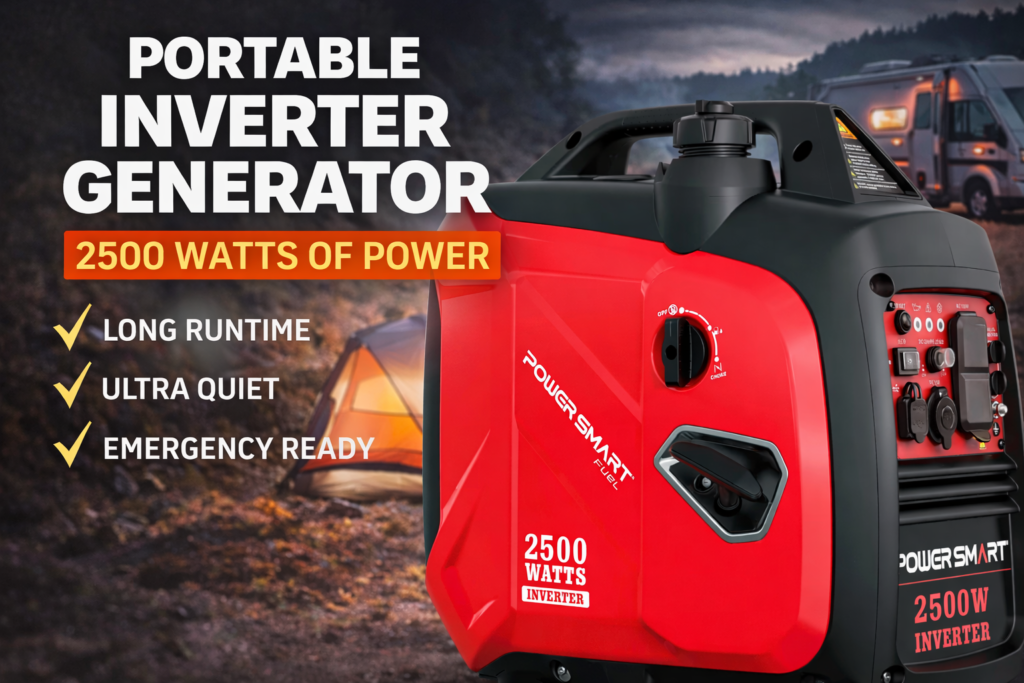
We’ve been using this PowerSmart portable inverter generator throughout the power-outage cluster.
It’s a 2,500-watt-class unit.
For some sump pumps and load combinations, that may be useful.
For other pumps, the starting surge may be too high or leave too little room for additional equipment.
That’s why I don’t promise:
“This generator runs sump pumps.”
I check the pump first.
Then I compare the actual pump requirements with the generator’s rated and surge output.
The Generator We’ve Been Using for Essential Outage Loads
If your particular sump pump falls within its capabilities, this is the portable inverter generator we’ve been using throughout our outage planning.
Check the PowerSmart 2500-watt inverter generator on Amazon
I would verify the actual pump specifications before buying any generator specifically for sump-pump duty.
The Generator’s Biggest Weakness Is That Somebody Has to Start It
This is why I don’t see a manual generator as a complete replacement for automatic sump backup.
If I’m awake and home, it’s excellent.
If the electricity disappears while I’m sleeping, the sump pit may already be rising before I realize what’s happening.
If I’m away from home, the generator might as well be on the moon.
That’s why my favorite layered approach is:
Automatic battery backup first.
Generator for endurance second.
The battery protects the basement immediately.
The generator can then extend protection for as long as I can safely supply fuel.
Option 4: A Water-Powered Backup Pump
Some homes connected to municipal water have another interesting option.
A water-powered backup sump pump uses municipal water pressure to help remove sump water.
That means it doesn’t depend on a battery that eventually runs out.
But this option isn’t right for every house.
It requires adequate municipal water pressure.
It consumes water while operating.
Proper installation and backflow protection matter.
And it doesn’t make much sense for a private-well home during an electrical outage because the well pump itself may have stopped.
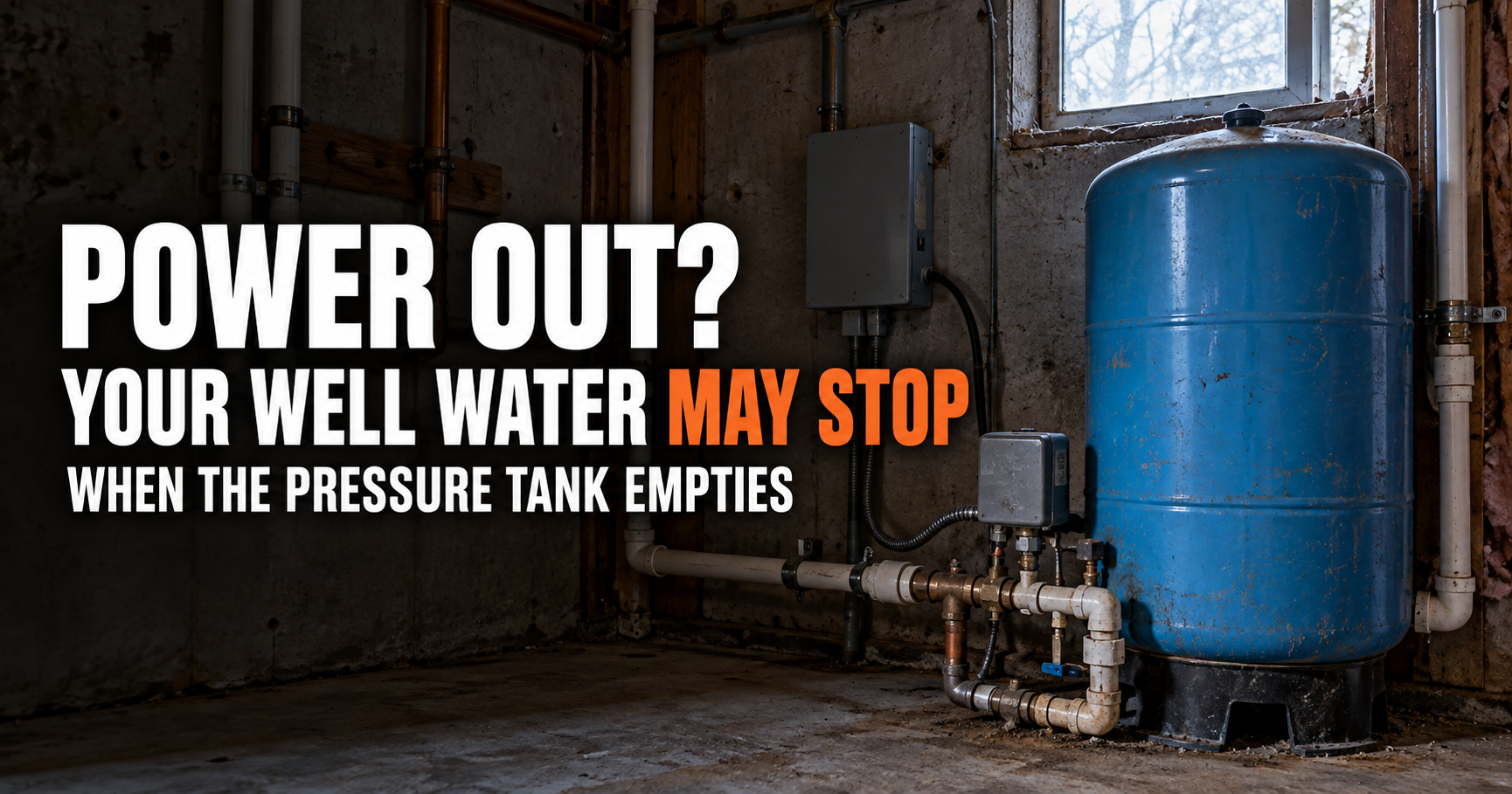
We’ve already covered what happens to my well water during a power outage.
The backup has to match the house.
The Generator Cord Is Part of My Backup System
If my sump pump is in the basement and my generator has to stay outside, the cord connecting them isn’t a minor detail.
I need a heavy-duty, outdoor-rated extension cord that’s properly sized for the electrical load and the distance I’m covering.
I don’t grab the longest cheap extension cord I can find just because it reaches.
A sump pump is a motor load. That means I’m already concerned about startup demand. An undersized or excessively long extension cord can add voltage drop and heat to a situation where I need the pump to start reliably every single time.
So when I’m planning generator backup, I plan the cord at the same time.
I Let the Safe Generator Location Determine the Cord Length
I never move the generator closer to the house because the cord I own is too short.
That’s backwards.
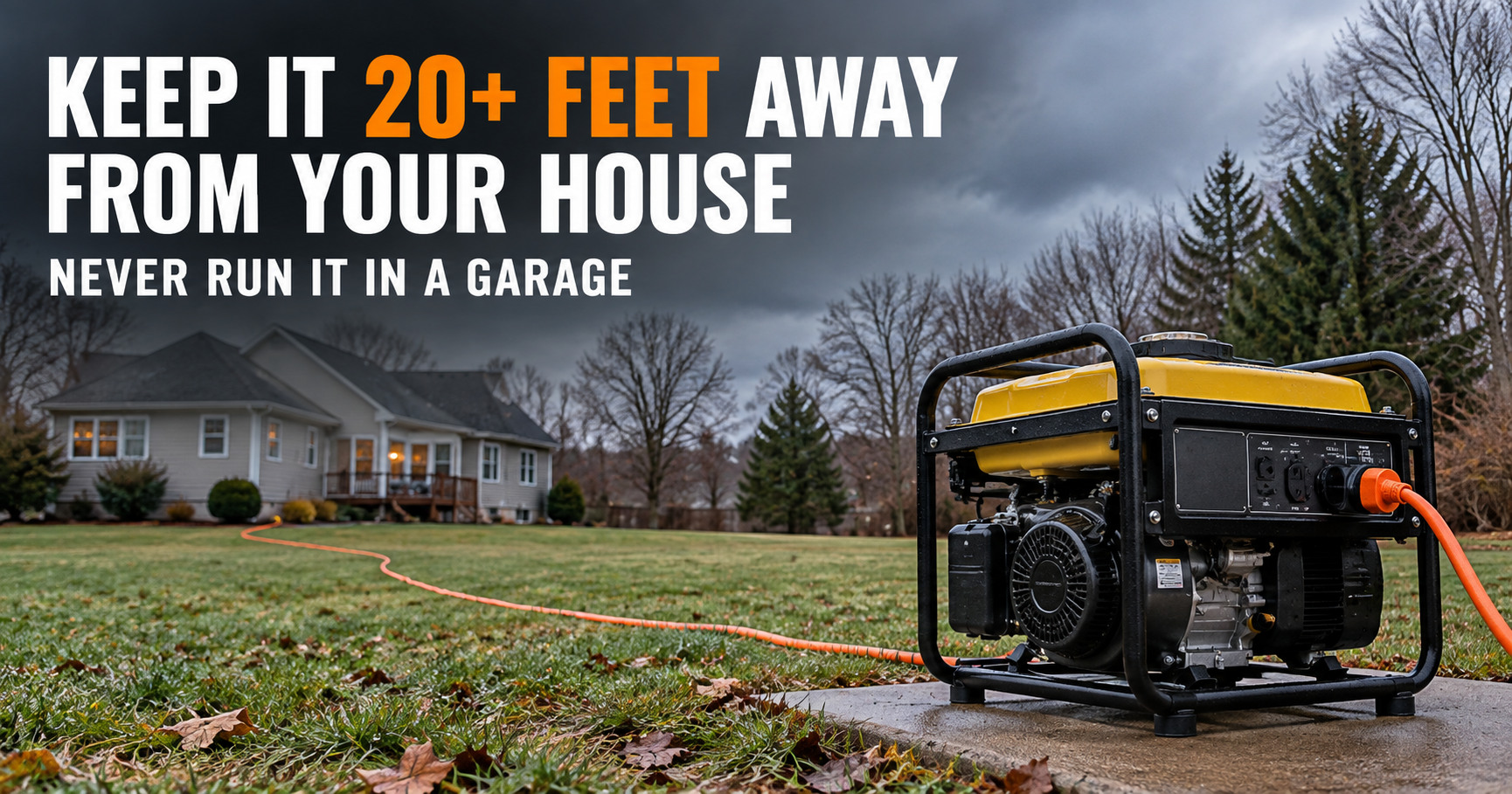
I’ve already covered how far I keep a generator from my house during an outage.
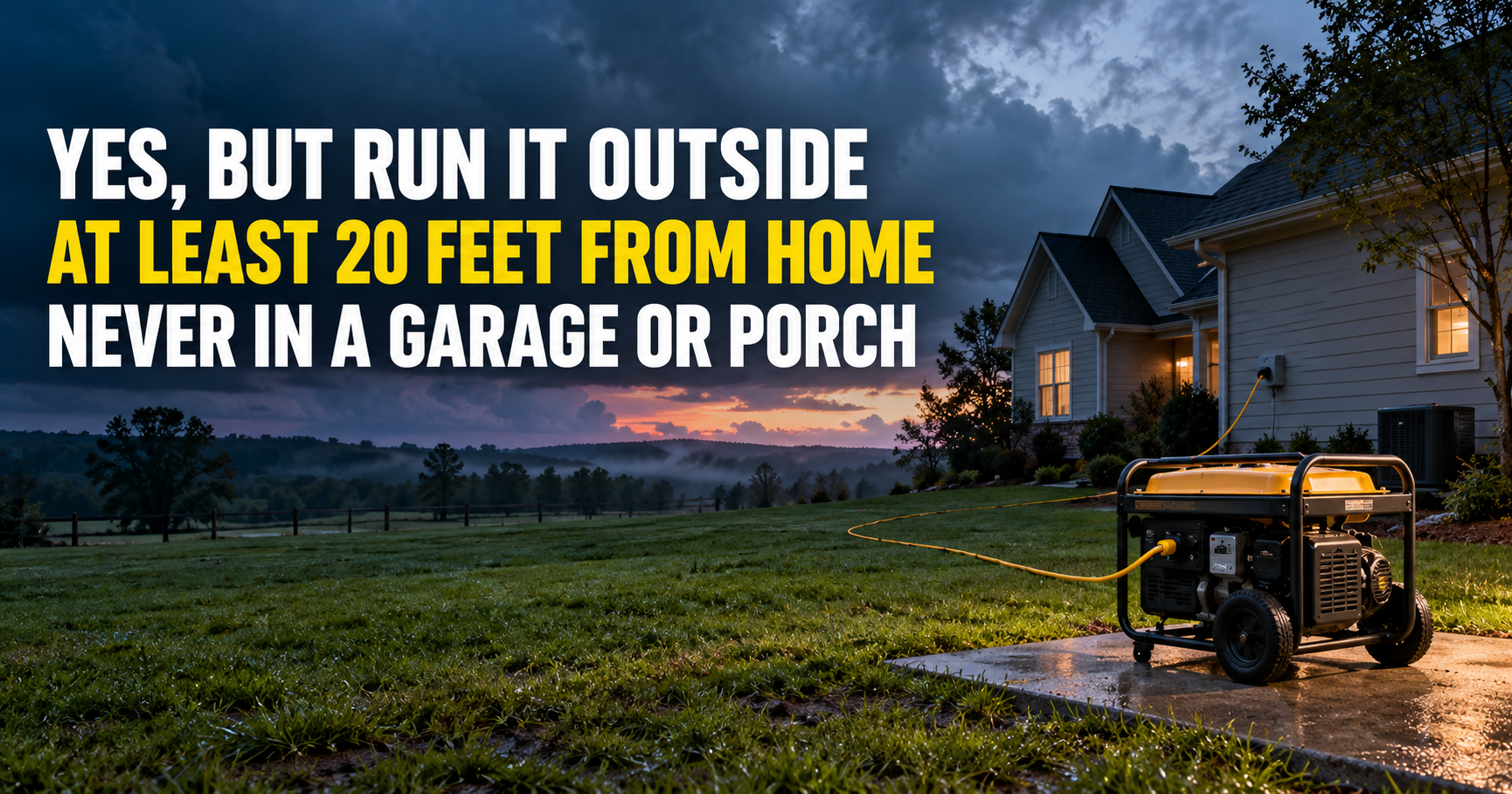
The generator stays safely outside and away from openings.
Then I buy the cord necessary to reach from that safe location to the equipment I’m powering.
If that means I need a longer, heavier cord, that’s what I use.
I don’t move a running generator beside a basement window because the cord from my garage happens to be 15 feet long.
I Don’t Daisy-Chain a Pile of Extension Cords
Three questionable extension cords connected end to end aren’t my idea of a reliable sump-pump system.
Every connection gives me another possible failure point.
And think about when I’m most likely to need this setup.
It’s probably raining.
The ground is wet.
Water may already be entering the basement.
I want as few questionable electrical connections as possible.
One properly sized cord is much more appealing to me than a chain of whatever cords I could find around the house.
I Keep Connections Dry and Off the Floor
Water and electricity are already uncomfortably close to each other in a sump-pump emergency.
I don’t make that worse.
I keep plugs, connections, power stations, and other electrical equipment somewhere dry.
I don’t leave a cord connection lying on the basement floor beside the sump pit.
I don’t handle energized plugs while standing in water.

If water has already reached electrical outlets or equipment, I treat that as an electrical hazard.
At that point, protecting my life matters more than protecting the basement.
I Never Backfeed the House Just to Reach the Sump Pump
If I want my generator connected to household circuits, I want proper equipment installed for that purpose.
I don’t make a homemade cord and feed generator electricity backward through a wall outlet.
That’s dangerous backfeeding.
If my sump pump simply plugs into an accessible receptacle and the pump and generator manufacturers allow an appropriate direct connection, that’s one situation.
Powering household wiring is another.
I don’t improvise that distinction during a storm.
I Test the Generator and Pump Together
This is the part that tells me whether all my planning actually works.
On a normal day, I put the generator in the location where I would really operate it.
I run the actual cord I plan to use.
I connect the sump pump correctly.
Then I safely raise the water level until the float activates.
I’m watching for several things.
Does the pump start immediately?
Does the generator noticeably struggle?
Does the pump complete a normal cycle?
Can it restart several times?
Does the extension cord or either plug become unusually warm?
Can I keep every connection dry?
Does the generator remain comfortably within its limits when my other planned loads are connected?
I would much rather discover a weakness during this test than during the storm.
A High-Water Alarm Is One of the Cheapest Layers I Can Add
Backup power is useful.
Early warning is useful too.
If the water rises above its normal level, I want something making noise before the basement floor gets wet.
A high-water alarm doesn’t pump anything.
That’s not its job.
Its job is to tell me that something in my normal system isn’t keeping up.
Maybe the primary pump failed.
Maybe the backup didn’t activate.
Maybe the discharge is blocked.
Maybe water is entering faster than either pump can handle.
Whatever the reason, I’d rather know when the water is still inside the pit.
A Remote Water Alarm Can Help When I’m Away
This becomes especially interesting if I travel or spend long days away from home.
A connected water sensor may be able to alert my phone when water reaches an abnormal level.
I like that as another layer.
I don’t depend entirely on it because the same storm causing the power outage could also affect internet or cellular service.
But if the alert works, it may buy me valuable time.
I Test the Float Switch Instead of Assuming It Works
The pump can be perfectly healthy while the float switch fails to tell it to turn on.
That’s why I test the actual activation system.
I safely add water to the pit.
I watch the float move.
I make sure the primary pump activates.
If I have a separate backup pump, I test that system according to its manufacturer’s instructions too.
I want to see water physically leaving the pit.
A battery indicator saying “ready” isn’t the same as proving the backup pump works.
I Test the Backup With the Primary Pump Out of the Picture
This matters.
If I add water to the pit and the primary pump immediately removes it, I haven’t really tested the backup.
The backup never had a chance to do anything.
I follow the backup system’s testing procedure so the secondary pump actually activates.
I want to know:
Does its float work?
Does the pump start?
Does it move enough water?
Does its alarm work?
Does the battery remain healthy during operation?
That’s a real test.
The Check Valve Can Quietly Waste My Battery
After the sump pump pushes water up the discharge line, I don’t want that water falling right back into the pit.
That’s what the check valve helps prevent.
If the valve fails, I may hear water rushing backward after the pump shuts off.
Then the pit fills again faster.
The pump starts again.
Then more water falls backward.
Now I’ve created unnecessary cycles.
During normal grid power, that’s hard on the pump.
During battery backup, those extra cycles are literally eating into my emergency runtime.
So the check valve is part of my backup-power plan even though it doesn’t contain a battery or plug into anything.
I Make Sure Water Is Actually Leaving the House
Hearing the sump pump run doesn’t automatically mean everything is okay.
I want to know where the discharge water is going.
A blocked discharge can stop the system from working properly.
A frozen discharge line can create trouble during winter.
A damaged pipe can dump water somewhere it shouldn’t.
And a discharge ending right beside the foundation can send water right back toward the basement.
That’s a terrible loop.
Pump water out.
Let it soak back toward the foundation.
Pump it out again.
During an outage, that wastes precious backup energy.
I Keep the Discharge Area Clear
Before storm season, I walk outside and look.
Is the discharge opening clear?
Has landscaping grown around it?
Did something damage the pipe?
Is the outlet positioned where water can move away from the house?
Could snow or ice block it?
These aren’t exciting preparedness tasks.
They’re exactly the kind that can make an expensive backup battery last much longer because the pump isn’t doing unnecessary work.
My Gutters Affect Sump-Pump Runtime Too
I don’t think of gutters as emergency-power equipment, but they absolutely affect how hard the sump pump has to work.
If hundreds of gallons of roof runoff are dumping beside my foundation, that water has to go somewhere.
Some of it may eventually become the sump pump’s problem.
So I keep gutters clear.
I make sure downspouts are connected.
I direct roof runoff away from the foundation where appropriate.
The best gallon of sump water is the gallon that never reaches the sump pit.
Grading Around the House Matters for the Same Reason
If the ground slopes toward my foundation, rainwater has an easy path toward the basement.
Backup pumps can compensate for drainage problems only so much.
I’d rather have gravity helping me.
This is where flood preparedness and power-outage preparedness overlap.
A bigger battery isn’t always the smartest fix.
Sometimes I need less water entering the system.
I Pay Attention When the Pump Suddenly Starts Running More Often
I like knowing what’s normal for my basement.
If the pump usually cycles once every 15 minutes during a heavy rain and suddenly starts cycling every three minutes under similar conditions, I pay attention.
Something changed.
Maybe the ground is unusually saturated.
Maybe a downspout failed.
Maybe the discharge is recirculating.
Maybe the check valve isn’t working.
Maybe drainage conditions changed.
The pump’s behavior gives me information.
That’s another reason timing cycles before an emergency is so useful.
Continuous Pumping Is a Completely Different Emergency
This is where battery-runtime estimates can fall apart.
Earlier, imagine I had an 800-watt pump operating six minutes per hour.
That was around 80 Wh of energy each hour before accounting for other losses.
Now imagine the same pump has to run continuously.
That’s approximately:
800 Wh every hour
A battery that looked enormous when the pump had a 10% duty cycle suddenly doesn’t look enormous at all.
If my pump is running continuously, I don’t just start calculating how many batteries I need.
I start asking why so much water is entering.
If the Pump Can’t Keep Up, Backup Power Isn’t the Main Problem
This is an important distinction.
A backup system can keep a capable pump running.
It can’t make an undersized pump magically move more water.
If water is rising even while the pump runs continuously, I have a pumping-capacity or drainage problem.
Maybe I need a larger pump.
Maybe I need a second pump.
Maybe the discharge is restricted.
Maybe water is entering the foundation at an extreme rate.
Whatever the cause, adding more battery runtime doesn’t fix a pump that can’t keep up with the inflow.
I Keep Important Things Off the Basement Floor Anyway
Even a good backup system can fail.
That’s why I don’t let flood protection stop at the sump pit.
If something would be destroyed by an inch or two of water, I try not to store it directly on the floor.
Family photos.
Important documents.
Electronics.
Emergency supplies.
Tools.
Cardboard boxes full of things I care about.
Shelving and appropriate storage containers give me another layer of protection.
I don’t want one failed float switch to destroy irreplaceable belongings.
I Keep the Battery and Power Station Elevated Too
The equipment protecting me from a flood shouldn’t become the first thing the flood destroys.
If I have a portable power station, battery charger, controller, or other electrical backup equipment, I keep it appropriately elevated and dry while following its installation requirements.
I plan around failure.
That might sound pessimistic.
I see it as realistic.
I Check Backup Batteries Before the Storm
A battery backup isn’t something I install and forget for ten years.
Batteries age.
Connections can corrode.
Chargers can fail.
Some battery types require maintenance.
Controllers can develop problems.
I follow the manufacturer’s inspection, testing, and replacement recommendations.
If the battery is reaching the end of its expected service life, I don’t wait for the next thunderstorm to perform the final test.
I Don’t Judge Battery Health Only by the Indicator Light
A charger saying the battery is full doesn’t necessarily tell me how much useful capacity an aging battery still has.
That’s why periodic system testing matters.
I want the backup pump to actually operate.
If the system provides battery-health testing, I use it according to the manufacturer’s instructions.
A battery can look fine sitting there and perform very differently under a real load.
My Generator Fuel Is Part of the Sump Plan
If the generator is my long-duration backup, fuel is now flood-prevention equipment too.
I think about how much I have.
How long the generator runs on a tank.
How heavily the sump pump is cycling.
What other loads I’m powering.
Whether nearby gas stations are likely to operate during a widespread outage.
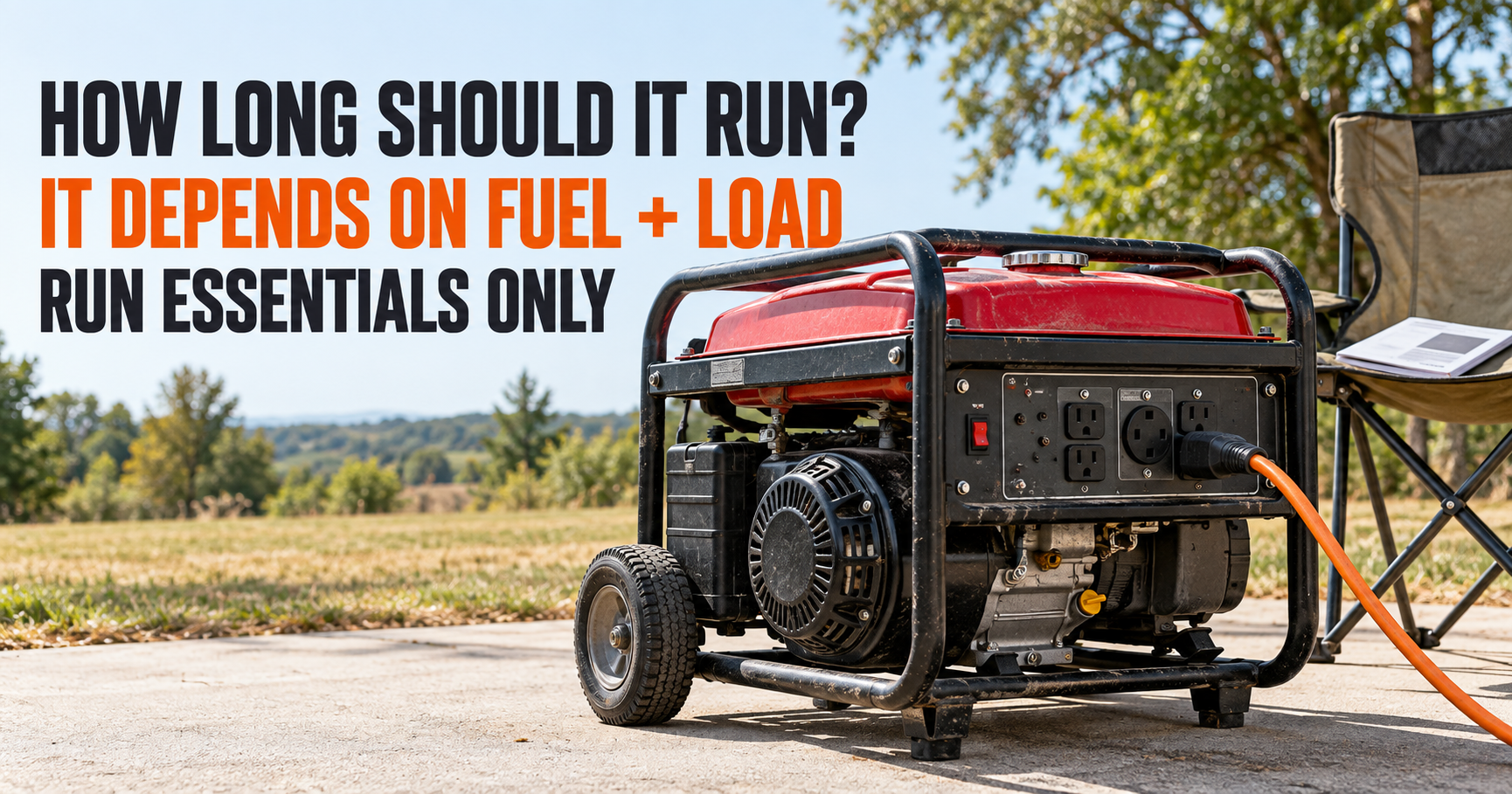
This is where the strategies from how I manage generator runtime during an outage become important.
But I make one major adjustment.
If the pit is filling rapidly, the sump pump gets priority.
I Don’t Shut Down the Pump Just to Follow a Generator Schedule
Maybe I normally cycle generator use to conserve fuel.
That’s fine when I’m managing a refrigerator.
A rising sump pit is different.
If the pump needs continuous or frequent electricity to keep water below the basement floor, that’s what I provide as long as I can do so safely.
My emergency plan serves the conditions.
The conditions don’t serve my schedule.
When the Generator Is Running, I Use Spare Capacity Carefully
If the generator has plenty of capacity beyond the sump pump’s needs, I may use some of it for other essential tasks.
Charging phones.
Charging power banks.
Running refrigeration.
Operating necessary lighting.
But I remain aware of motor startup surges.
The last thing I want is a refrigerator compressor starting at the wrong moment, overloading the generator, and knocking the sump pump offline while water is pouring into the pit.
The basement comes first.
If I Had to Choose One Backup, I Value Automatic Protection
If my basement can flood quickly and I can’t guarantee somebody will always be home, automatic backup has enormous value.
That’s why a dedicated battery-backup pump is so attractive.
It doesn’t have unlimited endurance.
But it responds immediately.
Then a generator can take over the endurance job once I’m available to operate it safely.
For me, those two systems complement each other extremely well.
My Ideal Sump-Pump Setup Has Three Layers
If basement flooding would be extremely expensive, this is the setup I like conceptually:
Layer 1: Reliable primary AC sump pump
That’s doing the everyday work.
Layer 2: Independent automatic battery-backup pump
That handles immediate grid failure and may also protect against some primary-pump failures.
Layer 3: Properly sized generator
That gives me a way to continue pumping through a much longer outage without depending entirely on finite battery capacity.
Then I add alarms and good drainage around all three.
That’s much stronger than depending on one pump and one power source.
The Setup I Choose Depends on How Much Failure Would Cost Me
This is how I decide whether all these layers are worth it.
An unfinished basement with a floor drain and almost nothing stored downstairs is one situation.
A finished basement containing bedrooms, furniture, electronics, HVAC equipment, and thousands of dollars worth of belongings is another.
If one night without a sump pump could cause $20,000 worth of damage, spending money on redundant pumping and power starts looking very different.
I match preparedness spending to the consequence of failure.
My Pre-Storm Sump Pump Check Takes Only a Few Minutes
When heavy rain is forecast, I don’t need to rebuild the entire system.
I check the things that matter.
I make sure the primary pump activates.
I check the backup system.
I verify the battery status.
I make sure the discharge is clear.
I check the high-water alarm.
I make sure the generator has fuel.
I make sure the generator cord is accessible.
I charge any portable battery system.
I check the weather forecast.
That’s a small amount of work compared with cleaning up a flooded basement.
If Water Reaches the Floor, My Priorities Change
Once standing water reaches electrical equipment, outlets, cords, appliances, or other energized systems, I’m no longer dealing with a simple sump-pump problem.
I’m dealing with a potential electrical hazard.
I don’t wade into water to unplug things.
I don’t reach for submerged electrical equipment.
I don’t start experimenting with the breaker panel while standing in water.
If I can’t safely address the situation, I stay out and get qualified help.
A basement can be repaired.
I don’t risk my life trying to save it.
The Best Backup Starts Before the Electricity Fails
I can’t control whether a thunderstorm knocks out the grid.
I can control whether that single failure automatically shuts down the only thing keeping groundwater out of my basement.
That’s the part I prepare for.
I learn how often my pump runs.
I learn how much power it actually needs.
I add automatic backup if the flooding risk justifies it.
I test the system.
I maintain the discharge.
I keep water away from the foundation.
And I have longer-duration power ready if the outage lasts beyond what the battery can handle.
That’s a much better plan than owning a generator in the garage and assuming I’ll figure everything else out when the basement starts filling.
About the Author
Caleb Mercer writes about blackout preparedness, backup power, sump pumps, generators, household flooding, and the systems that become critical when utilities fail. His work for the Survive Essentials Power Outages and Backup Power section focuses on practical layers of protection that families can test before severe weather turns a small equipment failure into expensive property damage.