The first mistake I’d avoid with a beginner foraging kit is turning it into another giant survival backpack.
I don’t need 40 pounds of gear just to gather blackberries, walnuts, edible greens, or mushrooms.
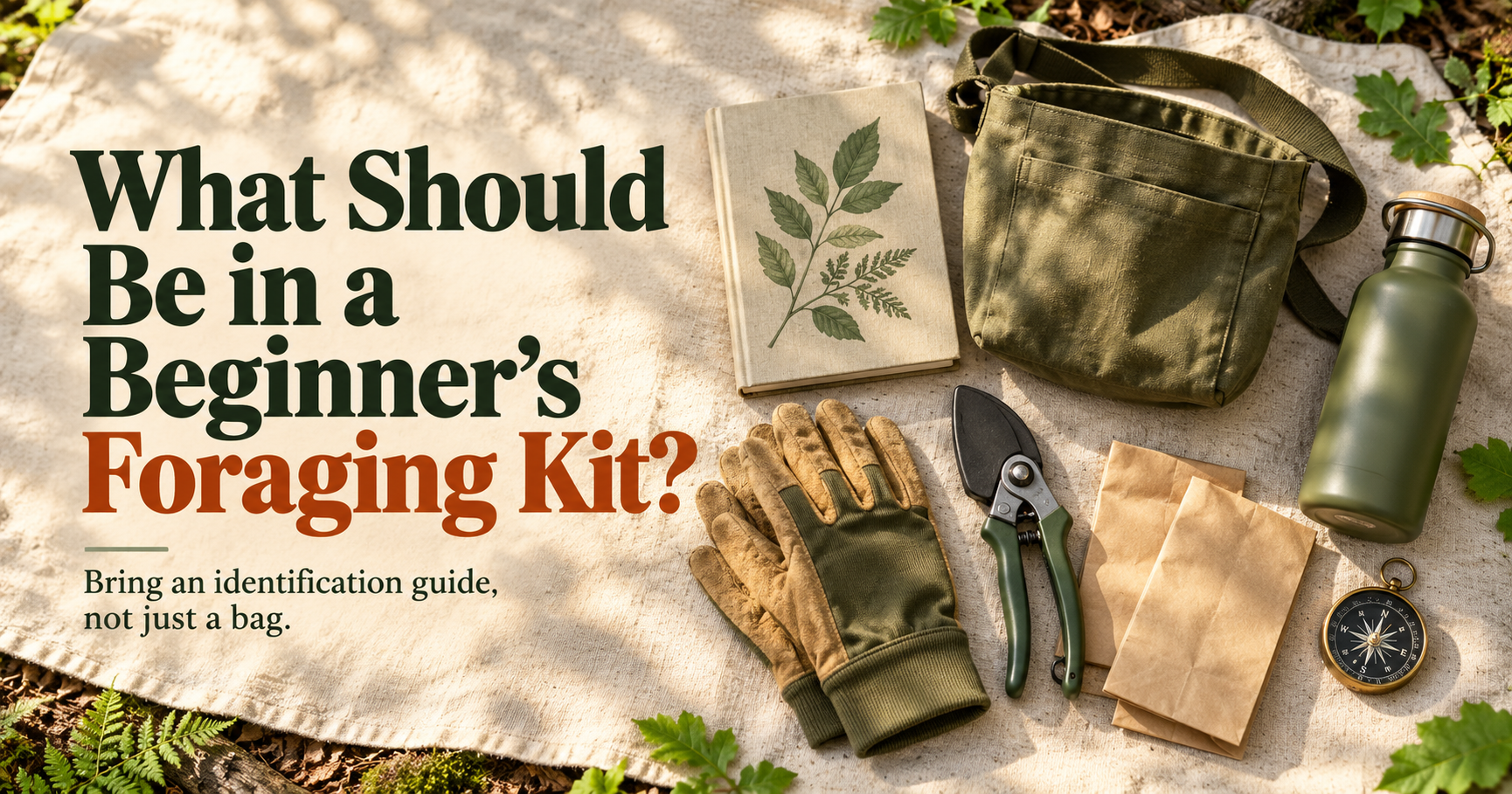
What I do want is enough equipment to collect things cleanly, identify what I found, stay oriented, deal with a small injury, and get back home without turning a simple foraging trip into a survival situation.
For most short trips, my kit is pretty simple.
A good bag or basket.
A small knife or scissors.
Gloves.
A field guide.
My phone.
Water.
A marker and a few bags or containers for keeping finds separated.
Basic first aid.
And enough navigation awareness that I don’t wander farther than I can comfortably get back from.
That’s really it.
The Foraging Bag Comes First
The container matters because different wild foods handle differently.
Mushrooms need airflow and protection from crushing.
Berries need support.
Nuts can handle a tougher canvas bag.
Tender greens shouldn’t get packed underneath several pounds of everything else.
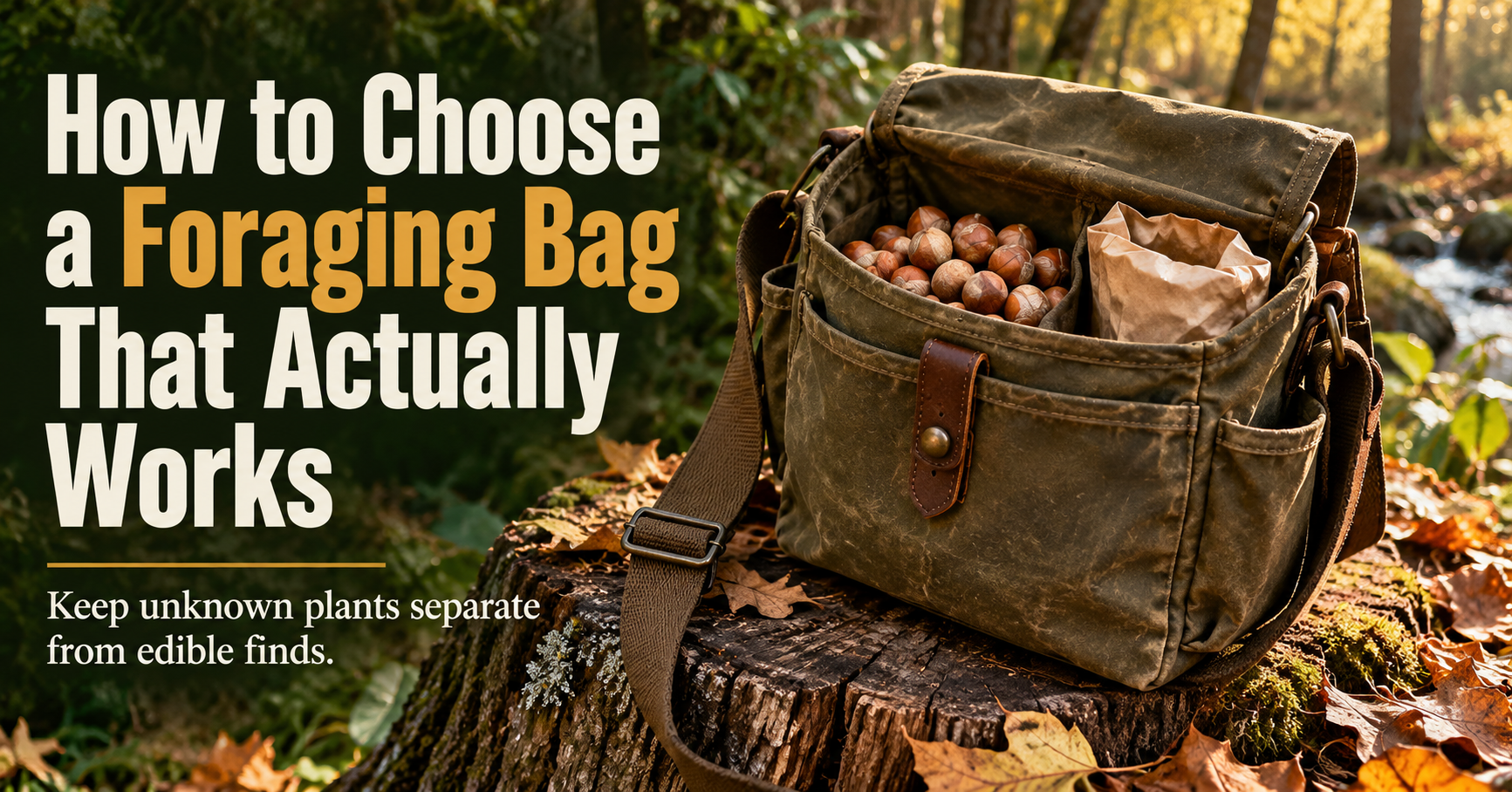
That’s why I already broke down how I choose a foraging bag based on what I’m actually gathering.
For a beginner who isn’t sure what they’ll collect most often, I’d rather use a medium-size bag and a few smaller containers inside it than one giant sack.
That gives me options without overcomplicating things.
I Like Having My Hands Free
This is one feature I appreciate quickly.
A waist bag, shoulder bag, basket with a comfortable handle, or small backpack can all work.
What I don’t love is carrying something awkward in one hand while trying to step over logs, move through brush, or climb a slope.
Foraging already puts my attention on the ground and surrounding plants.
I don’t want the container making movement harder.
A Small Knife or Scissors Is Enough for Most Beginners
I don’t need a huge survival knife hanging from my belt to collect mushrooms or cut herbs.
A small folding knife or sturdy pair of scissors can handle a lot of normal gathering tasks.
For mushrooms, a small blade can be useful for cutting the stem cleanly.
Scissors are handy for herbs and greens when I want to take only part of a plant.
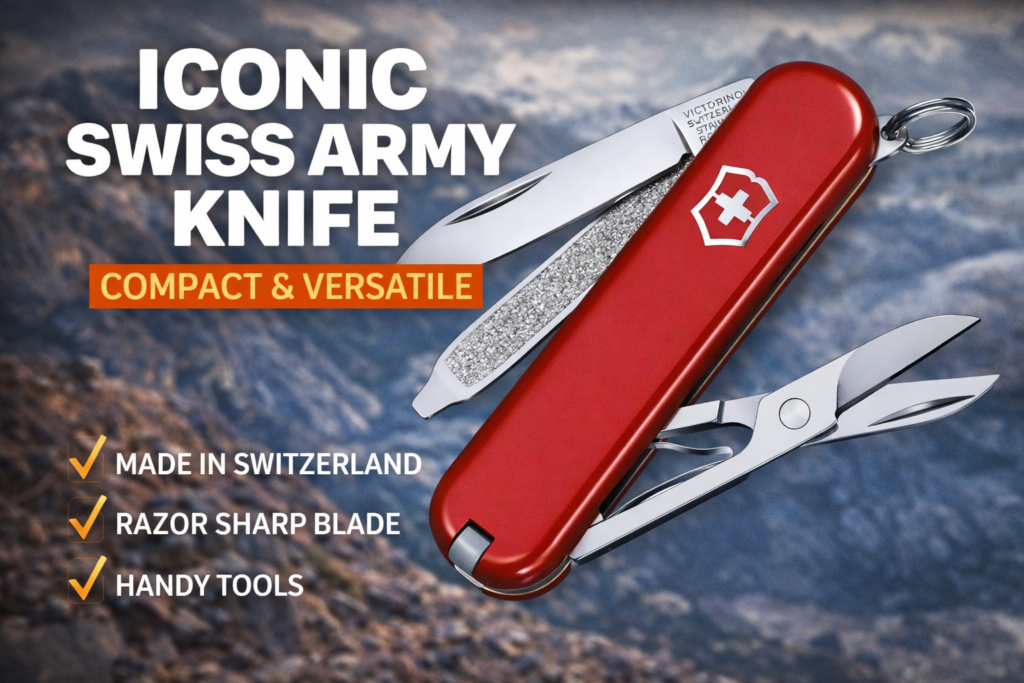
We’ve already covered the little pocket knife that ends up being useful for far more than its size suggests.
That’s closer to the kind of tool I’d carry on an ordinary foraging walk than a giant tactical blade.
The Small Pocket Knife We Already Use
If you want a simple lightweight knife rather than another large survival tool:
Check the Victorinox Classic SD Pocket Knife on Amazon
For gathering, I care more about usefulness and portability than looking tactical.
Gloves Are More Useful Than They Look
Gloves aren’t mandatory for every plant.
But I like keeping a lightweight pair available.
They can help when handling:
- Thorny berry canes
- Rough bark
- Nuts with messy hulls
- Plants I don’t want rubbing directly against my skin
- Debris on the forest floor
- Minor cleanup around what I’m gathering
They’re also useful when I unexpectedly need to move a branch or reach through thicker vegetation.
I don’t treat gloves as permission to grab plants I haven’t identified.
They’re protection, not identification equipment.

A Field Guide Belongs in the Kit
This is one place where I still like an actual reference book.
A phone is useful.
Apps can be useful.
Photos are useful.
But I don’t trust one image match to tell me something is safe to eat.
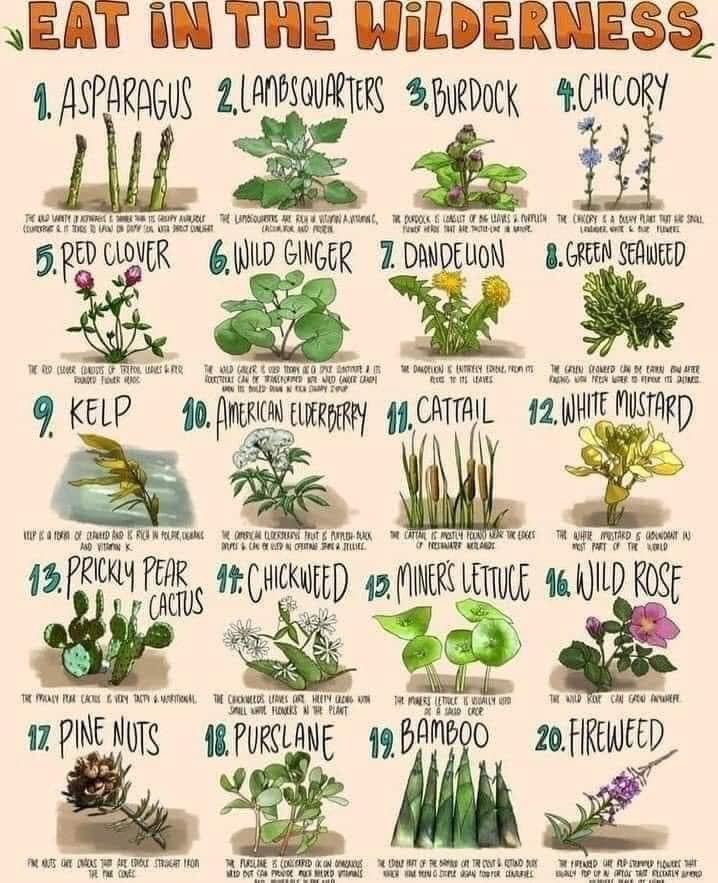
For mushrooms especially, proper identification can depend on details such as cap shape, gills, pores, stem features, where it’s growing, what it’s growing on, and the time of year. A broader reference to identifying edible wild foods can help put those identification details into a survival-food context.
A good regional guide gives me much more context.
If I’m serious about foraging, I’d rather own a guide written for the area where I actually live than one giant worldwide plant book.
I Don’t Use an App as My Final Edibility Test
Plant and mushroom identification apps are convenient.
I use them as one clue.
That’s different from saying:
“The app says 87% match, so I’m eating it.”
No chance.
If something is going into my mouth, I want positive identification from reliable information.
Mushrooms deserve even more caution because some toxic species can resemble edible ones closely enough to fool beginners.
If I can’t positively identify something, I leave it alone.
That’s not wasted food.
That’s good judgment.
I Carry a Phone Anyway
Even though I don’t let the phone make my final identification decision, it’s still one of the most useful things in my kit.
I can:
Take detailed photos.
Record where I found something.
Make notes.
Check maps.
Contact someone.
Use GPS.
Look up regulations when service is available.
Photograph identifying features before I disturb the plant.
That’s a lot of usefulness from something I’m already carrying.
I Download Maps Before I Lose Service
This is a habit I really like.
The place I’m foraging may not have good cell service.
That doesn’t necessarily mean my phone GPS is useless, but relying on live online mapping can become frustrating.
If I’m going somewhere unfamiliar, I save the area for offline use where my mapping app supports it.
I also pay attention to where I parked and which direction I’m traveling.
The smartest foraging tool may be the one that gets me back to the truck.
A Compass Is Cheap Backup
For a short walk on familiar property, I may never touch a compass.
I still like having one when I’m heading farther into unfamiliar woods.
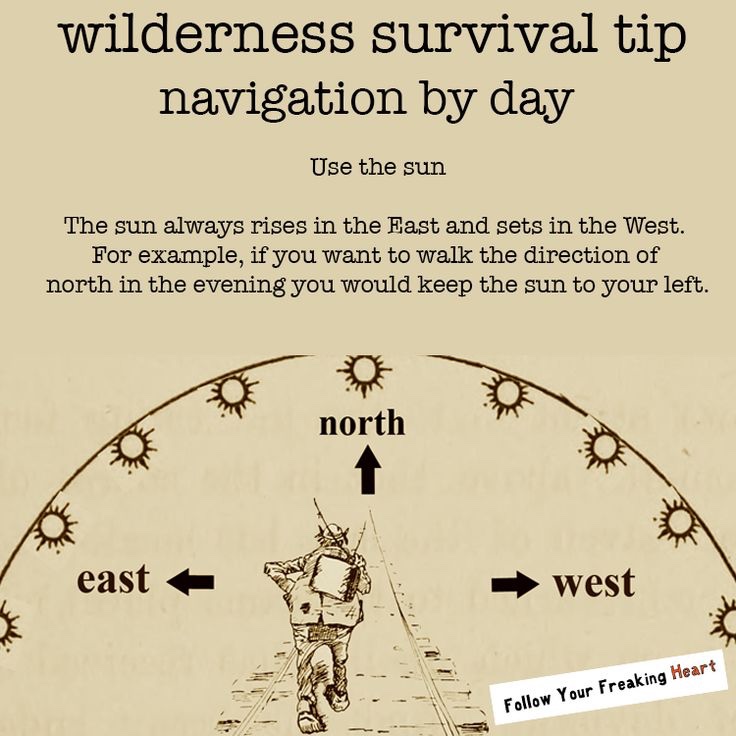
We’ve already got a broader survival navigation guide covering compass use and other navigation basics.
I don’t want to carry a compass I have no idea how to use.
That’s another tool worth practicing with before it’s needed.
Water Goes With Me Even on a Short Trip
Foraging can turn a planned 30-minute walk into two hours surprisingly fast.
You find one patch.
Then something interesting farther down the trail.
Then another area.
Suddenly you’re much farther from the vehicle than planned.
A bottle of water weighs very little compared with how annoying it is to realize you didn’t bring any.
This is especially important in warm weather.
I Carry a Few Small Paper Bags or Containers
One big bag isn’t enough when I’m collecting several different things.
I like smaller containers for separation.
That matters for quality.
It matters for identification.
And with mushrooms, it can matter for safety.
An unidentified mushroom doesn’t get tossed into the same container as mushrooms I’m confident are edible.
If I’m collecting something purely to identify later, I label it separately.
Waxed Paper Can Be Useful for Mushroom Specimens
For mushrooms I’m studying rather than eating, individual wrapping can help keep specimens separated.
That allows me to preserve identifying features instead of smashing several unknown mushrooms together into one damp pile.
A small notepad or marker makes this even more useful.
I can record where something was growing and what was nearby.
Those details can help with identification later.
I Carry a Marker
This is such a simple addition.
If I’m using several bags or containers, I can write:
Unknown mushroom
Blackberries
Possible oyster mushroom
Sample only, do not eat
That last one matters when several people are handling the harvest.
I don’t want someone reaching into the wrong container later and assuming everything I carried home was meant for dinner.
A Notebook Is Optional but Surprisingly Useful
My phone can handle notes.
A tiny notebook doesn’t need a signal or battery.
I can jot down:
Where I found something.
Date.

Weather.
Nearby tree species.
How much was growing there.
Whether the plant was flowering or fruiting.
For someone trying to learn seasonal patterns, those notes become surprisingly valuable after a year or two.
I Keep Basic First Aid With Me
A foraging trip doesn’t require my entire household trauma kit.
But I do want basic first aid available.
Small cuts.
Scrapes.
Blisters.
Thorns.
Minor falls.
Those are realistic outdoor problems.
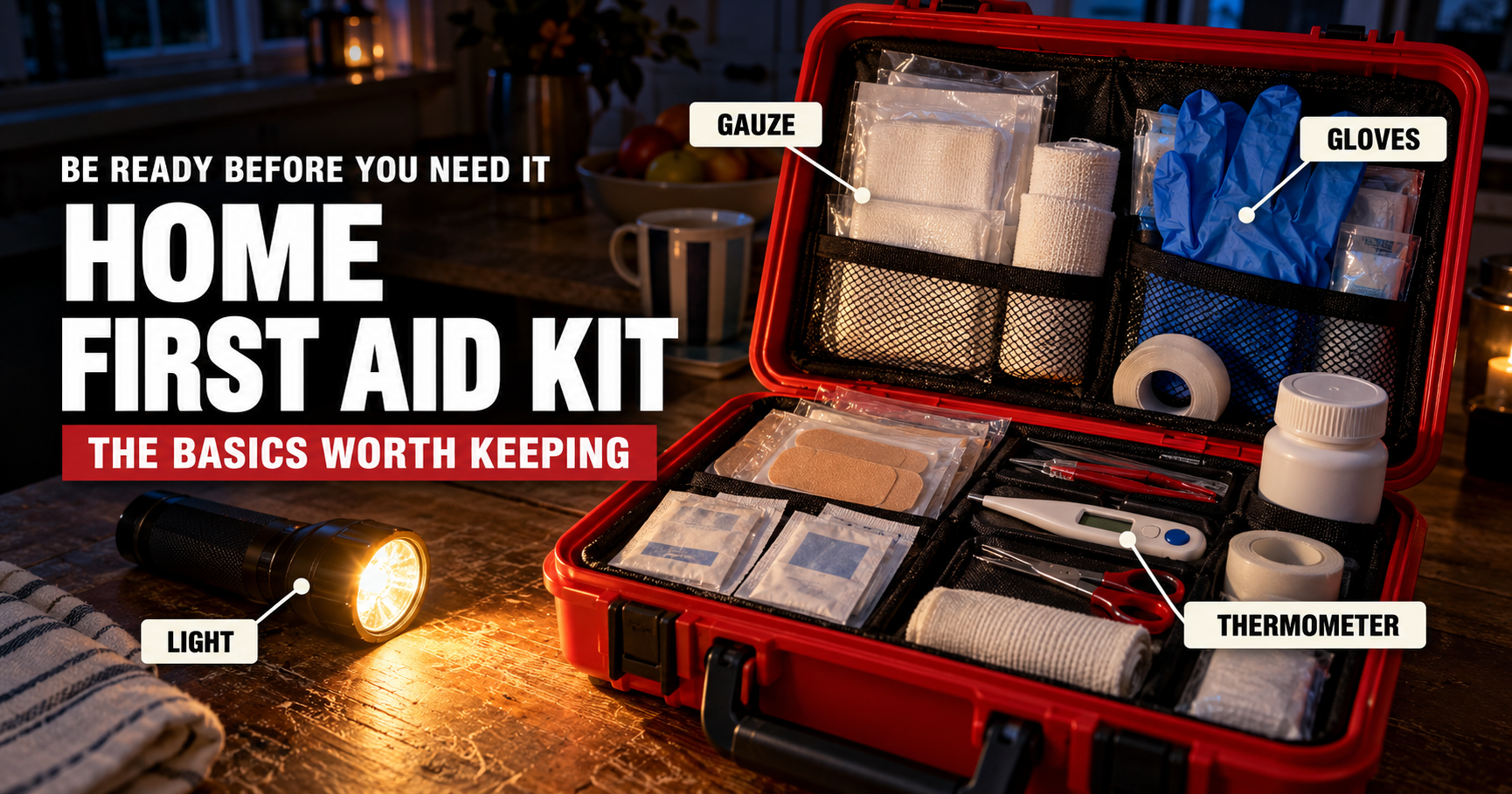
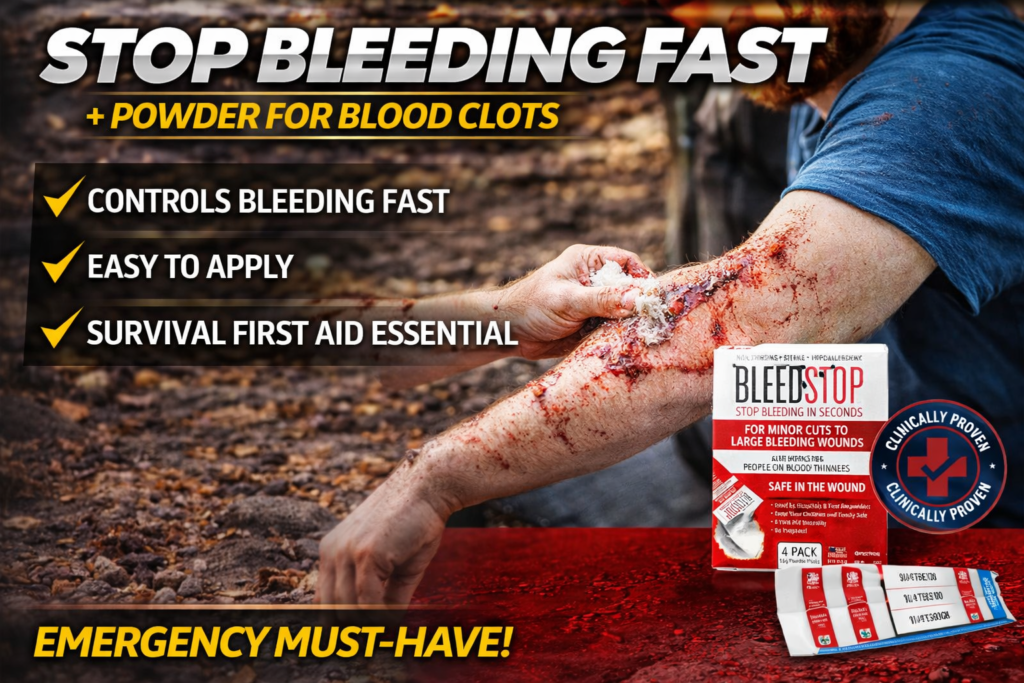
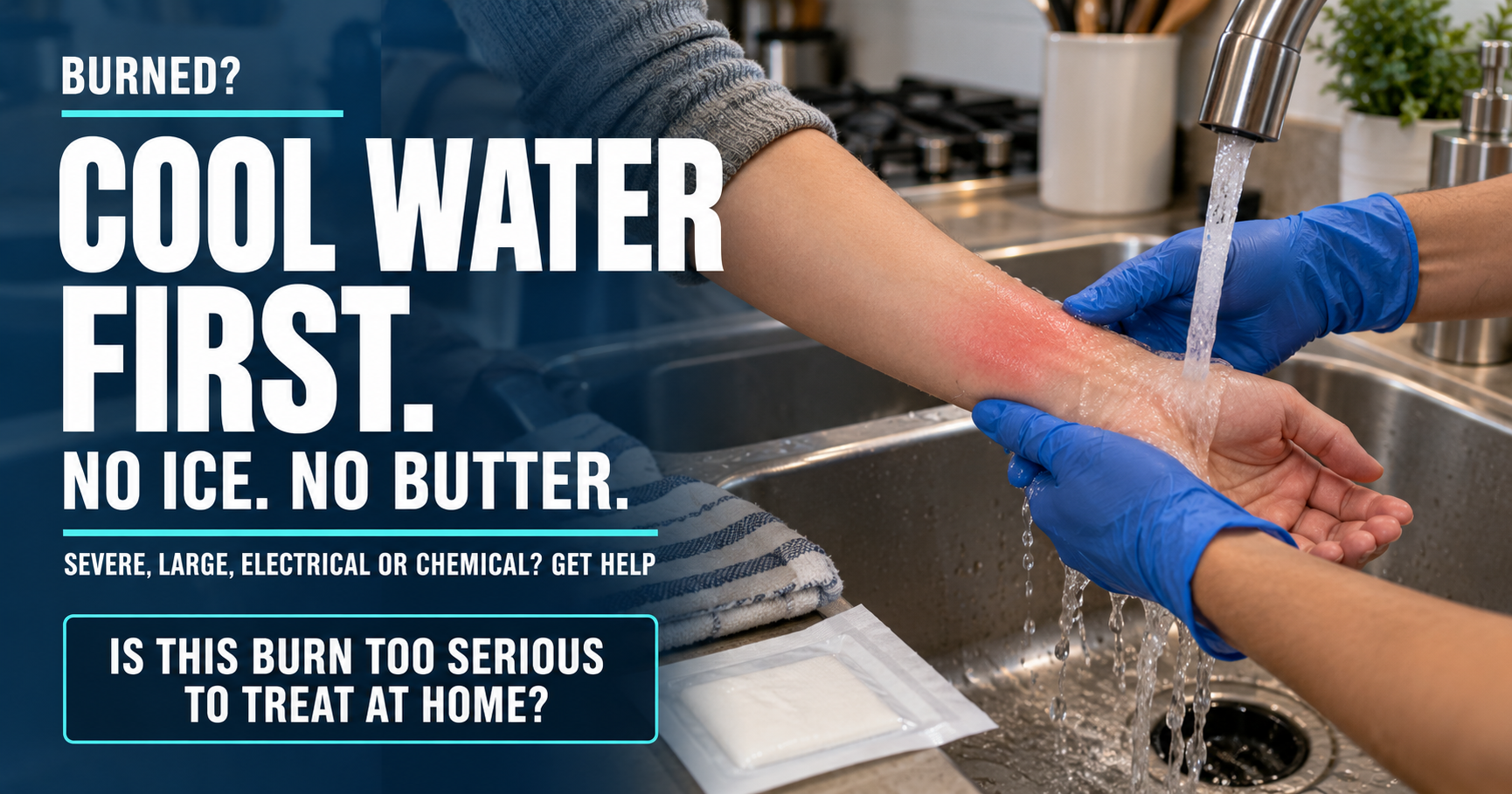
We’ve already built a much more complete home emergency first aid kit.
For a short foraging trip, I’d scale that down to a compact kit with supplies for ordinary minor injuries while still having a way to deal with something more serious until help arrives.
Good Shoes Matter More Than Another Gadget
If I’m walking uneven forest ground, decent footwear earns its place immediately.
Wet leaves.
Roots.
Loose rocks.
Mud.
Thorns.
Steep slopes.
I don’t need expensive expedition boots for every trip.
I do want shoes appropriate for the terrain.
A twisted ankle two miles from the truck can turn a pleasant afternoon into a much bigger problem.
Long Pants Can Save a Lot of Annoyance
This depends on where I’m going, but long pants are often worth it.
They help with:
Brush.
Ticks.
Thorns.
Poisonous plants.
Mosquitoes.
Scratches.
Again, I don’t need to dress like I’m crossing Alaska.
I just want my clothing to match the environment.
Tick Protection Belongs in the Plan
Foraging often means moving slowly through exactly the kind of vegetation where ticks are waiting.
I think about repellent, appropriate clothing, and checking myself afterward.
The bag isn’t the only equipment involved in gathering safely.
Sometimes what I wear matters more.
I Bring a Small Brush for Mushrooms
A little mushroom brush isn’t essential, but it’s convenient.
If I can remove loose dirt before putting mushrooms into the basket, I bring less mess home.
Some mushroom knives even include a small brush.
I don’t aggressively scrub or clean something in the woods if that could remove identifying features I still need.
Identification comes first.
Dinner comes later.
A Magnifying Glass Can Help With Identification
This is optional for beginners, but a small hand lens can be useful when examining plant or mushroom features.
Tiny hairs.
Gill details.
Surface texture.
Leaf characteristics.
Those details can matter.
If I enjoy identification as much as gathering, a small magnifier earns more value than another giant survival gadget.
I Don’t Carry a Shovel Unless I Actually Need One
This comes back to keeping the kit realistic.
If I’m gathering berries, a digging tool is pointless.
If I’m collecting certain specimens for identification or legally harvesting a root where that’s appropriate, a small digging tool may make sense.
The equipment should follow the task.
I don’t carry every possible tool on every trip.
A Backpack Can Carry the Stuff That Isn’t Food
This is where I separate the harvest from the gear.
Water.
First aid.
Extra layer.
Field guide.
Phone charger.
Rain shell.
Those things can stay in a small backpack while the foraging bag handles the actual harvest.
That keeps dirt, fruit juice, and mushrooms away from the rest of my equipment.
I Don’t Carry So Much Gear That Foraging Stops Being Fun
This is easy to do on a preparedness site.
We can turn a walk through the woods into a military operation if we’re not careful.
That’s not what I want.
For an ordinary beginner outing close to home, my kit might honestly be:
- Foraging bag or basket
- Small knife or scissors
- Gloves
- Field guide
- Phone
- Water
- Small first aid kit
- A couple separate containers
- Weather-appropriate clothing
That’s enough to learn a lot.
Everything else is optional based on the trip.
Identification Skill Is More Valuable Than Equipment
If I had $100 to spend on becoming a better forager, I wouldn’t necessarily spend all $100 on gear.

I’d rather put some of it toward a reputable field guide, local workshop, guided foray, or time learning from someone experienced. An Edible Wild Plants field guide can be one option for building identification practice before relying on a harvest.
The equipment helps me collect.
Knowledge tells me whether I should collect something in the first place.
That’s a much bigger difference.
I Check Collection Rules Before I Go
Foraging rules vary.
Private land requires permission.
Public land can have its own limits on what can be collected, how much, and whether gathering is permitted at all.
Some protected areas don’t allow removal of plants or other natural materials.
I check the actual location instead of assuming “public land” means free food.
I also leave protected or uncommon species alone.
I Don’t Gather From Places I Don’t Trust
Road shoulders aren’t where I want dinner coming from.
Neither are obviously sprayed rights-of-way, treated lawns, industrial sites, railroad edges, or places contaminated with waste.
Something can be perfectly edible as a species and still be growing somewhere I don’t want to harvest food.
Where it grows matters.
I Keep Unknown Finds Away From Food
This rule is simple.
If I’m not sure what it is, it doesn’t touch the things I intend to eat.
Different container.
Label it.
Study it later.
Especially with mushrooms, that habit removes unnecessary confusion.
My Beginner Foraging Kit Would Look Pretty Boring
That’s actually a compliment.
A good kit doesn’t need to look impressive.
It needs to make gathering safer and easier.
If I were walking out the door tomorrow, I’d take:
- A bag or basket matched to what I’m gathering
- A small knife or scissors
- Lightweight gloves
- Regional field guide
- Phone with offline map
- Compass if I’m going somewhere unfamiliar
- Water
- Compact first aid kit
- Separate bags or containers
- Marker or small notebook
- Weather-appropriate clothing
- Tick and insect protection when needed
That’s enough for most beginner trips.
The Best Foraging Kit Is One I Actually Use
Buying a pile of gear doesn’t make anyone a forager.
Going outside does.
Learning three plants really well is better than carrying a field guide containing 3,000 species and confidently identifying none of them.
Learning one mushroom species thoroughly is better than guessing at twenty.
That’s the approach I like.
Start close to home.
Carry simple equipment.
Learn what grows in your area.
Practice positive identification.
Keep good notes.
Use the right foraging bag for what you’re collecting.
Then gradually expand what you know.
By the time foraging ever becomes more than a hobby, the most useful thing in the kit won’t be the knife, compass, or bag.
It’ll be the experience you’ve already built using all of them.
About the Author
Evan Brooks writes about foraging, emergency food production, seed storage, gardening, and practical self-reliance for Survive Essentials. His work focuses on learning useful food-gathering skills before they’re needed, choosing simple equipment that actually earns its place, and building experience through regular practice rather than relying on gear alone.