I have weather apps on my phone.
I get emergency alerts.
I can pull up radar almost anytime I want.
So it would be easy to look at a NOAA weather radio and wonder why I need another device telling me about the weather.
For me, the answer is pretty simple.
I don’t want every way of receiving an emergency warning depending on my phone.
Phones are incredible emergency tools, but they still depend on battery power, cell service, network capacity, settings, and functioning communication infrastructure.
A dedicated NOAA weather alert radio gives me another warning system entirely. It is one part of the wider set of emergency communication options a household may want to compare.
And I’ve come to think there are actually two different weather radios worth considering.
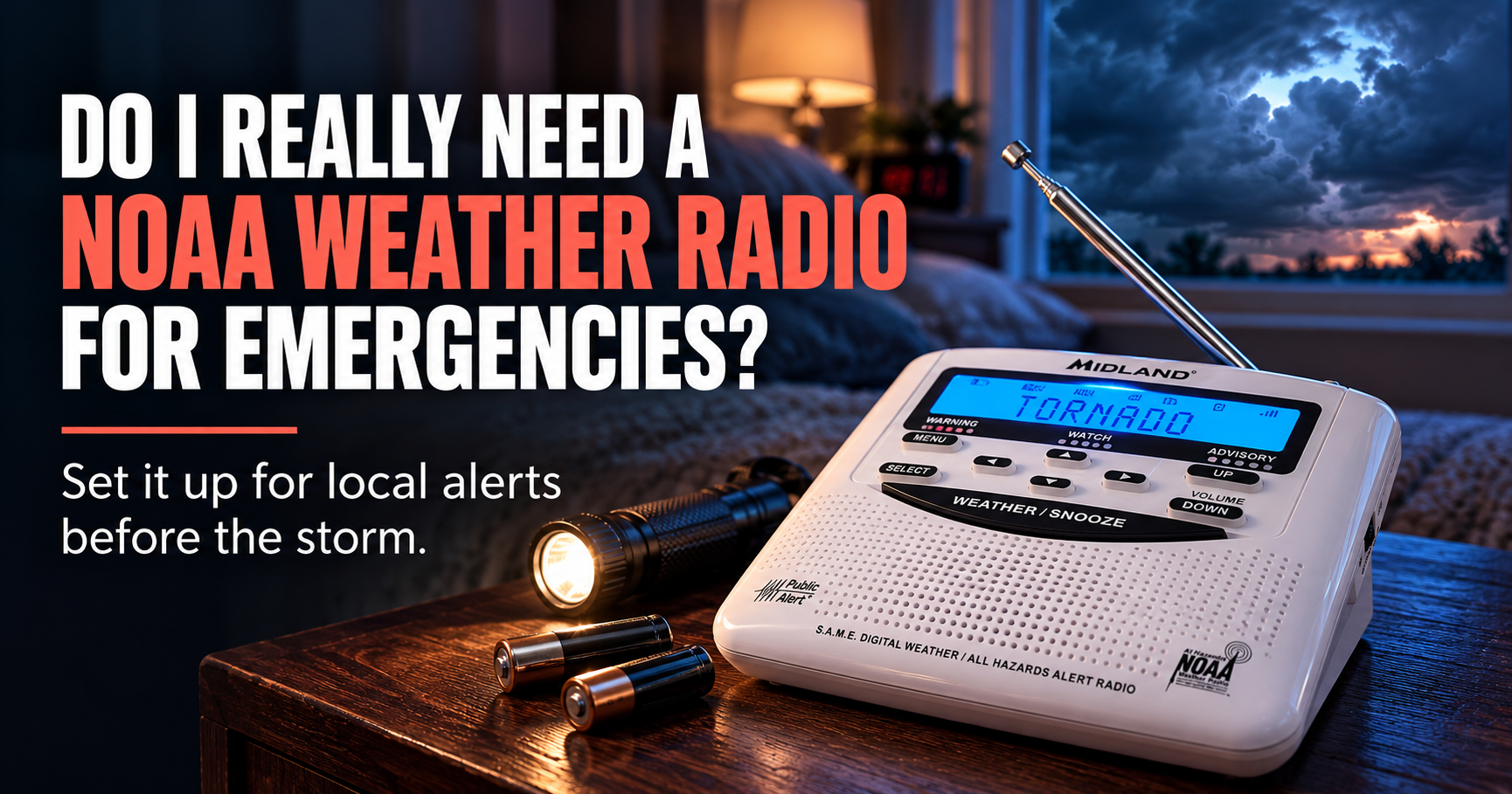
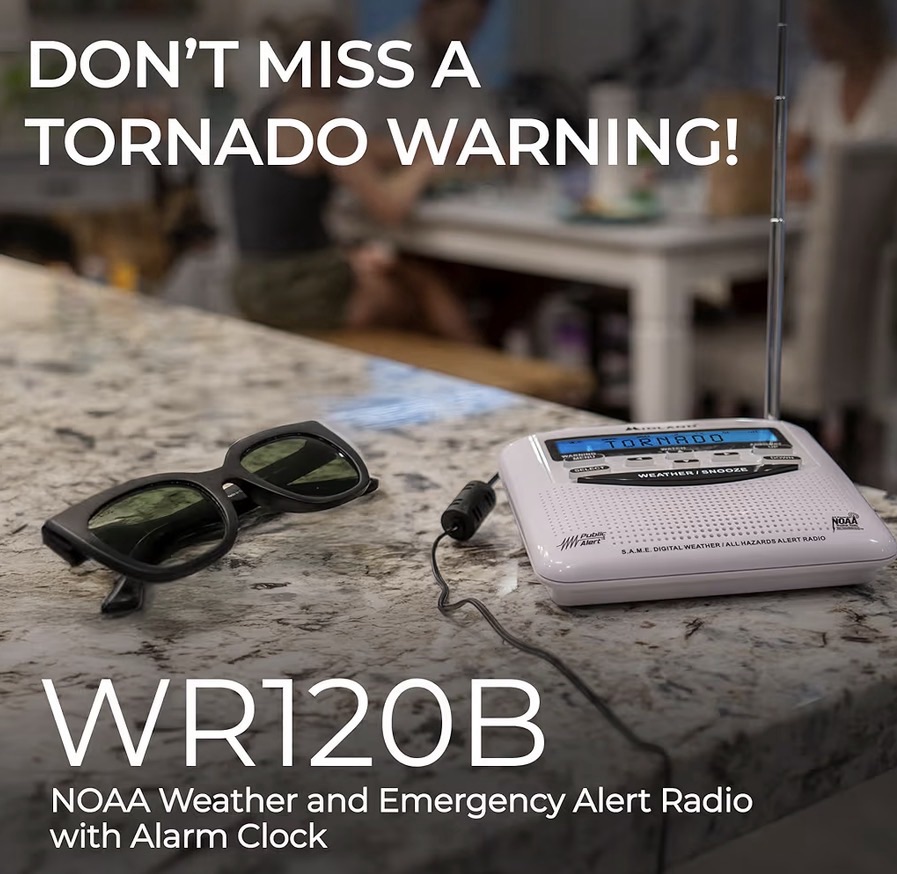
For the house, especially beside the bed, I like a dedicated alert radio such as the Midland WR120B.
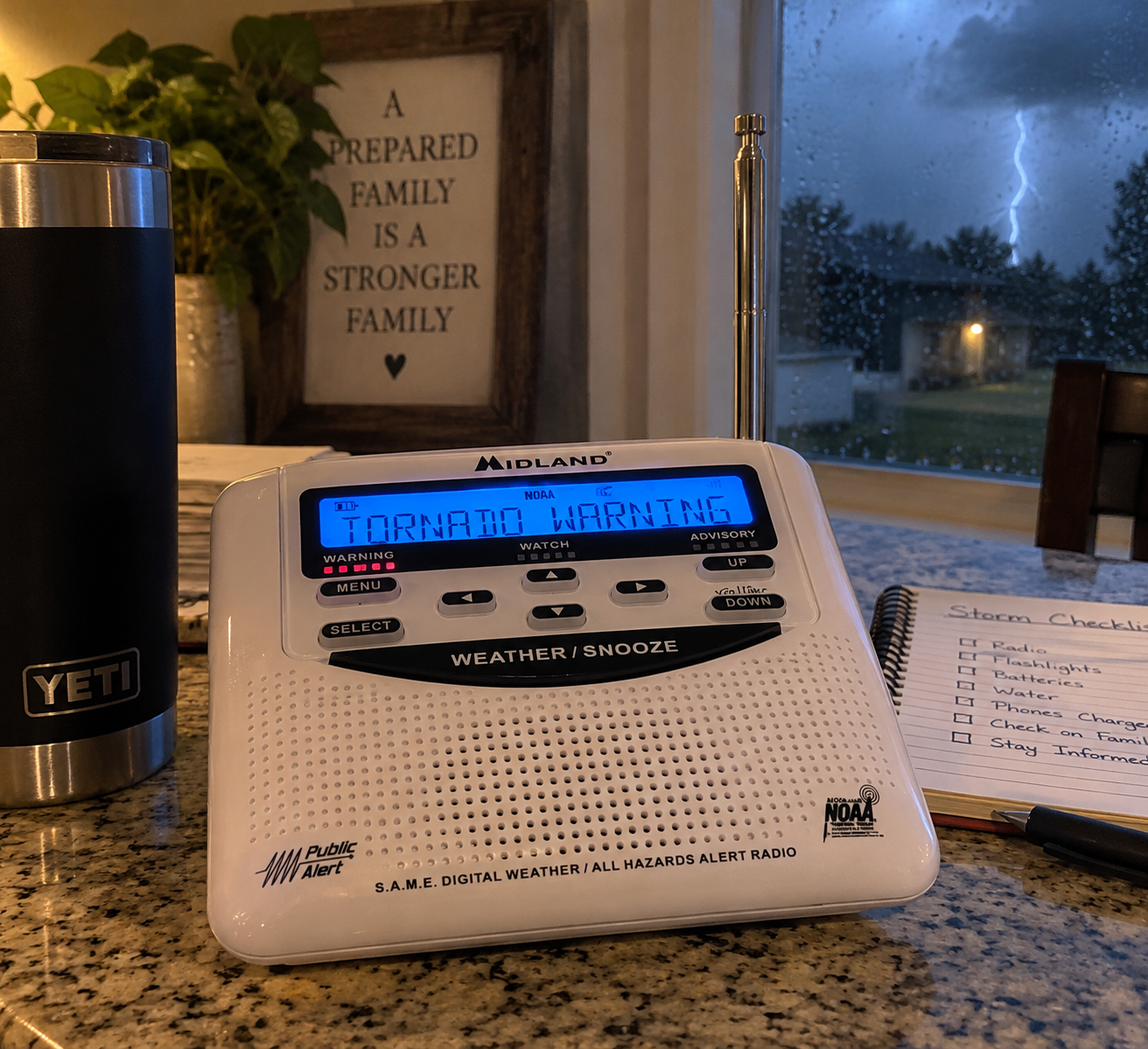
For blackouts, evacuation, camping, and portable emergency use, I like a rechargeable hand-crank radio.
They’re both weather radios, but they solve slightly different problems.
What Is a NOAA Weather Radio?
NOAA Weather Radio is a nationwide network that continuously broadcasts weather and emergency information from the National Weather Service.
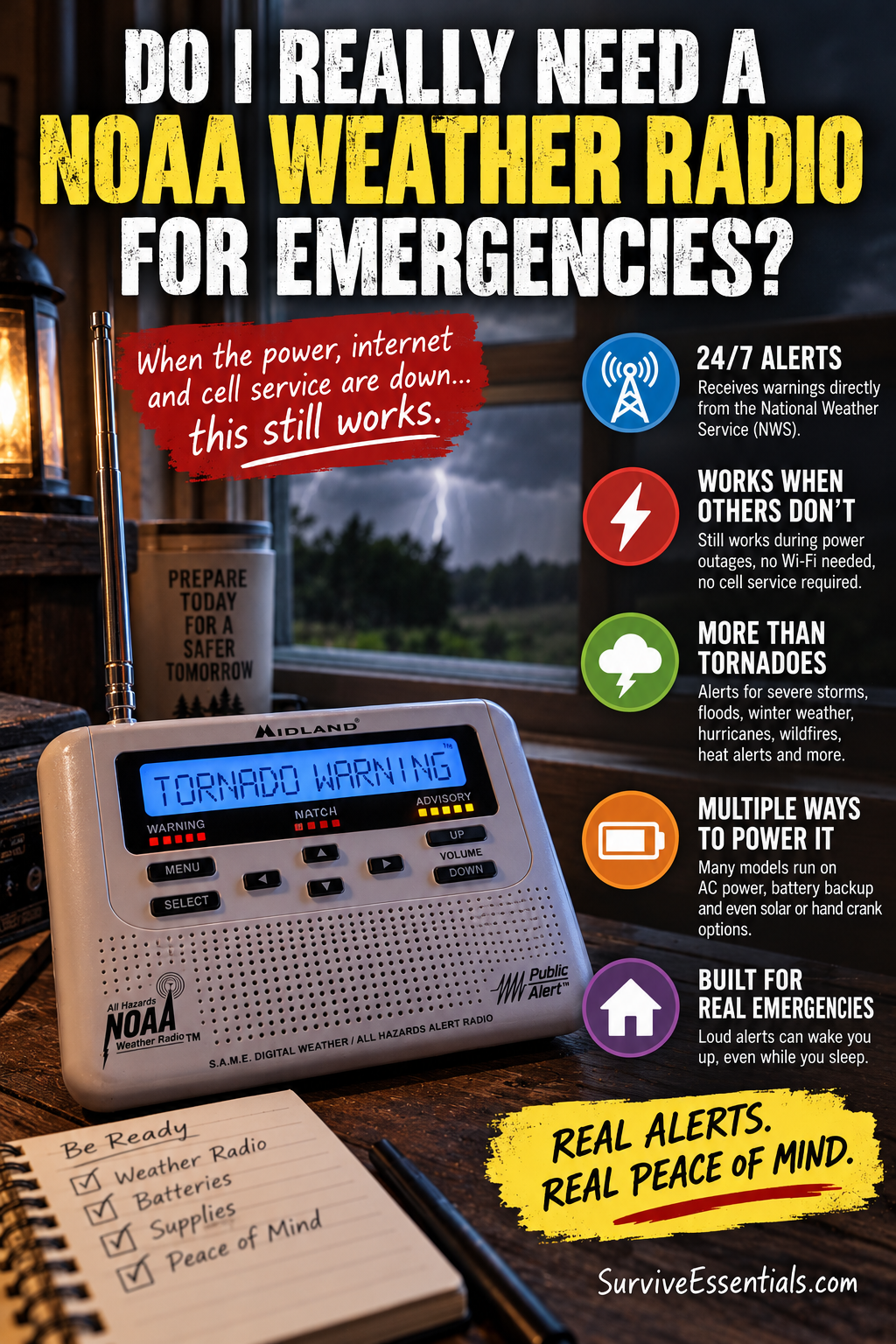
It isn’t just another AM/FM station.
Depending on what’s happening, broadcasts can include:
Weather forecasts.
Tornado warnings.
Severe thunderstorm warnings.
Flash flood warnings.
Winter weather alerts.
High-wind alerts.
Other hazard and emergency information.
For me, the important part is that I have another direct way of receiving those warnings when my normal technology isn’t cooperating.
My Phone Is Still My First Weather Tool
I’m not replacing my phone with a little radio.
If severe weather is developing, I’m probably looking at my phone.
Radar gives me information a basic weather radio can’t.
I can see where a storm is.
Which direction it’s moving.
Warning polygons.
Rainfall.
Lightning.
Forecast updates.
Local news.
Road conditions.
My phone is fantastic.
The NOAA radio is there because I don’t want the phone to be my only option.

The Midland WR120B Is the Home Radio I’d Want
For a dedicated household warning radio, the one I like for this setup is the Midland WR120B NOAA Emergency Weather Alert Radio.
Check the Midland WR120B NOAA Weather Alert Radio on Amazon
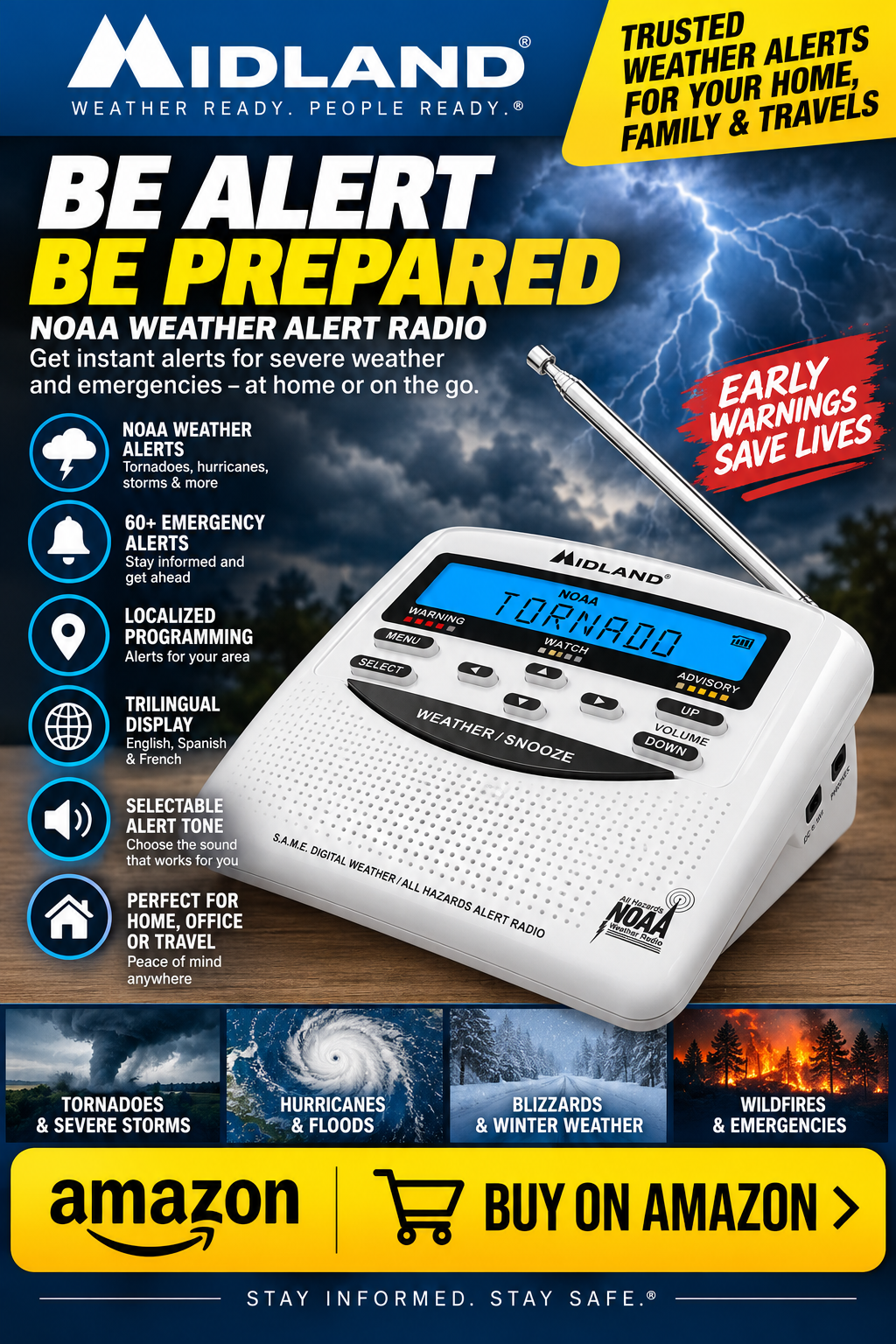
This isn’t the type of radio I’m buying primarily because it has a flashlight, giant battery, or survival gadgets attached to it.
Its main job is much simpler:
Sit in my house and alert me when an important warning is issued for my area.
That’s exactly what I want from a bedside weather radio.
Localized Alerts Are the Big Advantage
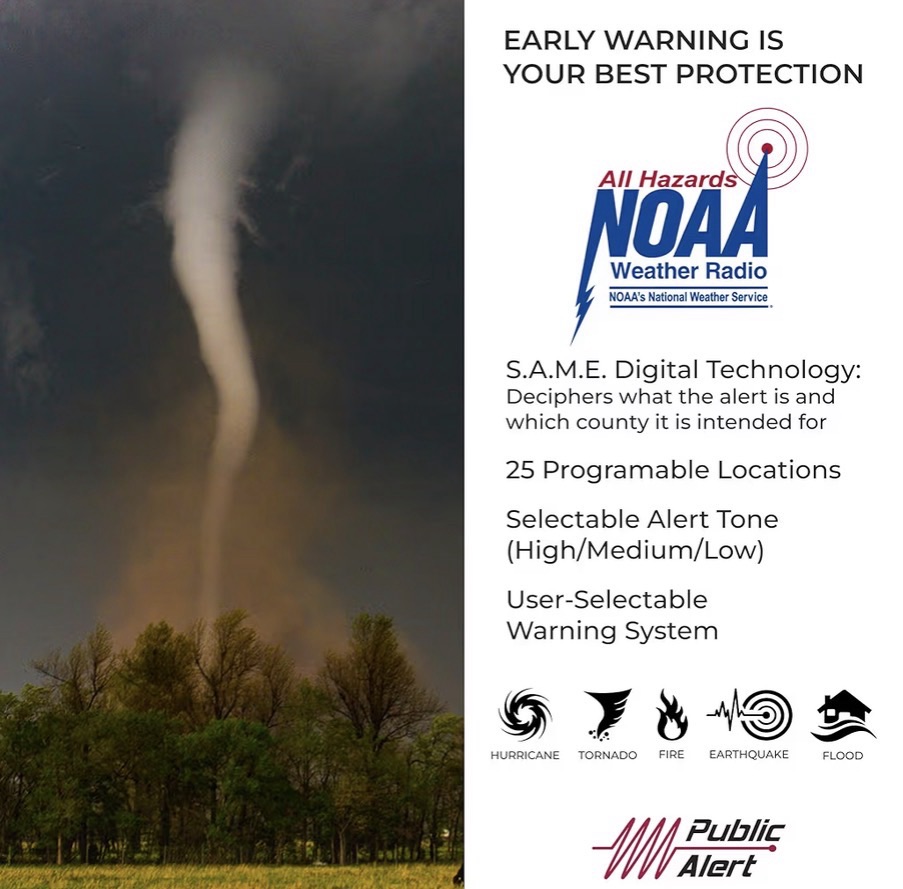
One of the best features on the Midland WR120B is SAME programming.
SAME stands for Specific Area Message Encoding.
Instead of treating every warning the NOAA transmitter broadcasts as equally important to me, a SAME-capable radio can be programmed for specific geographic areas.
For most people, that’s based on county codes.
That means I can focus the radio on where I actually live.
Why SAME Matters So Much at Night
Imagine a NOAA transmitter covers several counties.
Without localized programming, I may hear alerts for things happening well outside my area.
After enough unnecessary alarms, there’s a real temptation to stop paying attention.
I don’t want that.
If a weather radio is sitting beside my bed, I want it waking me because something important is happening where I live.
That’s why SAME is one of the first features I’d look for in a dedicated household alert radio.
I Could Program More Than One Area
There’s another useful side to localized alerts.
Maybe I live in one county but:
Work in another.
Have kids attending school somewhere else.
Have parents nearby in another county.
Own property elsewhere.
Depending on the setup, I may want alerts covering more than just my home county.
I wouldn’t program half the state just because I can.
I’d choose the areas that actually matter to my family.
Nighttime Tornadoes Are Where This Really Makes Sense
This is probably the scenario that sells me most on keeping a dedicated weather alert radio.
During the afternoon, I’m awake.
I probably know storms are coming.
I may already have radar open.
At 2:30 in the morning, everyone may be asleep.
The television is off.
Nobody is watching radar.
My phone might be charging across the room.
That’s when I want something whose entire job is getting my attention if a dangerous warning is issued.
Outdoor Sirens Aren’t My Only Warning System
Tornado sirens are useful.
I still don’t depend on them as the only way I’ll know something is happening.
They’re generally designed primarily to warn people outdoors.
Whether I hear one clearly from inside my house depends on:
Distance.
Wind.
Rain.
House construction.
Fans.
Air conditioning.
Televisions.
Where I’m sleeping.
If severe weather is dangerous enough to warrant a warning, I want several ways of hearing about it.

Phone Alerts Aren’t My Only Warning System Either
Phones can fail in completely ordinary ways.
Battery dies.
Phone is damaged.
Notification settings get changed.
Cell service goes down.
Network is congested.
Phone is somewhere I can’t hear it.
None of those scenarios requires some massive collapse.
That’s why redundancy matters.
What I Like About the Midland WR120B
For its role as a home weather alert radio, it has the features I’d actually want.
Localized SAME programming.
NOAA weather channels.
Emergency alerts.
Selectable alert behavior.
Battery backup.
Alarm-clock functionality.
A trilingual display.
It’s a dedicated warning device instead of a survival gadget trying to do twenty unrelated jobs.
See the Midland WR120B on Amazon
For something sitting beside my bed, I like that simplicity.
The Alert Modes Are Useful
The Midland lets me choose how alerts are presented.
That can include audible alert modes as well as display-based behavior.
For bedroom use, I want sound.
The entire point is waking me up.
A silent display alert isn’t doing me much good at 3:00 in the morning.
In another setting, though, having options can be helpful.
It Can Handle Dozens of Different Emergency Alerts
This isn’t only a tornado-warning radio.
NOAA Weather Radio carries many different alert types.
Depending on what’s issued in the area, that can include severe weather and other emergency information.
That gives the radio usefulness throughout the year.
Spring thunderstorms.
Summer flash flooding.
Winter storms.
High winds.
Other emergencies.
I don’t want emergency equipment that’s useful for only one very specific scenario if I can avoid it.
Battery Backup Is One of the Features I Care About Most
A weather radio would be pretty disappointing if it stopped working whenever the electricity went out.
Power outages and severe weather frequently go together.
The Midland WR120B can use AA batteries as backup power.
That’s exactly what I want.
The unit can remain plugged in during normal life, while batteries give it another way to keep working if household power disappears.
I Would Actually Check Those Backup Batteries
This is the boring part of preparedness that matters.
Batteries can die.
They can leak.
They can sit forgotten for years.
So when I’m checking smoke detectors, flashlights, emergency radios, and other household gear, I’d include the Midland’s backup batteries.
I don’t want to discover they’re dead during an actual outage.
The Alarm Clock Feature Makes More Sense Than I Expected
An alarm clock doesn’t sound like emergency equipment.
But I actually like the idea.
If the radio sits beside my bed and serves an everyday purpose, I know where it is.
I see it.
It’s plugged in.
It doesn’t disappear into a tote in the basement that nobody opens for four years.
Emergency equipment that gets incorporated into normal life tends to stay more familiar.
That’s useful.
Why I Still Want a Second Portable Weather Radio
The Midland is the one I want at home.
But it’s not the only radio I’d own.
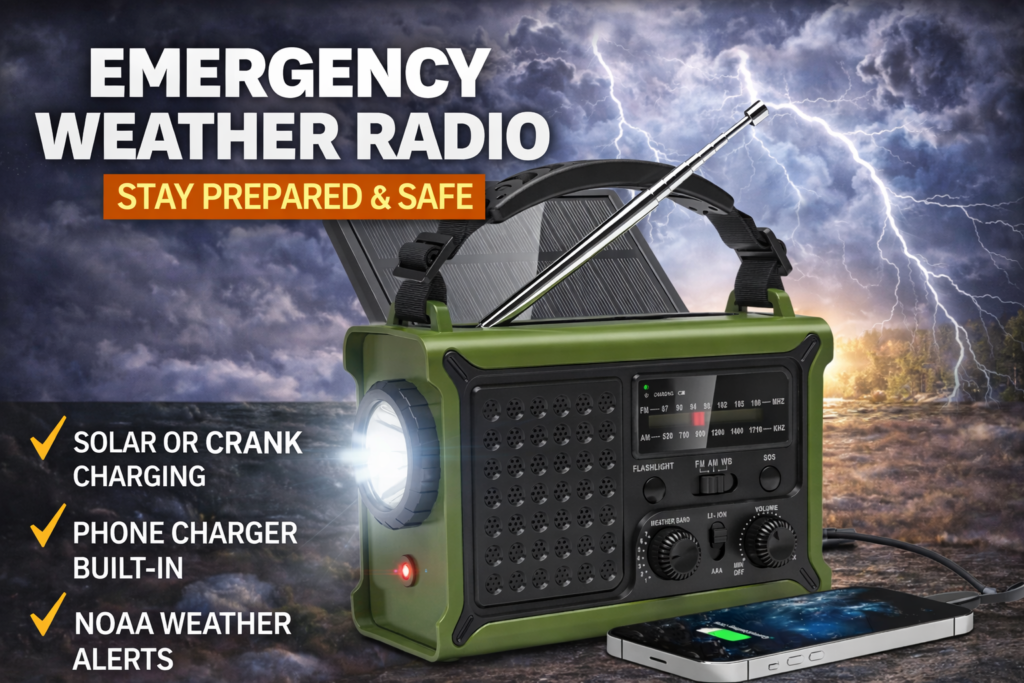
If the power has been out for an extended period or I need to leave home, I want something portable with several backup power options.
That’s where this one comes in:
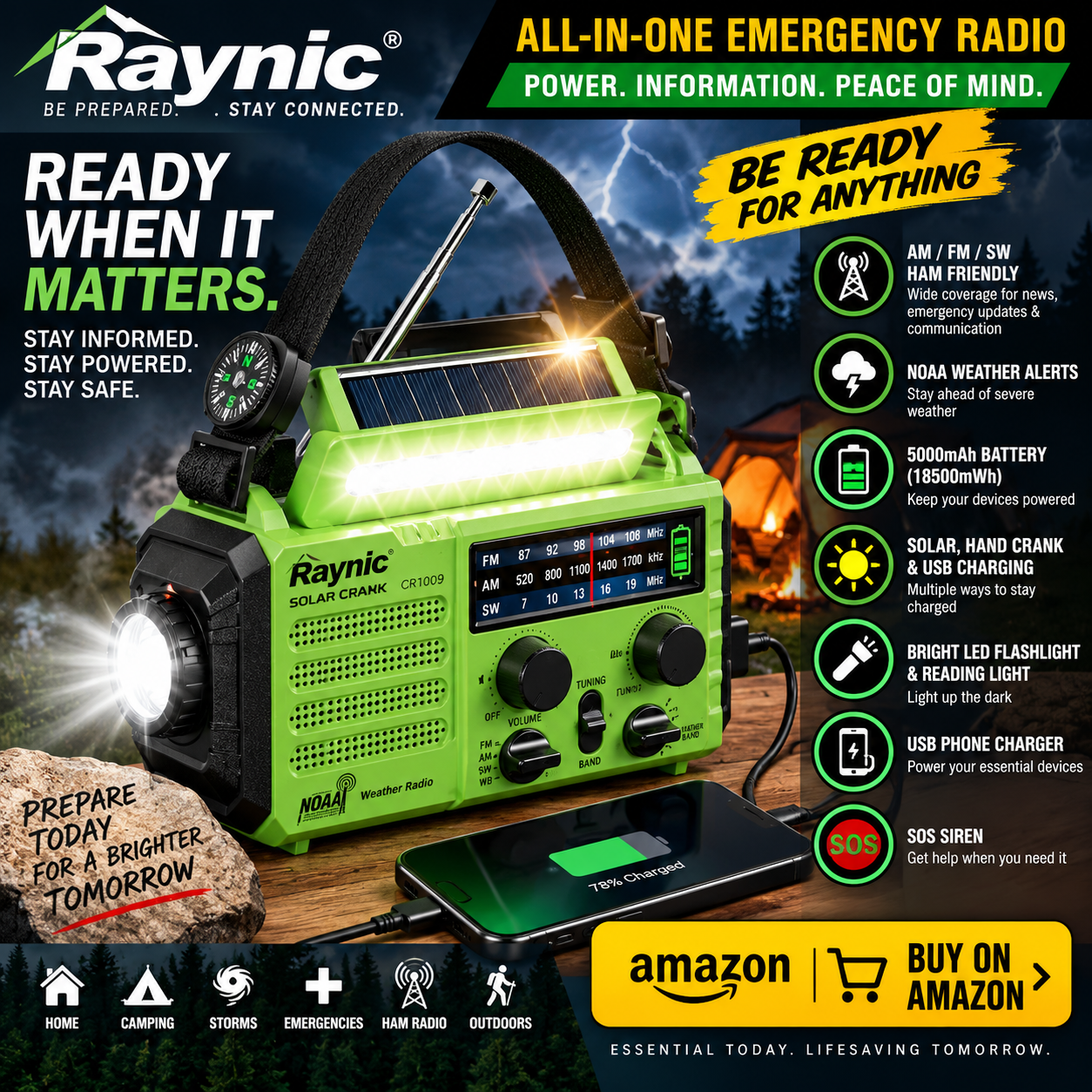
5000mAh Solar Hand Crank Emergency Weather Radio on Amazon
It gives me:
NOAA reception.
AM/FM/SW radio.
Rechargeable battery power.
Hand-crank charging.
Solar backup charging.
A flashlight.
SOS siren.
Emergency phone charging.
That makes much more sense inside an emergency kit.
The Two Radios Have Different Jobs
This is how I’d divide them.
Midland WR120B
Lives at home.
Stays plugged in.
Provides localized NOAA alerts.
Can wake me during overnight severe weather.
Uses battery backup during outages.
Portable Hand-Crank Radio
Lives with emergency supplies.
Can travel with us.
Works during extended outages.
Provides several charging options.
Includes lighting and emergency charging features.
That’s why I don’t think buying one necessarily makes the other pointless.
Which One Would I Buy First?
If I live somewhere where severe storms, tornadoes, flooding, winter weather, or other weather hazards are a real concern, I’d probably start with the Midland WR120B for the house.
Automatic localized warnings are incredibly useful.
Then I’d add the portable radio when building out the broader emergency kit.
If someone camps constantly or needs a radio primarily for evacuation and outdoor use, they might reverse that order.
The important thing is understanding what job each radio is supposed to perform.

I Would Program the Midland Immediately
I wouldn’t buy it and leave it sitting in the box.
I’d set it up.
Correct time.
Correct location.
Correct NOAA channel.
Correct SAME codes.
Preferred alert behavior.
Then I’d test reception.
This is one of those preparedness items where ten minutes of setup can dramatically change how useful it becomes.
I Would Test It Where I Plan to Sleep
Reception can vary around a house.
So if this is a bedside alert radio, that’s where I test it.
Not in the driveway.
Not in the kitchen if the bedroom is on another floor.
Exactly where the radio will live.
If reception is weak, I can experiment with:
Antenna position.
Radio placement.
Nearby windows.
Another part of the room.
I figure that out before storm season.
I Would Test the Basement Too
This matters even more if the basement is my severe-weather shelter.
Concrete.
Earth.
Metal.
Building materials.
All can affect reception.
Maybe the radio works perfectly upstairs but struggles in the basement.
I’d rather know that now.
If I need to take a portable radio downstairs with me, that can become part of the plan.
This Is Where the Portable Radio Helps Again
If the Midland stays upstairs and everyone moves to the basement, I can bring the portable hand-crank emergency radiowith us.
Now I have another receiver and another power source.
That’s the type of redundancy I like.
Simple systems overlapping each other.
Walkie Talkies Have a Completely Different Job
A NOAA weather radio receives information.
Walkie talkies let nearby people communicate with each other.
That’s why we’ve already built a separate guide on why walkie talkies work without cell service.
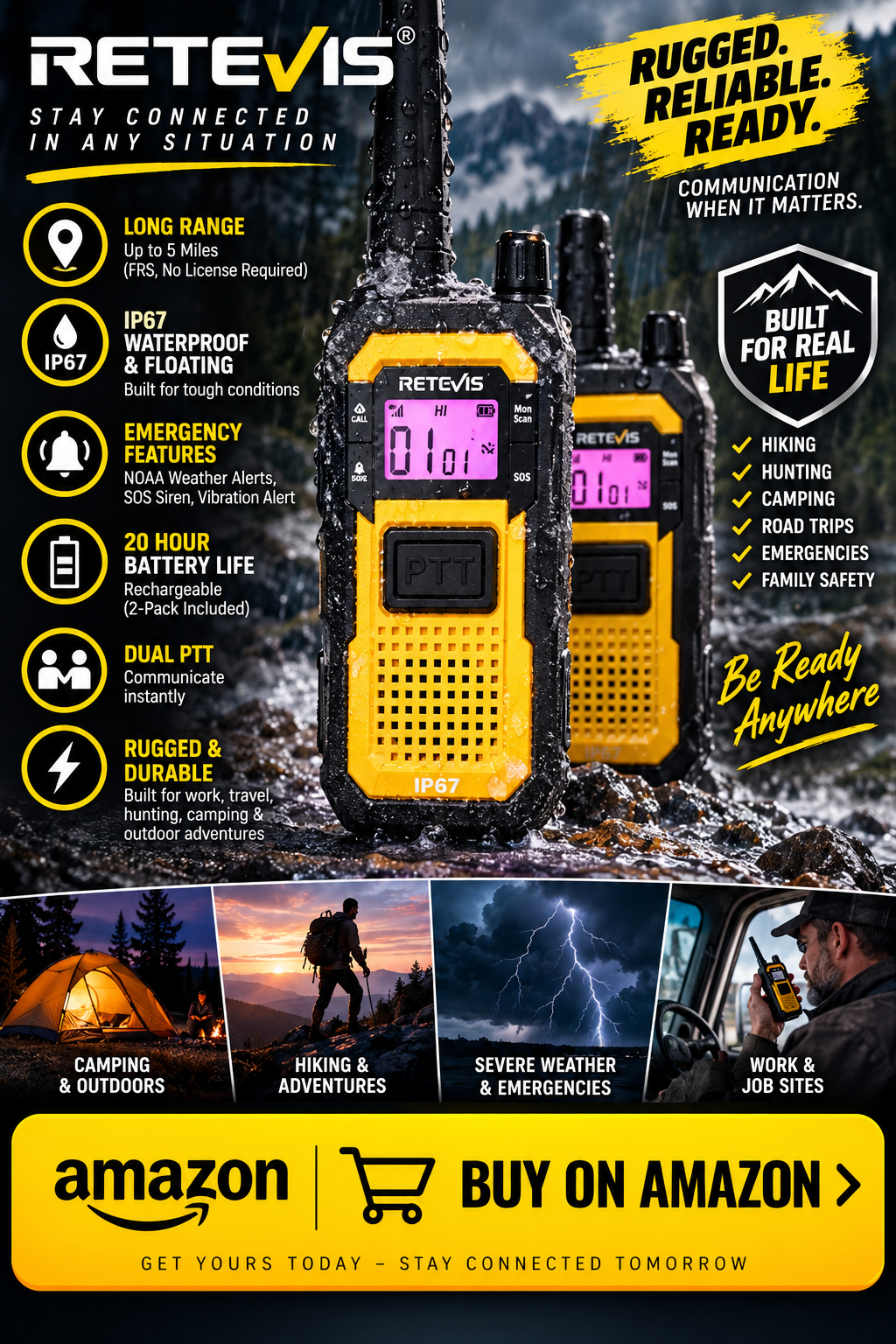
For that job we’re using the Retevis RB48 FRS Walkie Talkies.
Those could be useful between:
Vehicles.
Family members around a property.
People camping.
Nearby households.
Separate groups during an evacuation.
But they’re not replacing my dedicated household NOAA alert radio.
And Walkie Talkie Range Has Limits
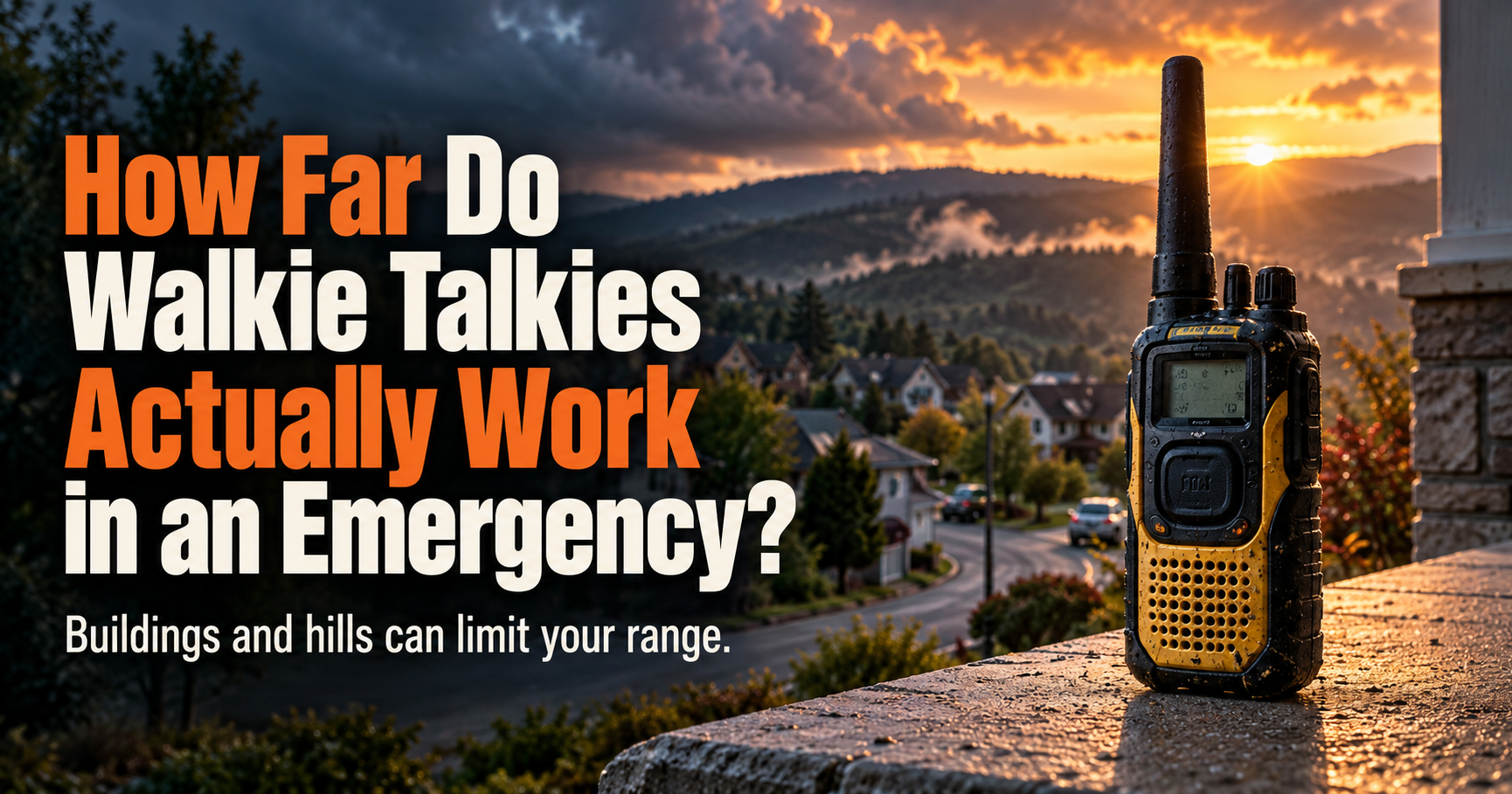
We’ve also covered how far walkie talkies actually work in an emergency.
Hills matter.
Buildings matter.
Trees matter.
Terrain matters.
That’s why each part of my communication setup solves a different problem.
Ham Radio Adds Another Level
For somebody willing to study, get licensed, and practice, amateur radio adds much broader communication options.
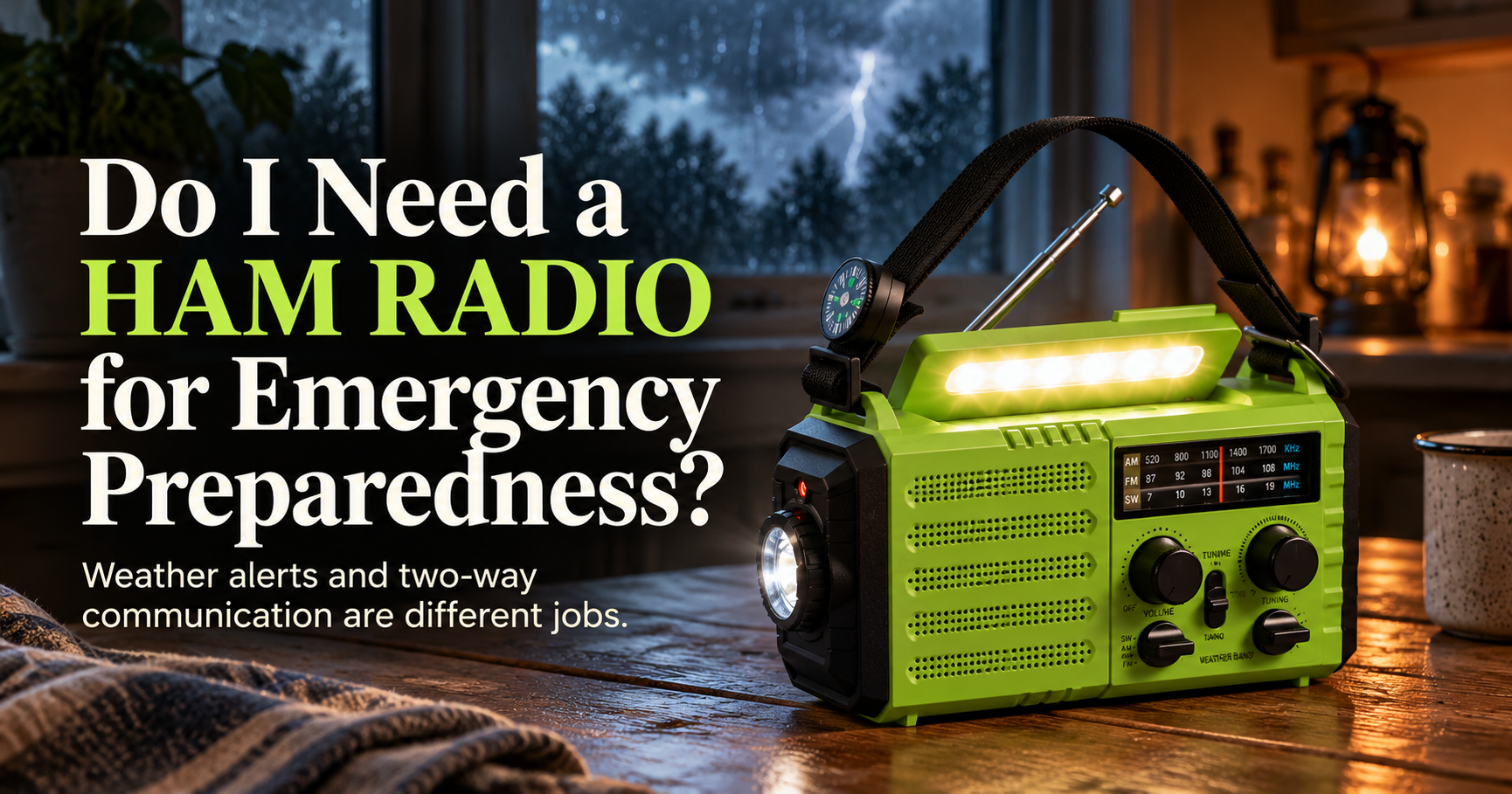
I’ve already gone into whether I think ham radio makes sense for emergency preparedness.
Again, that’s not competing with the Midland.
It’s another layer.
Weather radio receives warnings.
FRS radios handle simple local communication.
Ham radio can provide more advanced two-way communication.
Phones handle normal life.
The Family Plan Still Matters More Than the Equipment
All of these radios are tools.
They don’t decide what my family does when something happens.
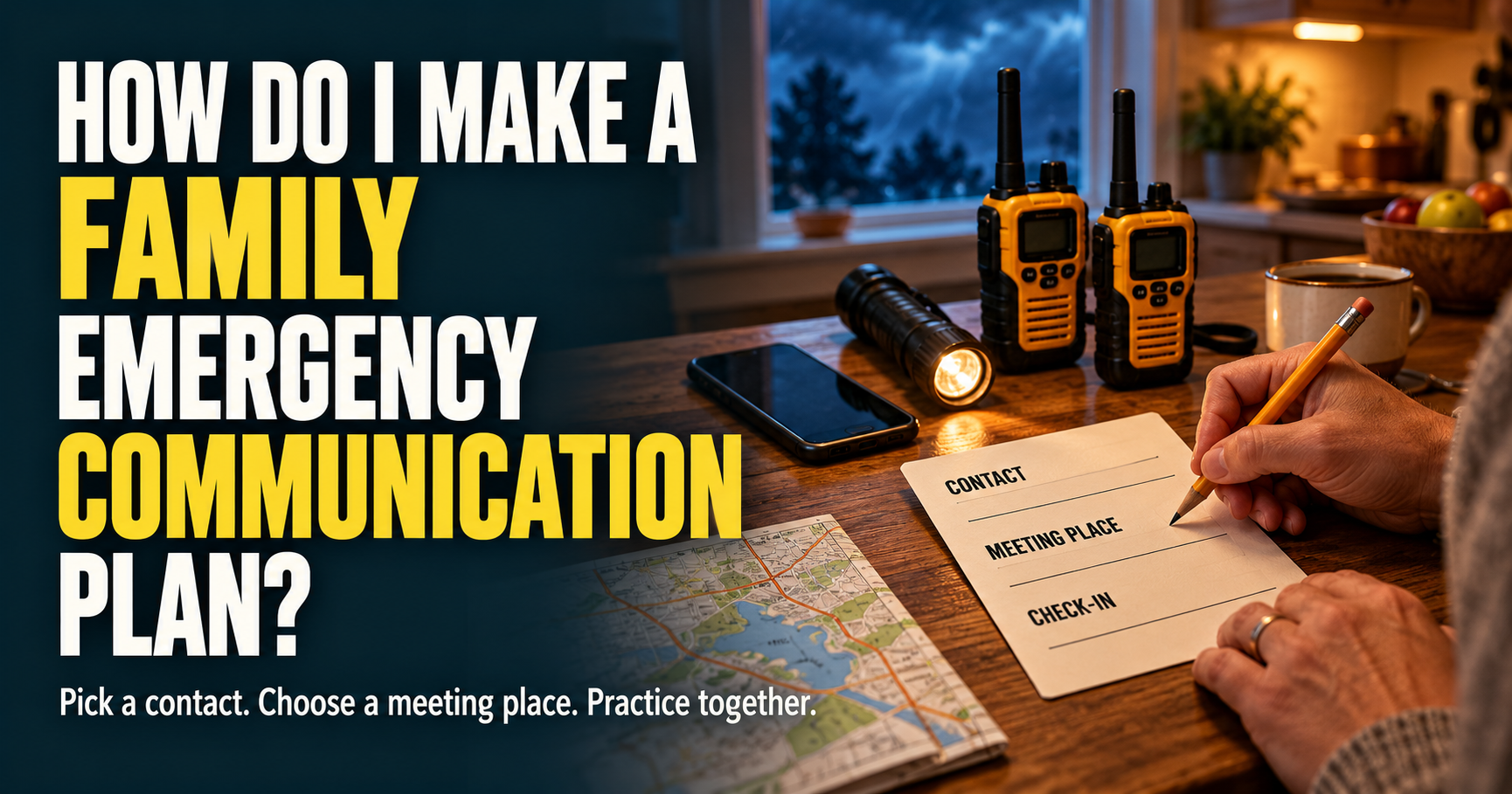
That’s why our family emergency communication plan is probably more important than any individual radio.
Everybody should already know:
Where we meet.
Who picks up the kids.
Who our out-of-area contact is.
What radio channel we use.
What happens if home isn’t safe.
What happens if nobody can reach anyone else.
The equipment supports that plan.
A NOAA Radio Is Especially Useful During a Power Outage
When electricity goes out, information can become harder to get.
Television may be gone.
Home internet equipment eventually shuts down.
Phones gradually lose battery.
Cellular networks may become strained.
A battery-backed or portable radio gives me another path.
That’s why our communications cluster naturally overlaps our power-outage preparedness.
Winter Storms Are Another Good Example
Imagine a heavy winter storm knocks out power overnight.
Roads are bad.
The house is cooling down.
Phones are slowly losing charge.
I want to know:
Are conditions getting worse?
Is another warning active?
Is freezing rain expected?
Are high winds coming?
Has an emergency message been issued?
A NOAA radio gives me another source of official information without needing home internet.
Flash Flooding Makes the Same Case
Flash flooding can develop quickly.
Phones are excellent for warnings, but I don’t want a single warning method.
A dedicated NOAA weather radio gives me another chance to hear that something dangerous is developing.
When we eventually build more flood-preparedness content, this article will connect naturally to it.
The Portable Radio Goes With Me During Evacuation
If authorities tell us to leave, the Midland WR120B probably stays home.
The portable radio comes with us.
That’s what I like about having separate roles.
The hand-crank radio can travel:
In the vehicle.
To a relative’s house.
To a shelter.
To a hotel.
To a campsite.
Wherever we end up.
Now I’m not depending on having the exact same communication setup everywhere.
I Don’t Treat the Little Solar Panel Like a Full Solar Generator
The built-in solar panel on a portable radio is a backup feature.
That’s how I view it.
I keep the radio charged before severe weather.
If normal charging becomes unavailable, the solar panel and hand crank give me additional options.
I wouldn’t intentionally leave it dead because I assume a little solar panel will quickly solve everything.
Preparedness works better when I start with charged equipment.
The Phone-Charging Feature Is Backup Too
I like having the option.
But I don’t plan to drain the emergency radio every night charging everyone’s phones.
If I have dedicated power banks or a portable power station, I’ll use those first.
The radio’s phone-charging feature is for when better options aren’t available.
That’s how I treat a lot of survival gear.
Backup for the backup.
I Would Check My Weather Radios a Couple Times a Year
Not every week.
That would be overkill.
But a couple times each year I’d check:
Does the Midland receive NOAA clearly?
Are the SAME settings still correct?
Are the backup batteries good?
Does the portable radio still charge?
Does its flashlight work?
Do I still have the charging cable?
Does NOAA reception work where we’ll shelter?
That keeps little problems from becoming emergency problems.
Before a Forecast Storm, I Check Again
If severe weather is expected that night, I’ll spend a few minutes getting everything ready.
Phones charged.
Power banks charged.
Portable radio charged.
Midland working.
Walkie talkies charged.
Flashlights handy.
That’s a small amount of effort for a much better night of preparedness.
Do I Need a NOAA Weather Radio If I Already Have a Smartphone?
I still think it’s worth having one.
Not because I expect my phone to constantly fail.
It usually won’t.
The radio exists for the situation when it does.
That’s how I think about most preparedness equipment.
I don’t store water because city water fails every Tuesday.
I store some because someday it could.
I don’t keep flashlights because electricity goes out every night.
I keep them because eventually it will.
A weather alert radio follows the same logic.
My Ideal Setup Is Pretty Simple
At home beside the bed:
Midland WR120B NOAA Emergency Weather Alert Radio
With the portable emergency supplies:
5000mAh Solar Hand Crank Emergency Weather Radio
For local two-way family communication:
Retevis RB48 FRS Walkie Talkies
And then phones, chargers, and our existing family communication plan fill in the rest.
That’s not an insane amount of equipment.
It’s simply several independent ways to receive information and communicate.
Do I Really Need a NOAA Weather Radio?
Technically, no.
I could probably go years using nothing but my phone.
But that’s not how I judge emergency equipment.
I judge it by what happens when something I normally depend on stops working.
The Midland WR120B gives me a dedicated localized warning system at home.
It can sit quietly beside the bed for months.
That’s okay.
Its job isn’t entertaining me every day.
Its job is getting my attention on the night when an important warning is issued and nobody in the house is watching the weather.
Then the portable solar hand-crank weather radio gives me another option if the power goes out or we have to leave.
Phone.
Dedicated NOAA alert radio.
Portable weather radio.
Walkie talkies.
Backup power.
Family plan.
That’s the type of emergency communication setup I trust much more than depending on one device and hoping nothing ever happens to it.
About the Author
Caleb Mercer writes about emergency communications, power outages, backup power, and practical household preparedness for Survive Essentials. His work focuses on building redundant systems before they’re needed, choosing emergency equipment that remains useful when normal services fail, and helping families stay informed and connected during real-world disruptions.