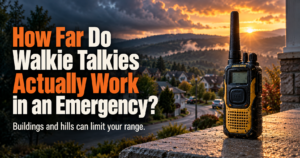
The range printed on a walkie talkie box is one of the numbers I trust the least.
You might see:
20 miles.
30 miles.
35 miles.
Sometimes even farther.
Then you get the radios home, walk a mile down the road, and suddenly the signal sounds terrible.
That doesn’t necessarily mean the radios are bad.
It means walkie talkie range depends heavily on what is between the two radios.
In a real emergency, I would care much more about how far my radios work around my house, neighborhood, vehicles, and local terrain than the maximum range somebody achieved under perfect conditions.
For most families, that’s the range that actually matters.
How Far Do Walkie Talkies Usually Work?
There isn’t one honest answer.
Two handheld radios might communicate very well over several miles in open terrain with favorable elevation.
Put those same radios between houses, hills, forests, or concrete buildings and the usable distance may drop dramatically.
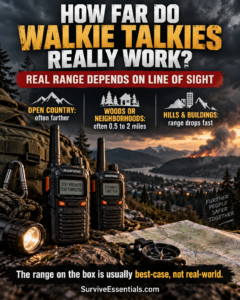
That’s why I think about range in three broad categories:
Best-case range
Clear line of sight, higher ground, very few obstructions.
Normal real-world range
Homes, trees, vehicles, ordinary terrain.
Bad-case range
Large hills, dense buildings, deep woods, valleys, concrete structures.
The same radio can behave very differently in each one.
Line of Sight Makes a Huge Difference
Walkie talkies tend to perform best when there isn’t much blocking the signal.
Imagine two people standing on separate hilltops with open ground between them.
That’s much easier for radio communication than two people the same distance apart with a ridge, neighborhood, and forest between them.
This is why maximum advertised ranges can technically be possible while still being unrealistic for how most people use radios.
I don’t plan around the maximum.
I plan around the environment.
Hills Can Kill Range Quickly
This is probably one of the biggest real-world problems.
If I’m standing on one side of a large hill and another family member is on the other side, the terrain itself can block or weaken communication.
We may be surprisingly close by road.
That doesn’t mean the radio signal has an easy path between us.
Move one person higher and communication may suddenly improve.
That’s why elevation can matter so much.
Getting Higher Can Help
If communication becomes weak, one of the simplest things I can try is moving to a better position.
A small hill.
Upper floor.
Open area.
Away from a large metal building.
Sometimes a small location change makes a noticeable difference.
I wouldn’t wander into danger just for a better signal, but understanding how terrain affects radio gives me options.
Houses Reduce Range Too
Neighborhood use can be unpredictable.
Wood-frame houses.
Metal roofs.
Garages.
Vehicles.
Concrete foundations.
Power infrastructure.
Trees.
All of those can affect the signal.
If I’m buying walkie talkies specifically so I can communicate with a relative three neighborhoods away, I don’t assume they will work just because the straight-line distance looks reasonable.
I test them.
Concrete and Steel Can Be Especially Difficult
Large commercial buildings can be rough on handheld radios.
Concrete.
Rebar.
Steel walls.
Multiple floors.
Machinery.
All of that can affect performance.
This matters during emergencies because family members aren’t always standing outside in an open field.
Someone may be inside a store.
School.
Hospital.
Office.
Parking garage.
That’s a very different environment.
Dense Woods Can Cut Range
Forest use is another place where advertising numbers can get misleading.
Trees, leaves, moisture, uneven terrain, and hills all affect radio propagation.
I’ve seen people assume that because a radio says “long range,” it’ll reach miles through thick timber without trouble.
I wouldn’t count on that.
A radio that works beautifully across open farmland may struggle much sooner in dense woods.
Weather Can Affect Conditions, But Terrain Usually Worries Me More
People often wonder whether rain or storms make walkie talkies useless.
For the kinds of FRS handheld radios most families use, terrain and physical obstructions are usually much bigger practical concerns than ordinary rain.
That said, severe weather can change the entire situation.
Wet equipment.
Power loss.
Noise.
Movement indoors.
People taking shelter behind concrete or below ground.
So even if the weather itself isn’t the main radio problem, the emergency conditions around it can be.



This Is Why Waterproof Radios Make Sense to Me
For preparedness, I don’t want equipment that becomes questionable as soon as it gets soaked.
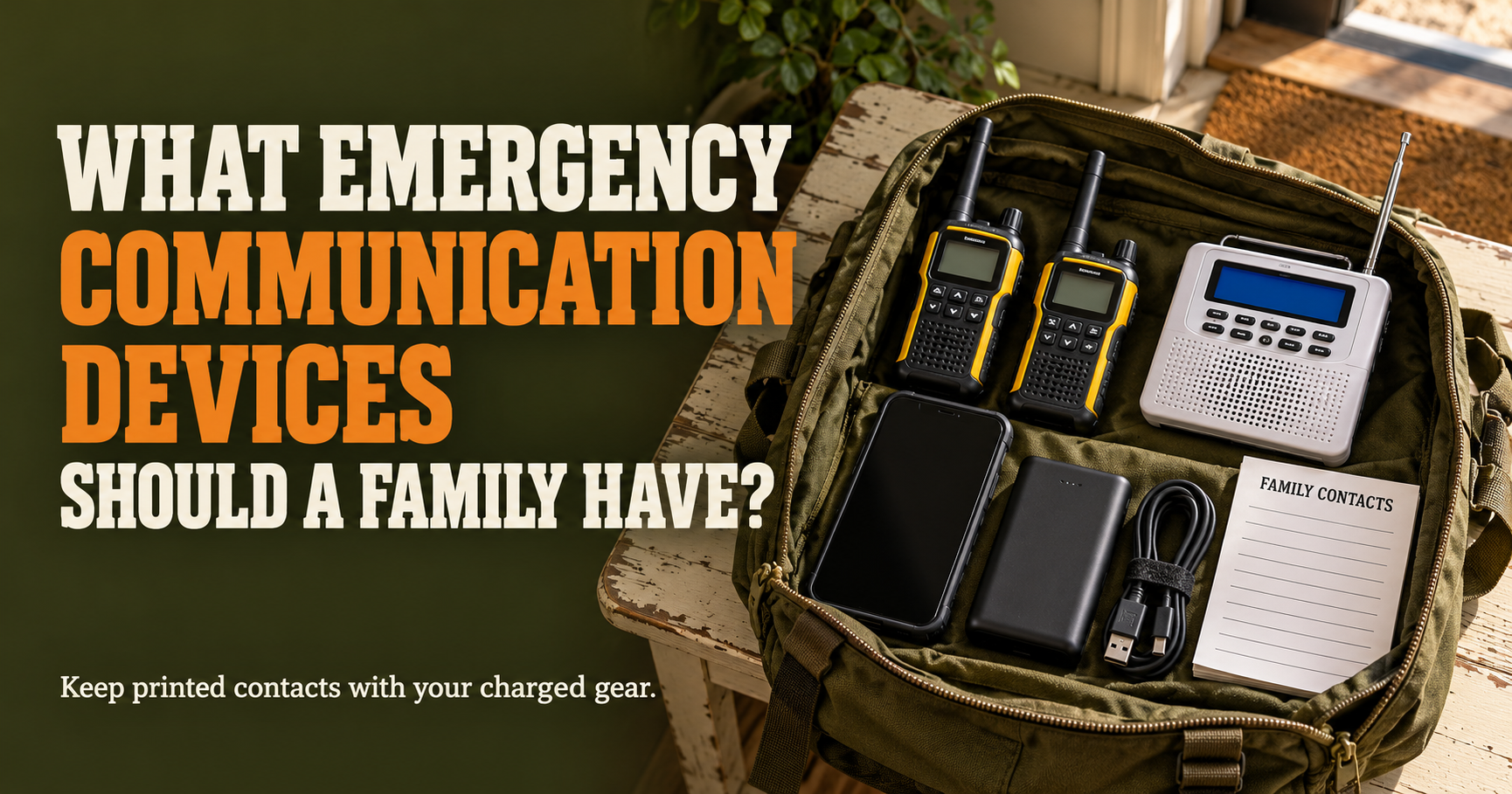
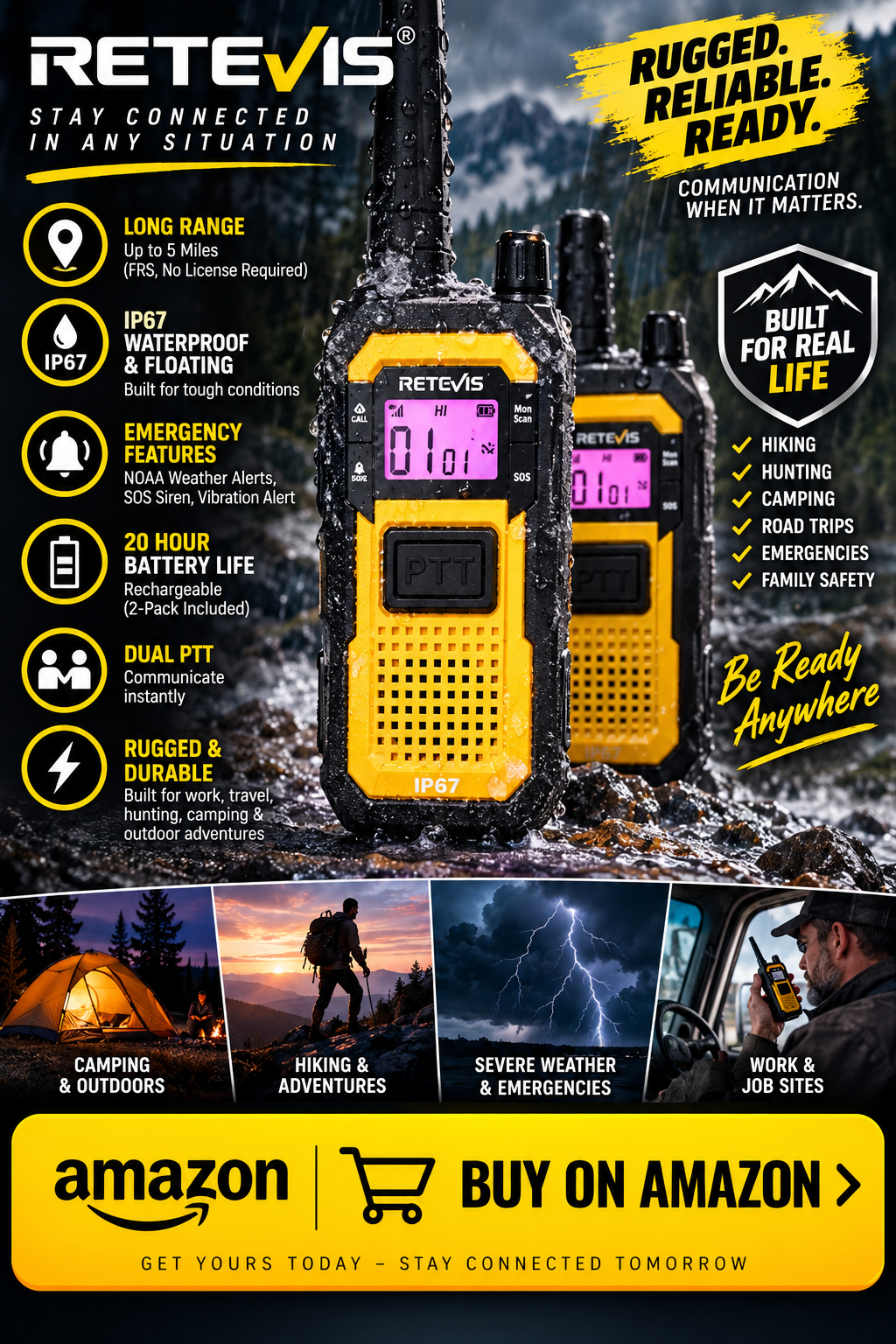
The pair we’re using in this cluster is the Retevis RB48 FRS Walkie Talkies.
See the Retevis RB48 FRS Walkie Talkies on Amazon
They’re IP67 waterproof and dust-resistant, rechargeable, use USB-C charging, include NOAA reception, and come as a two-pack.
Those features don’t magically increase radio range.
But they make the radios more practical in the kinds of conditions where I might actually need them.
The Retevis RB48 Range Still Depends on Terrain
This is important.
Buying a rugged radio does not cancel physics.
The RB48 may perform well in one location and much worse somewhere else.
That’s why I would never promise:
“These will reach exactly X miles.”
Instead, I’d use them around my own property and community until I know their real limits.
That’s much more useful.
The Best Range Test Is the One I Do Myself
Here’s what I’d do after buying a pair.
Give one radio to another person.
Leave one at home.
Then start testing.
At the end of the driveway.
A quarter mile away.
Half mile.
One mile.
Behind nearby hills.
Inside another building.
From the places family members commonly travel.
Make notes.
Now I know exactly where communication starts becoming unreliable.
That’s preparedness.
I Would Test From the Places That Matter Most
Random range testing is interesting.
Practical range testing is better.
I’d test:
Home to barn.
Home to neighbor.
Home to nearby relative.
Vehicle to vehicle.
House to storm shelter.
House to edge of property.
Camp to hiking area.
Whatever applies to my family.
If the radios work over the routes I actually care about, that’s more important than an impressive maximum range number.
What Is a Good Real-World Walkie Talkie Range?
I don’t like giving one number because it’s too easy to mislead people.
In open terrain, usable range can be several miles or more under favorable conditions.
In suburban neighborhoods, dense forests, or hilly terrain, range may shrink considerably.
Inside large buildings, it can be shorter still.
That’s why I consider “a few miles” a possibility, not a promise.
I test.
Why Do Some Walkie Talkies Claim 30 Miles?
Because under ideal conditions, long distances may be possible.
Those conditions might include:
High elevation.
Open terrain.
Clear line of sight.
Very little interference.
Few physical obstructions.
That’s very different from someone standing in a basement while another person is behind several hills.
The maximum number isn’t necessarily fake.
It’s just not the number I build my family emergency plan around.
Antenna Height Matters
Height can make an enormous difference.
The higher the antenna, the better chance the signal has of clearing nearby obstructions.
This is one reason a person standing on a hill can sometimes communicate much farther than someone in a valley.
Even holding the radio properly can matter.
I don’t bury it deep in a bag while trying to transmit.
I want the antenna in a reasonable position.
How I Hold the Radio Can Matter
I don’t cover the antenna with my hand.
I keep the radio upright when possible.
I speak clearly.
I don’t press the transmit button and immediately start talking.
I give it a brief moment, then speak.
Those small habits make communication more reliable.
Battery Level Can Affect My Experience Too
I don’t wait until the radios are nearly dead.
Weak or dying batteries can cause problems at exactly the wrong time.
That’s another reason I like rechargeable radios with practical charging options.
The Retevis RB48 uses USB-C charging, which gives me more backup-power options than a radio dependent on one unusual charger.
I Keep a Power Plan With the Radios
During an outage, I may need:
A charged power bank.
Vehicle USB power.
Portable power station.
Solar charging setup.
Another suitable USB source.
Communication gear needs an energy plan too.
That’s one reason I treat radios as part of the broader power-outage system instead of isolated gadgets.
FRS Power Limits Matter
FRS radios are designed as relatively straightforward personal radios.
They’re useful for families because operation is simple and doesn’t require an individual amateur-radio license.
But they aren’t giant high-powered base stations.
That simplicity comes with practical range limitations.
For many households, that’s okay.
I don’t necessarily need to reach 50 miles.
I may only need to reach the other vehicle, another family member nearby, or someone across our property.
GMRS Can Extend the Possibilities
GMRS equipment can provide additional capabilities, including higher-power options and repeater access with appropriate equipment.
That can increase practical communication coverage.
But GMRS normally requires an FCC license in the United States.
It’s another step up in complexity.
For somebody who wants more range without going all the way into amateur radio, GMRS may be worth researching.
Repeaters Can Change Everything
A repeater sits in a favorable location, receives a transmission, and rebroadcasts it.
That can extend communication far beyond what two handheld radios might achieve directly.
Ham radio and GMRS users can make use of repeaters depending on their equipment, licensing, and local systems.
But I never assume a repeater will always work during a disaster.
It may depend on:
Commercial power.
Backup batteries.
Generator power.
Internet links in some systems.
Physical infrastructure.
That’s why direct radio communication still matters.
Ham Radio Gives Me More Range Options
If I’m trying to communicate much farther than family walkie talkies realistically allow, amateur radio becomes more interesting.
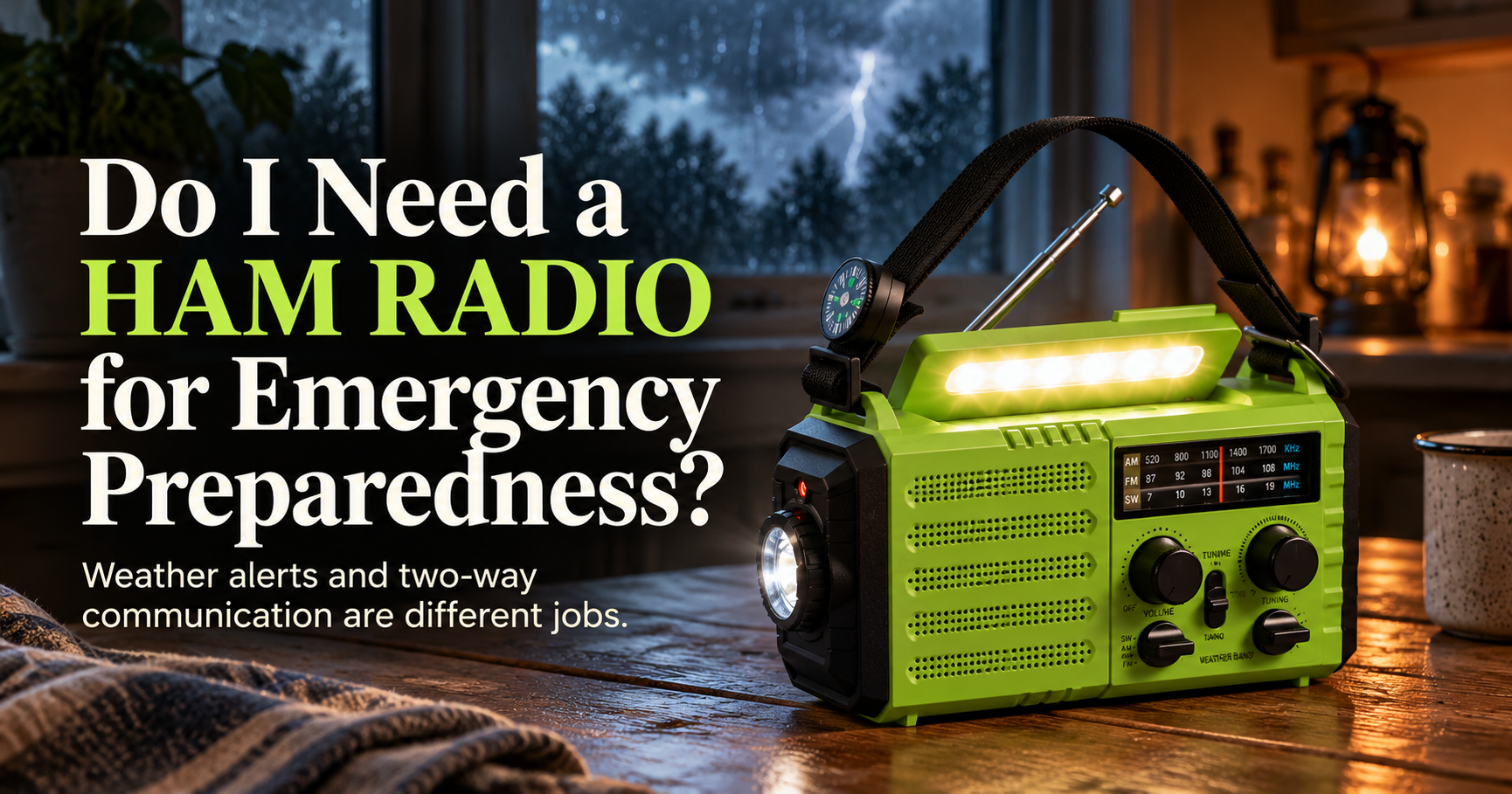
We’ve already covered whether ham radio makes sense for emergency preparedness.
Ham radio opens up far more equipment and frequency options.
It also requires more knowledge and licensing.
That’s why I don’t see ham radio and FRS as competitors.
They fill different layers.
My FRS Radios Are for Local Communication
This is exactly where the Retevis RB48 pair fits for me.
I’m thinking:
Family.
Property.
Vehicles.
Neighborhood.
Camping.
Nearby groups.
That’s the job.
If I need communication hundreds of miles away, I’m using another solution.
Walkie Talkies Work Without Cell Service
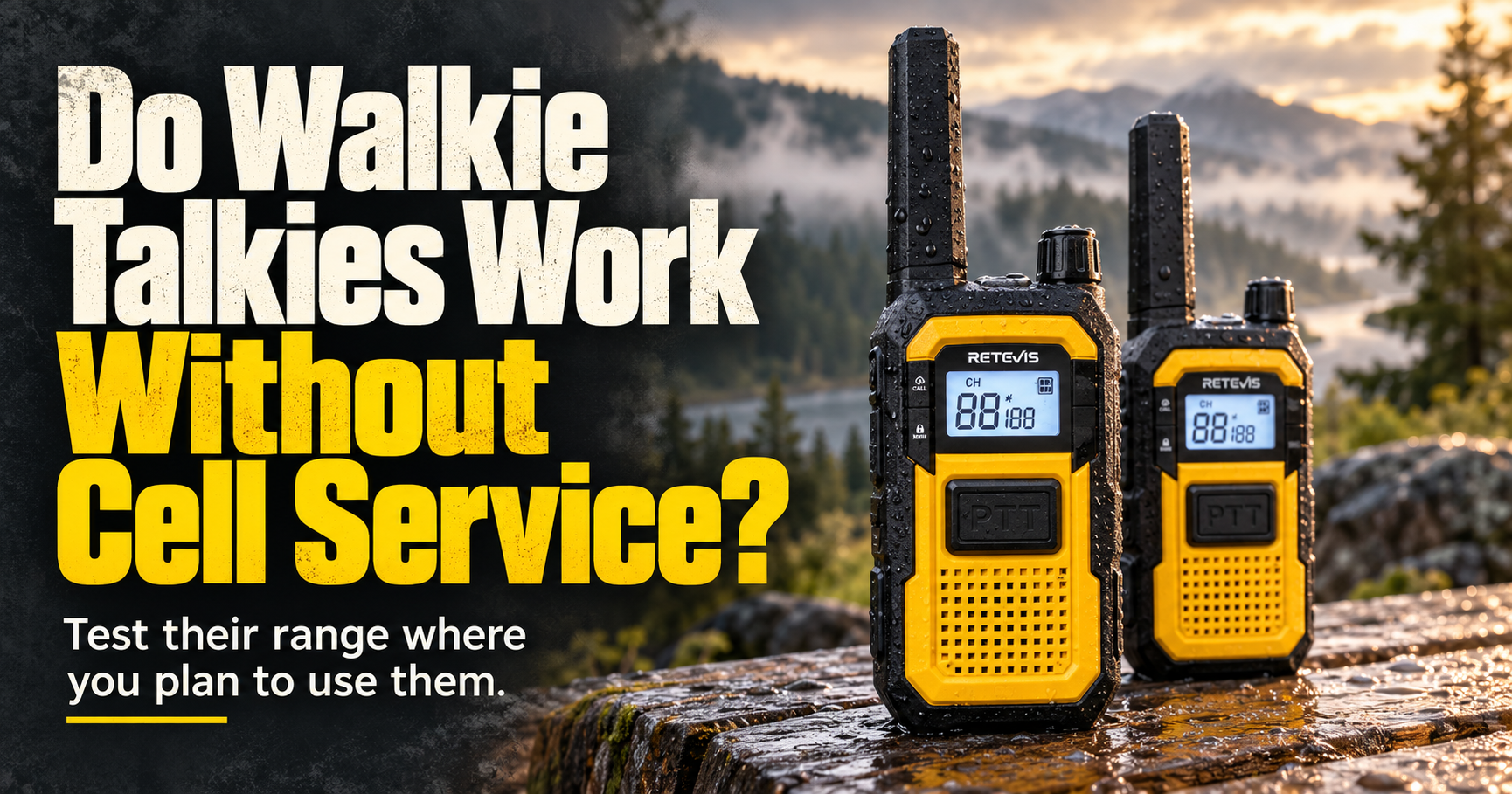
This range article naturally connects back to our earlier guide explaining why walkie talkies still work without cell towers.
The radios don’t need cellular infrastructure for direct communication.
But being independent from cell towers doesn’t mean unlimited distance.
That’s the distinction.
Independent doesn’t mean infinite.
Why They’re Great for Vehicle Convoys
Vehicle-to-vehicle communication can be one of the more forgiving uses.
Cars traveling together often remain relatively close.
If a group is evacuating, the radio can handle quick messages:
“We’re turning left.”
“Stop ahead.”
“We lost the last vehicle.”
“We’re pulling into the gas station.”
I don’t need 20-mile range for that.
I need reliable communication between vehicles that are relatively close.
Farms and Rural Property Are Another Good Fit
This is where I think real-world testing matters even more.
A farm might have:
Open fields.
Metal barns.
Tree lines.
Hills.
Low areas.
Outbuildings.
One side of the property could have excellent coverage while another has a dead spot.
Testing tells me where those spots are.
Neighborhood Preparedness Is Similar
If several nearby families use compatible radios, I can test beforehand.
Which homes can hear each other?
Which streets are blocked by terrain?
Would somebody on higher ground relay a message?
That kind of information can turn simple radios into a useful local communication system.
A Weather Radio Solves a Different Range Problem
A weather radio doesn’t need to reach another family member directly.
It’s receiving broadcasts from established transmitters.
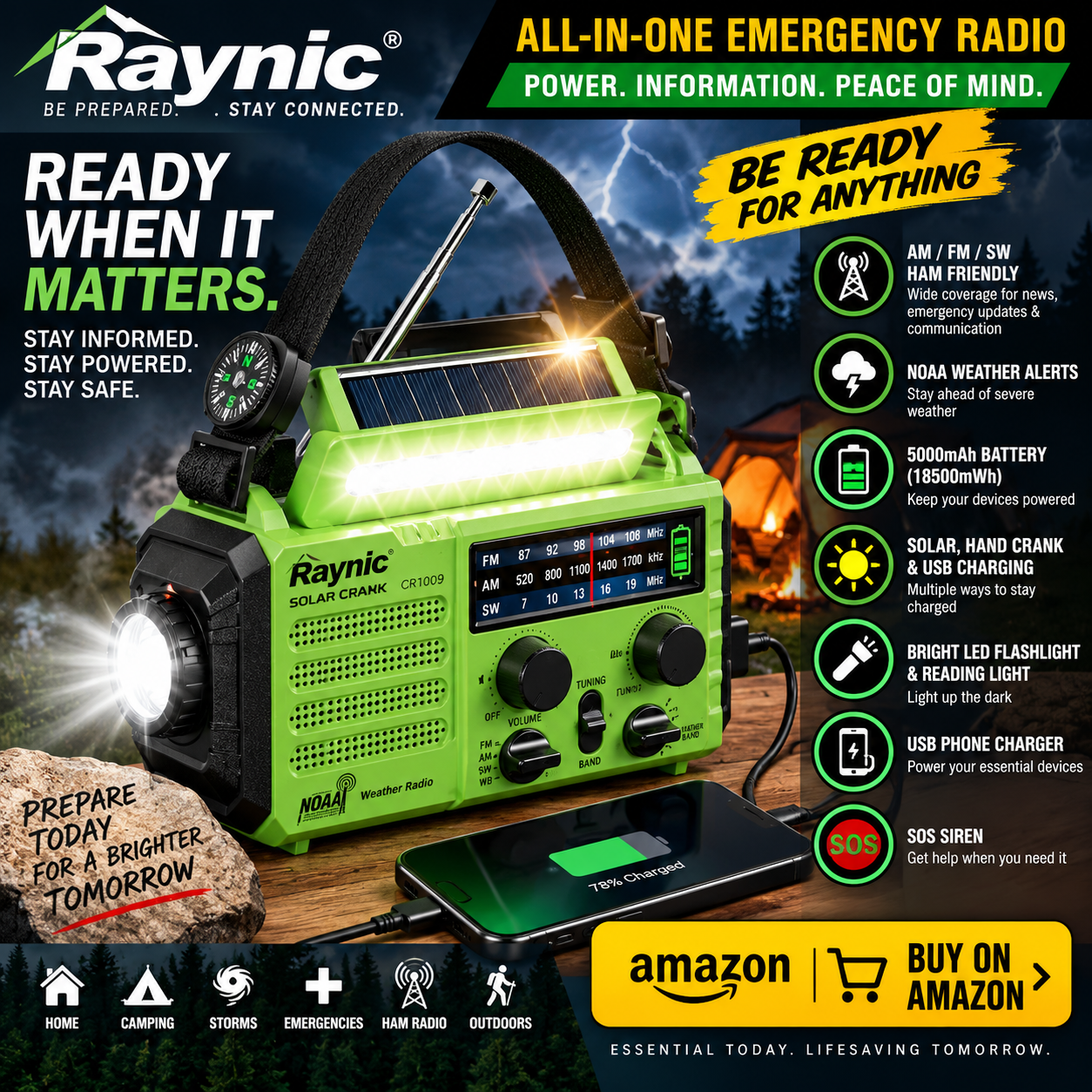
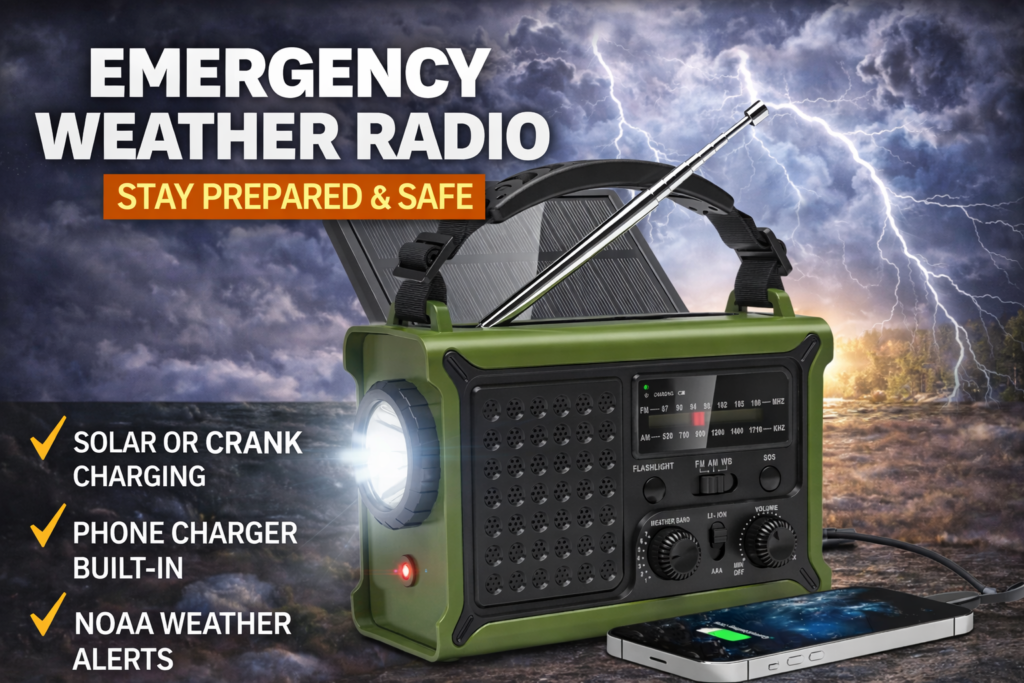
That’s why I still keep the 5000mAh Solar Hand Crank Emergency Weather Radio as another communication layer.
The weather radio tells me what’s happening.
The walkie talkie lets me speak with nearby people.
Different jobs.
I Don’t Need Maximum Range for Every Emergency
This is one thing I think prepper gear marketing sometimes gets wrong.
Everything doesn’t need to be maximum.
Maximum knife.
Maximum flashlight.
Maximum radio.
Maximum backpack.
I need equipment that solves the actual problem.
If my goal is communicating between two evacuation vehicles 500 yards apart, a working FRS radio may be perfect.
I don’t care that it can’t reach another county.
Range Means Nothing If Nobody Else Has a Radio
This sounds obvious.
But it’s important.
A walkie talkie isn’t like a cell phone where I can call almost anyone.
I can only communicate with someone who:
Has compatible radio equipment.
Is listening.
Is using the appropriate frequency or channel.
Is within usable range.
That’s why distribution is part of the plan.
I Would Keep One Radio in Each Vehicle During Evacuation
If our family leaves in two vehicles, I don’t put both radios in the same car.
One radio in each vehicle.
Charged.
Same channel.
Backup channel already agreed on.
Now the system actually works.
Same Thing Around the Property
One at the house.
One with the person outside.
Or one per work group.
The radios are only useful when they’re where the people are.
I Would Label the Channels
I like simple systems.
Something like:
Primary: Channel 5
Backup: Channel 8
The specific numbers don’t matter nearly as much as everybody knowing them.
I don’t want someone scrolling around in a stressful moment trying to remember what we decided six months earlier.
I Would Practice Weak-Signal Communication Too
This is something I think gets overlooked.
Don’t only practice when the signal is crystal clear.
Learn what a weak connection sounds like.
If audio starts breaking up:
Move.
Get higher.
Step outside if it’s safe.
Move away from large metal structures.
Try again.
Sometimes a small change fixes the problem.
Don’t Keep Repeating a Message From the Same Bad Spot
If the other person can’t understand me, saying the same thing five more times from the exact same location may not solve anything.
Change position.
Then try again.
Radio use is partly learning how the environment affects the signal.
Short Messages Help Weak Signals
A short clear message has a better chance of being understood than a rambling paragraph.
Instead of:
“Hey, I’m over here by the old building and I think I’m going to go toward…”
Say:
“I’m at the barn. Heading to the house.”
Short.
Clear.
Repeat important details if necessary.
Range Testing Should Be Part of My Preparedness Routine
I wouldn’t test once and forget forever.
Things change.
Trees leaf out.
Buildings get added.
Equipment ages.
Batteries weaken.
Family routes change.
I don’t need to obsess over it, but using the radios periodically keeps me familiar with them.
That’s another reason I like equipment that has normal everyday uses.
Could I Increase Walkie Talkie Range?
Sometimes.
Better positioning can help.
Higher ground can help.
Reducing obstacles can help.
Different radio systems may offer more power or repeater capability.
But with ordinary FRS radios, I wouldn’t start modifying equipment or chasing questionable accessories.
I would first ask whether I’m trying to make FRS do a job better suited to another communication system.
If I Need Much More Range, I Change Systems
That’s the simplest answer.
For nearby family communication:
FRS.
For certain broader local systems:
GMRS may make sense.
For somebody willing to learn more advanced radio communication:
Ham radio.
For remote wilderness communication far outside normal radio or cellular coverage:
Satellite-based options may make more sense.
I don’t force one tool to solve every problem.
What Range Would Make Me Happy?
Enough to cover the routes my family actually needs.
That’s my answer.
If the Retevis RB48 radios reliably communicate between my house and the places around my property where I need them, they’re doing their job.
If they keep two evacuation vehicles connected, they’re doing their job.
If they work around camp, they’re doing their job.
I don’t need the largest number on Amazon.
I need repeatable communication.
My Real Range Test Matters More Than Any Review
Reviews can tell me whether radios seem reliable.
Manufacturer specifications tell me what the equipment is designed to do.
But nobody else’s house, hills, forest, neighborhood, or emergency plan looks exactly like mine.
That’s why I’d test them myself.
I’d rather know:
These radios reliably reach from my house to this road
than believe:
These radios can reach 30 miles
because somebody on the internet said so.
How Far Do Walkie Talkies Actually Work in an Emergency?
As far as the environment allows them to work reliably.
That’s not a flashy answer.
It’s the useful one.
Open terrain may give me surprisingly good range.
Hills, buildings, and forests can cut that range dramatically.
A rugged pair like the Retevis RB48 FRS Walkie Talkies gives me a useful local communication option, but I still have to test it where I live.
That’s what I’d recommend to anyone buying walkie talkies for emergencies:
Don’t obsess over the maximum range number.
Charge them.
Hand one to somebody you trust.
Start walking or driving.
Find out exactly where the signal becomes weak.
Then build your emergency communication plan around what you know works.
That number is worth much more than whatever is printed on the box.
About the Author
Caleb Mercer writes about emergency communications, power outages, backup power, and practical household preparedness for Survive Essentials. His work focuses on testing equipment under realistic conditions, understanding the limitations of backup systems, and helping families build communication plans that still work when normal services become unreliable.